
Free resource · Advanced composition

Golden Triangle and Rectangle Armature: A Practical Guide for Artists

This guide introduces two advanced geometric overlays available in the Exact-Size Painting Reference & Grid Printer. The simpler Rule of Thirds, Centre Lines, Diagonals and Golden Ratio guides remain useful starting points. Golden Triangle and Rectangle Armature provide more directional structure when you want a more detailed analysis.

They can help with placing focal points, aligning important edges, organising directional movement, positioning paths, figures and horizons, comparing alternative crops and finding useful intersections.

Golden Triangle

The construction has one corner-to-corner diagonal and two shorter lines drawn from the remaining corners. Each shorter line meets the main diagonal at a right angle.

  • Arranging strong diagonal movement.
  • Positioning a figure or focal point near an intersection.
  • Guiding a road, river, shoreline or body angle.
  • Dividing a composition into unequal triangular areas.
  • Avoiding a static central arrangement.
Golden Triangle, original orientationA main diagonal from top-left to bottom-right, with two perpendicular reciprocal lines from the other corners.
Original orientation: main diagonal from top-left to bottom-right.
Golden Triangle, flipped orientationA main diagonal from top-right to bottom-left, with two perpendicular reciprocal lines from the other corners.
Flipped orientation: the printer’s Flip guide control switches to this mirror arrangement.

Golden Triangle painting examples

These complete, uncropped paintings were selected because the exact flipped construction reveals useful relationships. The readings are observations, not evidence of how either artist planned the work.

Winslow Homer — The Gulf Stream, 1899; reworked by 1906

Original painting · unaltered
Golden Triangle overlay · complete painting

With the guide flipped, the main diagonal runs through the reclining figure and the long mass of the damaged boat. The two shorter lines provide a way to compare nearby wave and shark shapes with that central direction, while the intersections help separate the boat from the surrounding dark water.

What the guide does not explain: The horizon, distant ship, waterspout and most sharks do not sit on the lines. The overlay is most useful for examining the boat’s direction, not for explaining every threat in the scene.

Winslow Homer, The Gulf Stream, 1899; reworked by 1906. The Metropolitan Museum of Art, New York. Catharine Lorillard Wolfe Collection, Wolfe Fund, 1906. Object 06.1234. Museum record. Public-domain image supplied through The Met’s Open Access programme; the yellow overlay was added by Vault Canvas without cropping or stretching the painting.
Emanuel Leutze — Washington Crossing the Delaware, 1851

Original painting · unaltered
Golden Triangle overlay · complete painting

With the guide flipped, the main diagonal passes through the flag group and central standing figure before continuing towards the left foreground. The shorter lines divide the crew and ice into related triangular masses, and their intersections offer places to compare secondary figures without placing everyone in the centre.

What the guide does not explain: The flagstaff, oars, horizon and several important faces follow other directions. They should not be moved onto the guide; the overlay leaves much of the painting’s remaining complexity unexplained.

Emanuel Leutze, Washington Crossing the Delaware, 1851. The Metropolitan Museum of Art, New York. Gift of John Stewart Kennedy, 1897. Object 97.34. Museum record. Public-domain image supplied through The Met’s Open Access programme; the yellow overlay was added by Vault Canvas without cropping or stretching the painting.

Rectangle Armature

The Rectangle Armature combines both corner-to-corner diagonals with four reciprocal lines. Each reciprocal starts at a corner and meets the opposite main diagonal at a right angle. Golden Triangle can be understood as one half of this fuller symmetrical construction.

  • Identifying several related intersections.
  • Organising multiple figures or masses.
  • Relating vertical, horizontal and diagonal edges.
  • Creating directional movement across the whole rectangle.
  • Checking whether important features form a coherent structure.

This is a general armature calculated from the actual rectangle. It is not a claim about a special rectangle proportion or a named historical system.

Rectangle Armature constructionTwo corner-to-corner diagonals and four reciprocal lines, each perpendicular to its corresponding diagonal.
Two main diagonals and four reciprocal lines, calculated from the rectangle’s actual proportions.

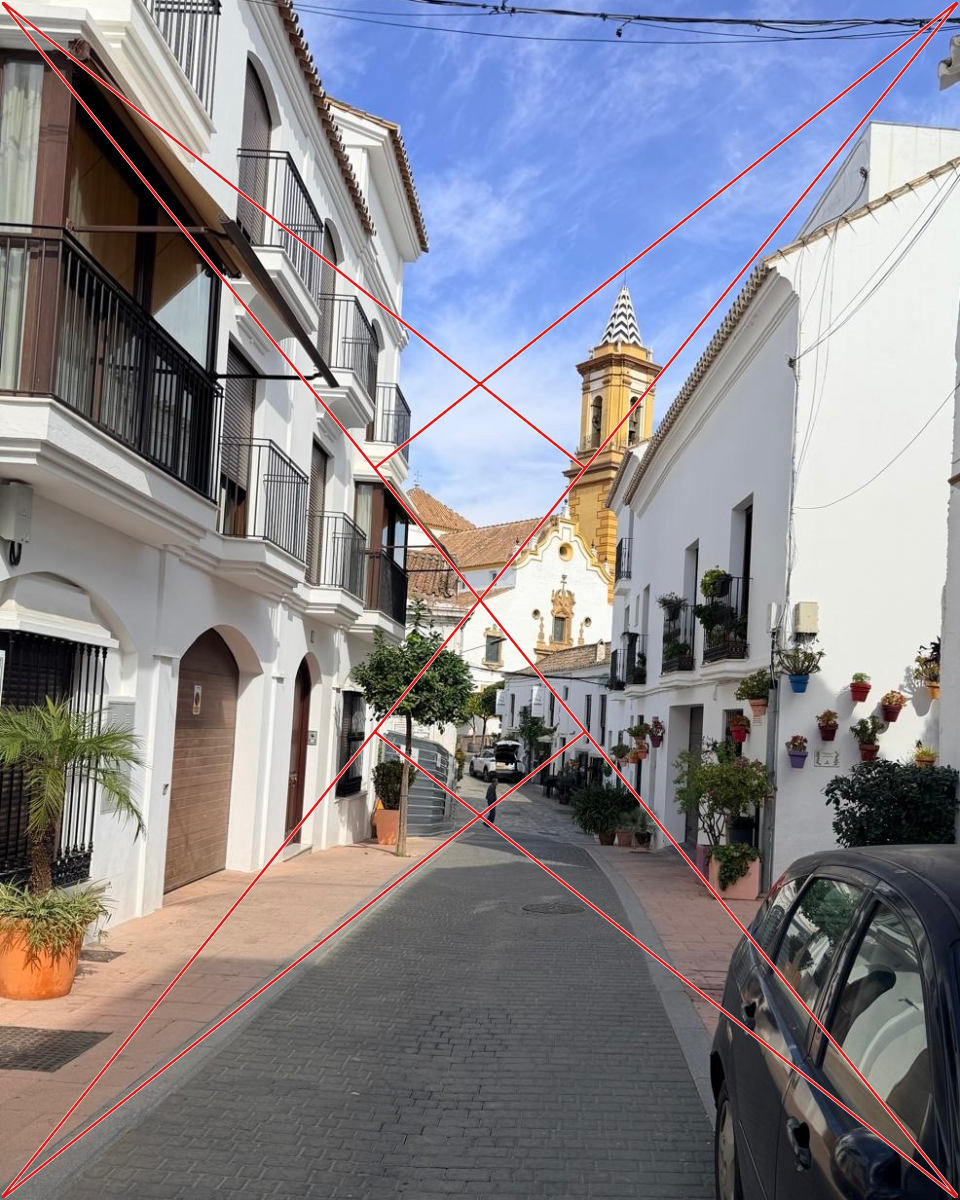
A rectangle armature in a real street scene

Follow the main diagonal from the top-left corner to the bottom-right. It follows the receding line of the buildings on the left, leading your eye into the scene. From the bottom-left corner, the shallower diagonal follows the left kerb into the street, while the steeper diagonal rises alongside the bell tower.

Try this with one of your own reference photographs. Overlay the rectangle armature, then shift the crop slightly. Which framing gives your eye the clearest route from the foreground to the part of the scene you want to emphasise?

Street in Estepona with red armature lines following the buildings on the left and the kerb, and rising beside the bell tower.
Estepona, Spain. A street photograph with the rectangle armature overlaid in red.

Rectangle Armature painting examples

Here the armature is useful for comparing several figures and masses rather than forcing every feature onto a line. Some intersections will occur by chance.

Jacques Louis David — The Death of Socrates, 1787

Original painting · unaltered
Rectangle Armature overlay · complete painting

The main diagonals cross close to the cup and Socrates’s outstretched hand, establishing a clear central relationship. Other intersections fall near Plato at the left, the disciple presenting the cup and the seated groups at the right, so the armature can help compare separate figures and architectural masses across the wide rectangle.

What the guide does not explain: The masonry, bed, many gestures and faces follow horizontal, vertical or independent diagonal directions. Some near-alignments will occur by chance; the armature does not account for every figure.

Jacques Louis David, The Death of Socrates, 1787. The Metropolitan Museum of Art, New York. Catharine Lorillard Wolfe Collection, Wolfe Fund, 1931. Object 31.45. Museum record. Public-domain image supplied through The Met’s Open Access programme; the yellow overlay was added by Vault Canvas without cropping or stretching the painting.

Johannes Vermeer — Young Woman with a Water Pitcher, about 1662

Original painting · unaltered
Rectangle Armature overlay · complete painting

The two diagonals connect the window, woman and table across the tall rectangle. Their central crossing sits within the figure, while the surrounding intersections offer comparisons among her head and arms, the pitcher and basin and the large covered table.

What the guide does not explain: The map, window frame and many edges remain independent of the overlay. Not every vessel or hand meets a line, and close intersections in a quiet interior can occur by chance.

Johannes Vermeer, Young Woman with a Water Pitcher, about 1662. The Metropolitan Museum of Art, New York. Marquand Collection, Gift of Henry G. Marquand, 1889. Object 89.15.21. Museum record. Public-domain image supplied through The Met’s Open Access programme; the yellow overlay was added by Vault Canvas without cropping or stretching the painting.

How to use these guides

  1. Choose or upload the reference.
  2. Set the intended painting proportions.
  3. Start with the guide switched Off and identify the principal subject and movement.
  4. Try Golden Triangle for a strongly directional composition.
  5. Flip Golden Triangle to compare the mirrored arrangement.
  6. Try Rectangle Armature when several masses, figures or directional edges need organising.
  7. Use the image-position controls to make small, deliberate adjustments.
  8. Switch the guide off again and judge whether the composition works without the lines.
  9. Save a digital reference or create the exact-size PDF when satisfied.

The guide should support the image, not force every object onto a line.

Try it with your own reference

Try Golden Triangle and Rectangle Armature in the Exact-Size Painting Reference & Grid Printer.

All processing happens in your browser. Your reference image is not uploaded to or saved by Vault Canvas. The tool can:

  • Apply either guide and flip Golden Triangle.
  • Combine a composition guide with a measured grid.
  • Adjust the crop with controlled zoom and nudge buttons.
  • Save a digital reference.
  • Produce an exact-size tiled A4 PDF.

Further reading and sources

All construction lines are calculated from the same rectangle geometry used by the printer. Painting reproductions retain their complete original proportions; only the yellow overlay and dark outline have been added to the analysed versions.

← Back to all resources