
Collection Management for Artists and Collectors
A practical guide to collection management for artists, collectors, galleries and estates: what to record, how it differs from artwork archiving, how collection management software works, and how to build a system that scales over a lifetime.
15 min read
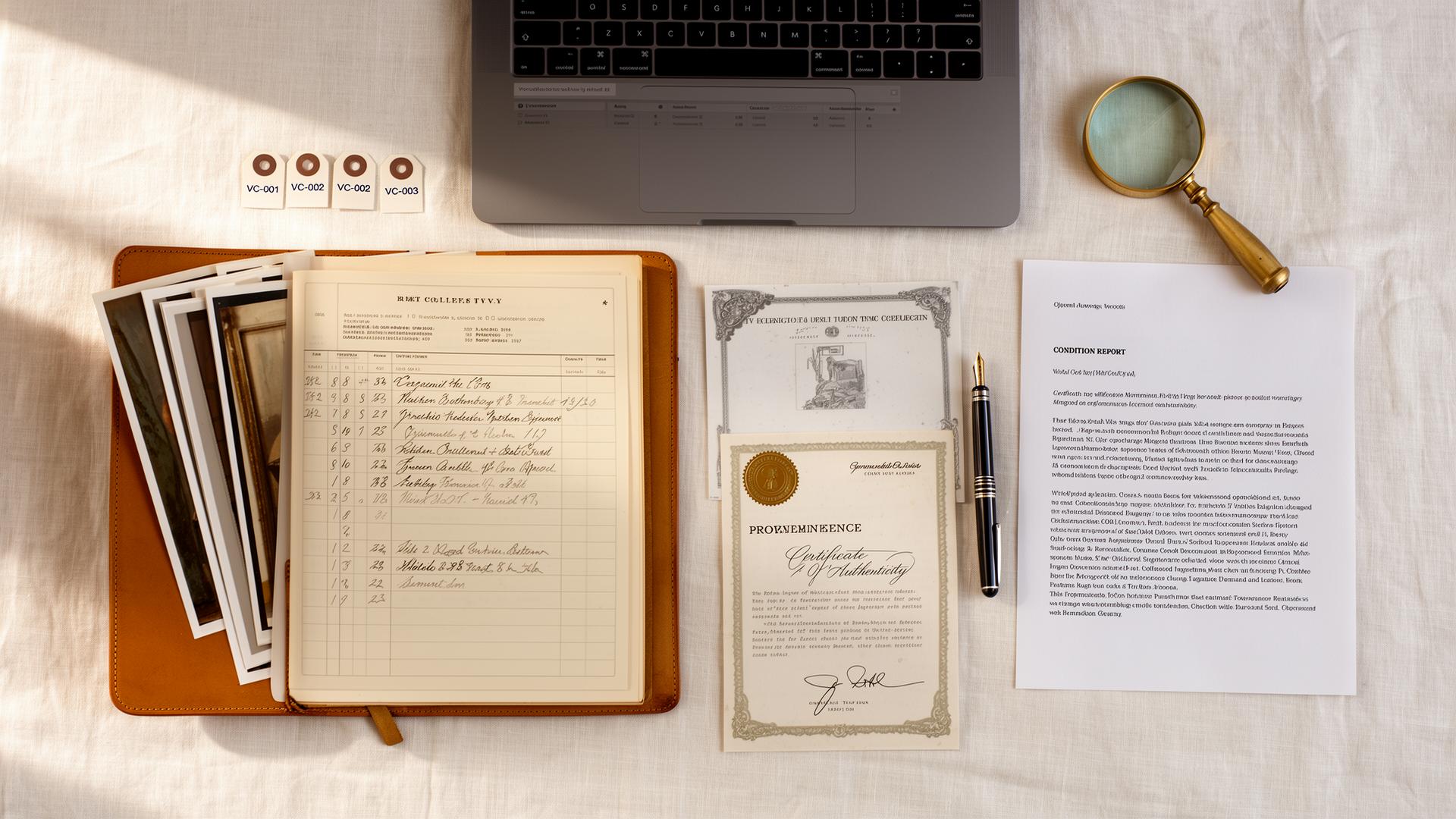
Collection management is the discipline of organising, documenting and stewarding a body of artwork over its lifetime. For artists, it is the practice of keeping a coherent record of every work they have made, where each work is and what has happened to it. For collectors, it is the practice of keeping equally coherent records for every work they own — what they paid, who they bought it from, where it is hanging, what it is insured for and what evidence of authenticity exists. For estates, executors and galleries, collection management is the connective tissue that allows a collection to survive a change of hands without losing its history. This guide explains what collection management is, how it differs from artwork archiving, and how to build a system that scales from a first acquisition or a first studio inventory through to a lifetime body of work.
What Is Collection Management?
Collection management is the set of records, processes and decisions used to look after a group of artworks as a coherent whole. It covers what is in the collection, where each work is, who owns it, what condition it is in, how it has moved and what supporting documentation exists. A well-managed collection can be described accurately on any given day — every work accounted for, every fact retrievable, every transaction documented.
It applies wherever artworks accumulate. An artist with two hundred paintings made over fifteen years is managing a collection of their own output. A private buyer with thirty acquired works hanging across two homes is managing a collection of objects they own. A gallery holding consigned work for ten artists is managing a working collection on behalf of others. An estate inheriting a deceased artist's studio is managing a collection that must now outlive its maker. The records differ in emphasis, but the underlying discipline — knowing what is there, where it is, what it is and what has happened to it — is the same.
Collection management matters because artworks have long lives and short memories attached to them. Receipts get lost. Photographs sit on retired phones. Galleries close. Owners move, divorce, die or simply forget where a work was hung in 2014. The collection itself persists; the facts around it quietly erode unless someone is keeping records on purpose.
Collection Management vs Artwork Archiving
The two terms are often used as if they were the same, and they are closely related, but they sit at different levels.
Artwork archiving is the practice of building the underlying historical record for individual works — assigning inventory numbers, photographing to archival standards, logging provenance events, attaching certificates and supporting documents. The archive is the source of truth for facts about each artwork.
Collection management is what you do with those records once you are responsible for a group of works. It adds an operational and stewardship layer on top of the archive: where everything currently is, what the collection is worth in aggregate, what is insured, what is on loan, what is on consignment, what needs conservation, what should be exhibited next, what the succession plan is.
A useful way to hold the distinction:
| Discipline | Purpose | Scope | Audience | Example use |
|---|---|---|---|---|
| Artwork archive | Preserve the full historical record of each work | Per-artwork: every fact, every event, every document | Artist, estate, future researchers | Substantiating provenance years after a sale |
| Collection management | Steward a group of works as a coherent whole | Across the collection: locations, values, status, plans | Artist, collector, gallery, executor | Producing a current valuation for insurance renewal |
In practice the two overlap heavily — a collection cannot be managed without solid per-artwork records, and an archive becomes a collection the moment someone takes responsibility for the whole. The distinction is one of emphasis: archiving looks backwards and inwards at each work; collection management looks across the body of work and forwards in time.
Why Artists Need Collection Management
Artists become collection managers whether they intend to or not. A practice that produces fifteen to thirty finished works a year will, within a decade, generate several hundred objects scattered across studio storage, framers, galleries, exhibitions, loans, gifted works and private sales. Without an active collection management approach, that body of work becomes opaque even to its maker.
Day to day, collection management lets an artist answer practical questions in minutes rather than days: which works are currently available for a curator's exhibition request, what is on consignment at which gallery and for how long, what has been priced at what value and when, which works are sitting in storage that could be reframed and re-shown, which paintings need photography re-shot before a publication deadline. The same records support clean reporting at year end — sales, commissions, gifts, works in progress, stock on hand — without reconstructing the year from memory and emails.
Over the long arc of a career, collection management changes what is possible. It makes a monograph achievable because the works can be located, photographed and described. It makes a retrospective realistic because the artist (or curator) can identify and approach current owners. It makes resale fair and verifiable because the record of original sale exists. It protects the artist's artwork inventory from the slow attrition of forgotten works, mislaid documentation and unrecorded transfers that quietly diminishes most studio practices.
Why Collectors Need Collection Management
For collectors, the case is even more concrete. A managed collection protects the value, provenance and insurability of every work in it. An unmanaged collection puts every one of those at risk.
Ownership records are the foundation. For each work a collector should be able to produce, on demand, a sales invoice or transfer document, a certificate of authenticity where one exists, current and prior photographs, a record of where and when it was acquired, and the chain of custody from artist to current owner. Without these, a work that is unquestionably authentic in the owner's mind can become difficult to sell, insure or lend.
Insurance and valuation are the next layer. Insurers do not pay out on what the collector remembers; they pay out on what can be documented. A collection management system makes a current schedule of values straightforward to produce, attaches photographs and condition notes to each entry, and provides the evidence required when a claim is made. The same records support periodic revaluation as the market for an artist moves.
Provenance is the long-term value. A collector who maintains clean artwork documentation — invoices, COAs, exhibition history, condition reports — passes a much more valuable object to the next owner than a collector who relies on memory. At resale, the difference between a documented work and an undocumented one shows up directly in price and saleability.
How Much Should Be Recorded?
Enough to answer, for any work in the collection: what is it, where is it, who owns it, how is its condition, what supporting documents exist, and what has happened to it. In practice that resolves into a consistent set of fields recorded the same way for every work.
| Field | Notes |
|---|---|
| Inventory number | Unique, stable, never reused |
| Title | As given by the artist |
| Artist | Full name; for collectors, also nationality and dates |
| Year | Of completion (and of any restoration) |
| Medium | Materials and substrate |
| Dimensions | Height × width × depth; framed and unframed |
| Location | Current physical location |
| Owner | Current owner; private collectors may anonymise externally |
| Provenance | Append-only chain of custody |
| COA reference | Certificate number and date issued |
| Condition | Latest condition report and date |
| Value | Acquisition value, current insurance value, dates of valuation |
| Acquisition details | Date, source, price, invoice reference |
| Exhibition history | Venue, dates, curator, catalogue reference |
The list is not exhaustive — collections with editioned works, prints, or commissioned pieces will add fields — but it is the irreducible minimum for an artwork to be considered properly recorded. Recording the same fields the same way every time matters more than the breadth of the field list.
Building a Collection Management System
A collection management system is the practical apparatus that holds these records and lets the people responsible for the collection use them. It can be very simple at first and grow in formality as the collection does.
Physical records still have a place. Original signed certificates, original invoices, exhibition catalogues and conservation reports are best kept as physical originals in an archival folder per artwork, with the digital system holding scans. Originals matter; scans are for access.
Spreadsheets are how most collections start, and there is nothing wrong with that. A well-disciplined spreadsheet with one row per work, consistent columns, a separate sheet for provenance events and a folder of linked images can manage a collection of a hundred works adequately for years. The risks are well known — accidental overwrites, version drift across copies, no enforced field types, no link between the row and the images — but they are tolerable at small scale if the discipline is good.
Databases add the structure that spreadsheets lack. Defined fields, enforced types, unique identifiers, and proper relationships between records (artwork ↔ owner ↔ exhibition ↔ image ↔ COA). A database makes queries reliable and reports trustworthy. Most collections that outgrow spreadsheets do so because they need to ask questions across the collection — "show every work on consignment longer than six months" — that a flat sheet cannot answer cleanly.
Dedicated collection management platforms are the next step up. They package the database with a user interface designed for artworks specifically — image-led views, provenance timelines, exhibition logs, valuation history, sharing permissions, exports for insurers and galleries. They reduce the operational overhead of running a collection at scale.
There is no virtue in adopting the most sophisticated tool first. The right system is the one whose discipline is sustainable for whoever is keeping the records.
Collection Management Software
When people refer to collection management software, they generally mean a dedicated platform built specifically for artworks rather than a generic asset manager. The category exists because artwork records have specific shapes — multiple high-resolution images per work, provenance as an append-only timeline, COAs as linked documents, condition reports as dated entries, valuations as a time series — and generic tools handle those shapes badly.
Useful collection management software should at minimum do the following:
- Maintain a structured record per artwork with images, specifications, location and status.
- Track provenance as an append-only sequence of events, not a single editable text field.
- Link certificates of authenticity, invoices, condition reports and other documents to the artwork record.
- Track movement: studio, framer, gallery, exhibition, loan, sale, storage.
- Hold valuation history with dates and sources.
- Produce reports — insurance schedules, exhibition checklists, consignment lists, year-end summaries — without spreadsheets being assembled by hand.
- Support multiple stakeholders with appropriate permissions (artist, gallery, assistant, executor, conservator).
- Back up automatically and export the underlying data in open formats.
The point at which artists and collectors typically outgrow spreadsheets is when more than one person needs to operate on the same records, when exhibitions and loans start moving works between locations frequently, or when the collection becomes valuable enough that insurance, conservation and succession planning need to be supported by trustworthy records rather than ad-hoc files.
Art Collection Management Best Practices
A small set of disciplines, applied consistently, separates collections that hold their integrity over decades from those that do not.
Numbering systems. Every work gets a unique inventory number that is never reused. Artist collections commonly use initials–year–sequence (e.g. JS-2024-014). Private collectors usually use a simple sequential acquisition number. The format matters less than the consistency.
File structures. One folder per artwork, named with the inventory number and short title. Inside: master images, derivative images, scans of documents, condition photographs by date. The folder structure should mirror the database so a record and its files are always findable from either direction.
Backup procedures. At least two independent backups — one online (cloud), one offline (external drive kept off-site). Backups should be tested by attempting a restore at least annually. An untested backup is a hope, not a backup.
Documentation standards. Photograph specifications, file naming conventions, provenance event formats and condition report templates should be written down once and applied every time. Standards make records comparable across years and across the people keeping them.
Append-only provenance. Never overwrite a provenance event. Each transfer, loan, sale and exhibition is added as a new entry with date, parties and reference. Earlier entries remain visible even when superseded.
Periodic reconciliation. At least annually, physically locate every work in the collection and confirm the record matches reality. Reconciliation catches drift early.
Collection Management for Estates and Executors
The hardest collection management problem is the one that arrives at a change of hands — most commonly an artist's death. At that moment, the practice that produced the work stops, and everything that was held in the artist's head, on their phone, in their email or in a drawer of receipts is suddenly all that exists.
For artist estates and executors, collection management has three priorities.
The first is inventory consolidation: locating and recording every work the artist made or owned, including works on consignment, on loan, gifted, in storage and held by past owners. Where records exist they are reconciled; where they do not, they are reconstructed from invoices, exhibition catalogues, correspondence and photographs.
The second is record preservation: bringing the artist's archive into a system the estate can operate. That usually means scanning physical documents, consolidating images from multiple devices and drives, and rebuilding provenance for any work whose history is incomplete. The work done while the artist was alive is rarely reproducible after; the goal is to lose nothing further.
The third is succession planning. A well-managed estate decides early what happens to the collection — works to be retained, works to be released to the market, works to be donated to institutions, works to be reserved for future exhibitions or monographs. Succession is operational as well as legal: who has access to the records, who can approve sales, who handles authentications, how the collection management system is maintained over the years and decades the estate will exist.
For artists, the kindest thing a working practice can do for its eventual estate is to leave behind clean, current, well-structured records — an artist estate should be inheriting a managed collection, not reconstructing one.
Common Collection Management Mistakes
A small number of mistakes account for most of the avoidable damage done to collections over time.
- Treating photographs as documentation. A folder of images is not a record. Images are evidence attached to records, not the records themselves.
- Editing provenance. Overwriting a provenance entry destroys evidence. Provenance is append-only.
- Reusing inventory numbers. Reused numbers create ambiguous references that compound over time. Numbers are permanent.
- Letting valuation drift. A value recorded in 2014 is not a current value. Insurance schedules need periodic refresh against actual market evidence.
- No backup, or one backup. A single copy is not safe. A copy and an untested backup is also not safe.
- Mixing collections. An artist's own work and works acquired from others should be tracked as separate collections with separate inventory series.
- Losing the certificate, keeping the work. A COA detached from its artwork is worth very little. Both must be traceable from either side.
- Trusting memory. "I'm sure I sold that to the Henderson collection in 2016" is not provenance. Documents are provenance.
- No succession plan. A collection without a documented plan for what happens next becomes a problem for someone less prepared.
- Outgrowing the system silently. Spreadsheets that have stopped being maintained because they have become unwieldy are worse than no system at all; they create a false sense of order.
The Future of Collection Management
The discipline itself is centuries old; what is changing is the infrastructure around it. Several developments are reshaping collection management for artists and collectors.
Digital provenance is becoming standard. Provenance recorded inside a managed system — append-only, timestamped, linked to documents — is more reliable than provenance held as a written history. Over time, digital provenance is expected to become the default for serious collections, with paper records as supporting evidence rather than the primary source.
QR-linked records allow physical works to point back to their digital record. A discreet inventory tag or label encoded with a unique identifier lets an authorised party retrieve the work's record on the spot — useful for installations, exhibitions, loans and condition checks.
Collector verification is emerging as a way for new owners to confirm a work is what it claims to be by checking against the artist's or estate's records. Done well, it reduces forgery, reassures buyers and protects the secondary market.
Long-term digital archives are the underlying shift. Collections that were once held in filing cabinets are now held in databases with documented backup, redundancy and export paths. The expectation is that an artist's records — and a collector's records — should outlive any specific software, format or platform. The discipline of collection management is increasingly the discipline of building records that survive the tools used to keep them.