
Artwork Archive Database: How to Build a Digital Archive Database
A practical guide for professional artists on building an artwork archive: what to record for every work, how to photograph and document artwork, how an artwork database differs from inventory, how provenance and certificates of authenticity fit in, and how to manage records for the long term.
18 min read
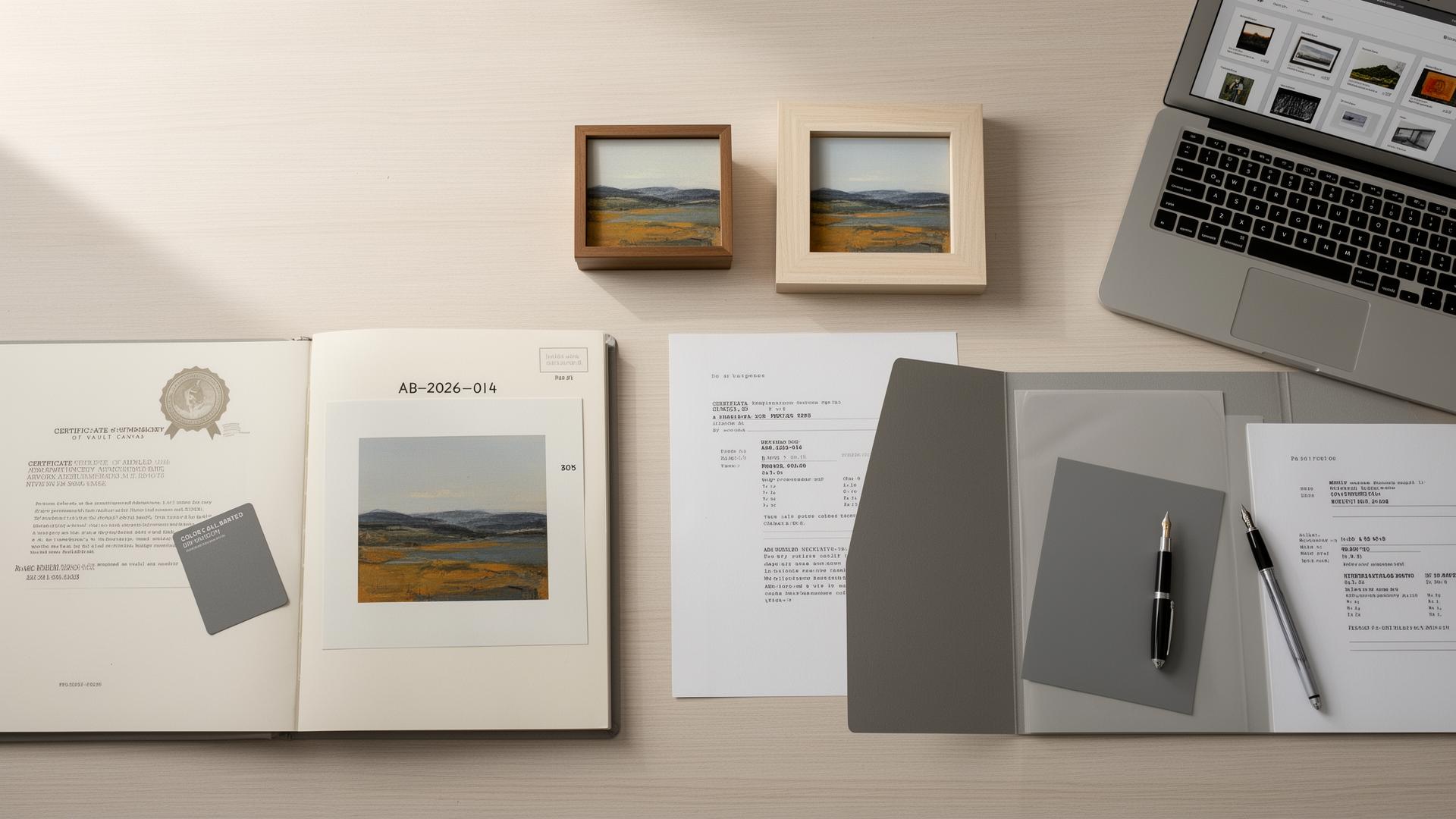
An artwork archive is the single most valuable administrative asset an artist will ever build. It outlasts websites, galleries, studios and even careers. Every original work an artist makes generates a small constellation of facts — dimensions, materials, exhibition history, owners, prices, photographs, certificates — and those facts either accumulate into a coherent record or scatter across drawers, hard drives and email threads. This guide explains how to build a professional artwork archive, what an artwork database is, how it relates to artwork inventory and artwork management, and how to document artwork in a way that supports provenance, collector confidence and long-term value.
What Is an Artwork Archive?
An artwork archive is the complete historical record of every work an artist has made — finished, sold, destroyed, gifted, loaned or held in studio. It is not a portfolio and it is not a stock list. A portfolio shows a curated public face. An inventory shows what currently exists and where. An archive is the underlying memory of the practice: every work, with every fact attached to it, for the lifetime of that work and beyond.
A proper artwork archive answers three questions about any work the artist has ever made:
- What is it, materially and physically?
- What has happened to it — exhibitions, sales, owners, condition events?
- Where is the evidence — photographs, certificates, invoices, correspondence?
When those three layers are recorded consistently from the first work onward, the archive becomes the foundation for everything else: pricing, gallery relationships, estate planning, monographs, retrospective exhibitions, insurance claims and resale verification. When they are not, the work survives but its history quietly disappears.
Archive vs. portfolio vs. catalogue raisonné
A working portfolio is a public, curated subset of the archive built for an audience. A catalogue raisonné is a scholarly, published account of every known work by an artist — typically produced late in or after a career. The archive sits beneath both. It is private, exhaustive and continuously updated. The portfolio borrows from the archive; the catalogue raisonné is eventually compiled from it.
Why Every Artist Needs a Digital Archive
The argument for a digital archive is not about technology. It is about what happens to artwork records when they are not centralised. Photographs sit on a phone and never get backed up. Provenance lives in a paper file the artist cannot find when a collector emails three years after a sale. Certificates of authenticity are issued but never logged. A work loaned to a group exhibition is returned with a small scuff and there is no baseline image to prove it was not there before.
Every one of those failures is recoverable while the artist is active. Most become unrecoverable later. A digital archive — a single, structured, backed-up system that holds the records for every work — closes those gaps while it is still cheap to close them, and it changes what the artist can do day to day: quote a collector reliably on a work made three years ago, send a gallery a clean consignment list in minutes, file an insurance claim with documented condition photographs, substantiate provenance when a work returns to market, and hand a clean record to an estate or executor. None of that requires sophisticated tools. It requires that the artist decided, at some point, that the records mattered.
The Difference Between an Artwork Archive, Database and Inventory
These three terms are used interchangeably in conversation and they should not be. Each has a specific function in a working artist's records.
- Artwork archive — the lifetime historical record. Append-only in spirit. Includes works that no longer exist, works that have changed hands many times, and works the artist would rather forget. Its purpose is memory and evidence.
- Artwork database — the structured store underneath the archive. Defined fields, enforced data types, unique identifiers, and relationships between records (artwork ↔ owner ↔ exhibition ↔ image). Its purpose is to make the archive searchable, reportable and reliable.
- Artwork inventory — a current-state snapshot drawn from the database. What exists right now, where it is, and what its status is (in studio, on consignment, loaned, sold, destroyed). Its purpose is operational: shipping, insurance, gallery management.
The archive is the what happened. The database is the how it is stored. The inventory is the where things stand today. A professional artwork records system covers all three without confusing them.
What Information Should Be Recorded for Every Artwork?
A useful record balances completeness against the discipline required to maintain it. Too few fields and the archive cannot answer questions. Too many and the artist stops filling it in. The fields below are the working minimum. Every artwork in the archive should have all of them.
Core identification
- Unique inventory number
- Title
- Year of completion
- Medium (e.g. oil on linen over panel)
- Substrate / support
- Dimensions (height × width × depth, in centimetres and inches)
- Weight (framed and unframed where relevant)
- Signature location and signing details
- Edition (unique, or numbered edition with edition size)
Production and presentation
- Materials list (paints, mediums, varnish, ground)
- Framing specification or "unframed"
- Hanging hardware
- Date completed and date signed
Status and location
- Current status (in studio / on consignment / sold / loaned / destroyed)
- Current physical location
- Asking price and currency
- Sale price (if sold) and date of sale
History
- Exhibition history (venue, dates, curator, catalogue reference)
- Ownership history (chain of custody)
- Provenance notes
- Condition events (damage, conservation, reframing)
Documentation references
- High-resolution master image
- Detail, signature, verso and condition photographs
- Certificate of authenticity reference number
- Linked invoices, consignment notes and correspondence
The discipline is not the length of the list. It is recording the same fields in the same way, every time, from the first work onward.
How to Archive Artwork Step-by-Step
This is the working sequence. It is the same for an emerging artist with twelve works and a mid-career artist with eight hundred. Treat each step as a non-negotiable stage before a work is considered "filed".
Step 1: Assign an inventory number
Before a new work is photographed, signed or sold, give it an inventory number. A reliable convention is INITIALS-YEAR-SEQUENCE, e.g. AB-2026-014. The number never changes. It does not matter if the title later changes, if the work is reframed, or if it crosses borders. The inventory number is the spine of every record that follows. This act of artwork cataloguing is the single most important habit in the archive.
Step 2: Photograph the artwork
Capture a colour-accurate master image (minimum 3000 pixels on the long edge, sRGB, archival TIFF where possible, with JPEG derivatives). Add detail shots of the surface, the signature, the verso and any framing or hanging hardware. File names should embed the inventory number — e.g. AB-2026-014_master.tif, AB-2026-014_signature.jpg. This step is covered in detail in the photography section below.
Step 3: Record core metadata
Open the database record for the new inventory number and enter every field in the checklist above. Do this immediately after photography while the materials list is fresh and the work is in front of you. Records filled in months later are almost always wrong.
Step 4: Store provenance information
From the first record, the work has provenance — even if the only entry is "Held in studio of the artist." Each subsequent event (gallery consignment, sale, loan, gift, exhibition) appends to the provenance, never overwrites it. Use the article on artwork provenance as the standard for how each entry should read.
Step 5: Link certificates and supporting documents
When the work leaves the studio, generate the certificate of authenticity, store a signed copy in the archive, and link it to the inventory number. Do the same for sales invoices, consignment notes, shipping documentation and any condition reports. The certificate should reference the inventory number on its face so the link survives outside the system.
Step 6: Back up the archive
A single copy is not an archive. Maintain at least two independent backups: one local (an external drive kept offsite or in a fireproof safe) and one cloud-based, geographically separate from the working machine. Verify the backups quarterly by restoring a single record. An archive that has never been test-restored is an unverified archive.
Step 7: Maintain and update records over time
Block thirty minutes a week to update the archive: new works added, sales logged, exhibitions recorded, condition events noted. The maintenance habit is the difference between an archive that compounds in value and a collection of half-finished spreadsheets. Annual reviews — a single afternoon to reconcile inventory against physical location — keep the system honest.
How to Photograph and Document Artwork Properly
Photography is the single largest source of long-term value in the archive, because every other piece of documentation can be reissued and a lost master image cannot. The standards below are appropriate for a working artist; museum-grade capture is more demanding but rarely necessary.
Image specifications and file naming
Capture the master at a minimum of 3000 pixels on the long edge (6000+ for works intended for large-format reproduction) as archival TIFF or DNG, with JPEG derivatives for working use. Use sRGB for web and AdobeRGB for print masters, on a calibrated monitor. Light the work with two diffused sources at 45°, with a polariser to control glare on oil and varnish, and include a colour checker in at least one frame per session. File names embed the inventory number — AB-2026-014_master.tif, AB-2026-014_signature.jpg — so the link to the record survives outside the database.
Capturing condition and detail shots
A complete record for each work includes: full front (square to the surface), full verso, signature close-up, two or three surface details, framing and hanging hardware, and any pre-existing condition notes (small repairs, prior conservation, edge wear). These images establish the baseline against which any later damage will be assessed. This is what "documenting artwork" actually means in practice — not one photograph, but a small set that answers every question a future conservator, gallerist or collector might ask.
Creating an Artwork Database
A database is what turns a folder of records into something the artist can actually use. The difference between a spreadsheet and a database is enforced structure: every record has the same fields, every field has a defined type, and records can relate to each other (an artwork belongs to an owner, appears in an exhibition, has many images, references one certificate).
A working artwork database needs, at minimum, an Artworks table keyed on inventory number; Images linked many-to-one per artwork by purpose (master, detail, signature, verso, condition, install); Owners representing each individual or institution across time; Exhibitions for each show a work appears in; Documents for certificates, invoices and consignment notes; and Transactions for sales, consignments, loans, gifts and returns.
Querying across those relationships is what makes the database useful: "every work currently on consignment with Gallery X", "every painting sold to Collector Y over the last decade", "every work exhibited in 2022 that has not been photographed in framed condition". A flat spreadsheet cannot answer any of those questions reliably.
Spreadsheet vs. artwork database
Most artists pass through a predictable sequence of tools. Each works until it does not.
- Paper records. A studio ledger or index cards. Beautiful as an object, fragile as a system. Loss is total and silent. Acceptable as a parallel artefact, never as the only record.
- Excel spreadsheets. A workable starting point. Single-user, prone to version conflicts, no enforced data types, no relationships between records. Most artists outgrow Excel between 50 and 150 works, when search becomes slow and integrity errors creep in.
- Google Sheets. Solves the version-control problem and adds collaboration. Inherits every other limitation of a spreadsheet. Useful for shared consignment lists, fragile as a long-term artwork records system.
- Dedicated artwork archive systems. Purpose-built tools enforce the structure described above — unique IDs, defined fields, image management, provenance threading, exhibition history. The archive stops being a file the artist maintains and starts being a system that maintains itself.
- Purpose-built platforms such as Vault Canvas. Built specifically around the working artist's workflow — artwork inventory, provenance, certificates, photography, sales records — with the relationships already wired together, so a sale updates the inventory and provenance record, and the artwork's Certificate of Authenticity is generated from the same details.
The point of the comparison is not to rank tools. It is that artists typically outgrow spreadsheets at the point where the cost of bad records starts to exceed the cost of better software — usually around the first gallery relationship, the first commissioned work above £2,000, or the first collector who returns to buy again. Recognising that moment is more important than the specific tool chosen at it.
Building an Artwork Inventory System
An artwork inventory is the current-state view of the archive. It answers: what do I have, where is it, and what is its status? It is the document the artist sends to a gallery before a studio visit, the insurer before a renewal, and the executor in an emergency.
The inventory should be derived automatically from the database rather than maintained separately. Every artist who maintains two parallel lists eventually has two contradictory lists.
A useful inventory format includes:
- Inventory number
- Title, year, medium, dimensions
- Status (in studio / on consignment / sold / loaned)
- Current location (studio / specific gallery / collector / storage)
- Insurance value
- Thumbnail image
- Date of last status change
Inventory numbering should be issued sequentially and never recycled. Renumbering past works retroactively to "tidy up" is one of the most destructive mistakes an artist can make in an archive — it severs every external reference (invoices, certificates, gallery records) from the work they describe.
Managing Provenance and Ownership Records
Provenance is the documented chain of ownership and custody. It is what a serious collector or auction house verifies before a purchase, and what an insurer relies on after a loss. In the archive, provenance is not a single field — it is an append-only sequence of events attached to each work, with the inventory number as its spine.
Each provenance entry should include the date, the event type (sale, consignment, loan, gift, return, exhibition), the parties involved, and a reference to the supporting document held elsewhere in the archive. The first entry is always "Held in studio of the artist". The last entry is the current status. The middle is the history.
The deeper standard — what counts as a provenance event, how to handle gaps, what to do when records conflict — is covered in the artwork provenance article. The point in the context of the archive is that provenance is only as reliable as the system that records it, and the system is only as reliable as the discipline applied to it.
Certificates of Authenticity and Archive Records
A certificate of authenticity is the document that travels with the work, but its archive entry is what gives it legal and curatorial weight. Each issued certificate should be logged in the database with: certificate number, inventory number of the work it certifies, date of issue, recipient, and a stored scan of the signed original.
If a fresh certificate is ever needed — after damage to the original, say, or when a new owner asks for one — the artist produces a replacement from the artwork record and signs it, keeping their own note of when and why it was replaced. What a good certificate should contain, and how to produce one, is covered in the certificates of authenticity article.
In the archive, the certificate and the artwork record reference each other. A certificate without an archive entry is a piece of paper. An archive entry without a linked certificate is an unsupported claim. Both together are evidence.
How Galleries and Collectors Use Artwork Archives
Galleries and serious collectors work with artist archives constantly, whether the artist realises it or not. Every enquiry that begins "do you still have the painting from the 2023 show?" is a query against the archive. Every collector asking for provenance before purchase is verifying the archive. Every insurance valuation depends on the archive supporting the claimed value.
For galleries, the archive underwrites consignment lists, exhibition planning, press and catalogue production, and sales support — providing high-resolution images, accurate specifications, exhibition history and verifiable provenance on demand. For collectors, it provides verification before purchase and continuity after it. A work backed by a complete archive entry — clean provenance, documented condition, linked certificate, exhibition history — sells with more confidence and less risk. The same work without that record sells for less, or does not sell at all on the secondary market. The relationship is symmetrical: artists who maintain professional archives attract galleries and collectors who value them, and the resulting record makes the work more saleable in turn.
Common Mistakes When Archiving Artwork
The same handful of mistakes appear in nearly every artist archive that needs rebuilding. Avoiding them is more valuable than any specific tool choice.
- No master images. Only low-resolution social-media exports survive. The work cannot be reproduced for catalogues, prints or insurance.
- No offsite backup. The single hard drive fails and decades of records vanish in an afternoon.
- Retroactive renumbering. An artist "tidies up" inventory numbers and severs every external reference to past works.
- Mixing studio and sold inventory. Status is not tracked, so the same painting appears as available in two galleries.
- No provenance trail. Sales are recorded as transactions but the ownership chain is never assembled.
- Certificates issued but not logged. The certificate exists in the buyer's hands; the archive cannot confirm it.
- No condition baseline. A work returns from exhibition with damage and there is no documentation of its pre-loan state.
- Filling the archive in arrears. Records are reconstructed from memory months later and are quietly wrong.
Each of these is cheap to prevent and expensive to repair.
Creating a Long-Term Artwork Management System
An archive built for the next five years is different from one built for the next fifty. Long-term artwork management treats the archive as an asset that will outlive specific software, specific storage media, and eventually the artist. That changes the priorities.
- Format longevity. Master images in formats that will still be readable in twenty years (TIFF, DNG). Records exportable to plain CSV at any point.
- Backup discipline. Two independent copies, quarterly verification, geographic separation.
- Estate readiness. The archive should be intelligible to someone who is not the artist. A short written guide to how the system is organised — kept with the legal will — is worth more than any individual record.
- Succession. Identify, in writing, who has authority to access and maintain the archive if the artist cannot. Many practices fail this test entirely.
Managing sold, loaned and consigned artwork
The hardest records to keep clean are the ones for works no longer in the studio. Each category needs its own discipline.
- Sold works. Sale logged with date, price, buyer, invoice reference and any conditions of sale (resale rights, exhibition obligations, reproduction permissions). Ownership record opened. Certificate logged.
- Consigned works. Consignment agreement filed. Status set to On consignment with [gallery] with start date and review date. Returned works update status back to In studio with a fresh condition check.
- Loaned works. Loan agreement filed with insurance value, return date and condition report on dispatch and return.
- Exhibition records. Every appearance logged: venue, dates, curator, catalogue, photographs of the install where possible.
- Collector ownership history. Each change of hands appended to the provenance, never overwritten. Where a collector requests anonymity, record the transaction and note the discretion separately.
- Provenance continuity. The thread through all of the above. Every gallery consignment, sale, loan and exhibition is also a provenance event, and the archive should reflect that automatically rather than requiring it to be entered twice.
The integrity of these records is what allows a work to re-enter the market — through resale, gift, donation or inheritance — with its history intact rather than reconstructed.
When an archive becomes a collection management system
For larger collections, artists and collectors often move beyond artwork archives into formal collection management systems. The threshold is not a specific number of works — it is the point at which the records need to support multiple stakeholders (artist, gallery, estate, conservator, insurer) operating on the same data with different permissions and views. At that scale, the archive is still the foundation, but the practices around it become the formal discipline of collection management.
Frequently Asked Questions
Continue Reading
The archive is the foundation; what you do with the work it holds is the next question. For the commercial relationship most galleries actually offer — and the records every consigned work should travel with — see Gallery Consignment for Artists. For direct sales from the studio or website, see How to Sell Artwork Online.