
Free resource
Artist Statement & Biography Template
Write a clear artist statement, short biography and longer biography with an editable workbook and a complete fictional example.
No email required. Free to use and adapt.
Internationally suitable · Editable in Word, Pages and Google Docs
A practical workbook for three different documents
The workbook takes the artist through preparing an artist statement in the first person, a short biography in the third person and a longer biography in the third person, with prompts, working lengths and a final accuracy check.
See the complete writing process
The worked example follows one artist from raw notes through a weak first draft and an editorial review to completed versions of the statement and both biographies.
Mara Venn is a fictional artist created solely to demonstrate the writing process. Her places, exhibitions, training and achievements are invented.
Download the worked example PDFUnderstand the difference
- Artist statement
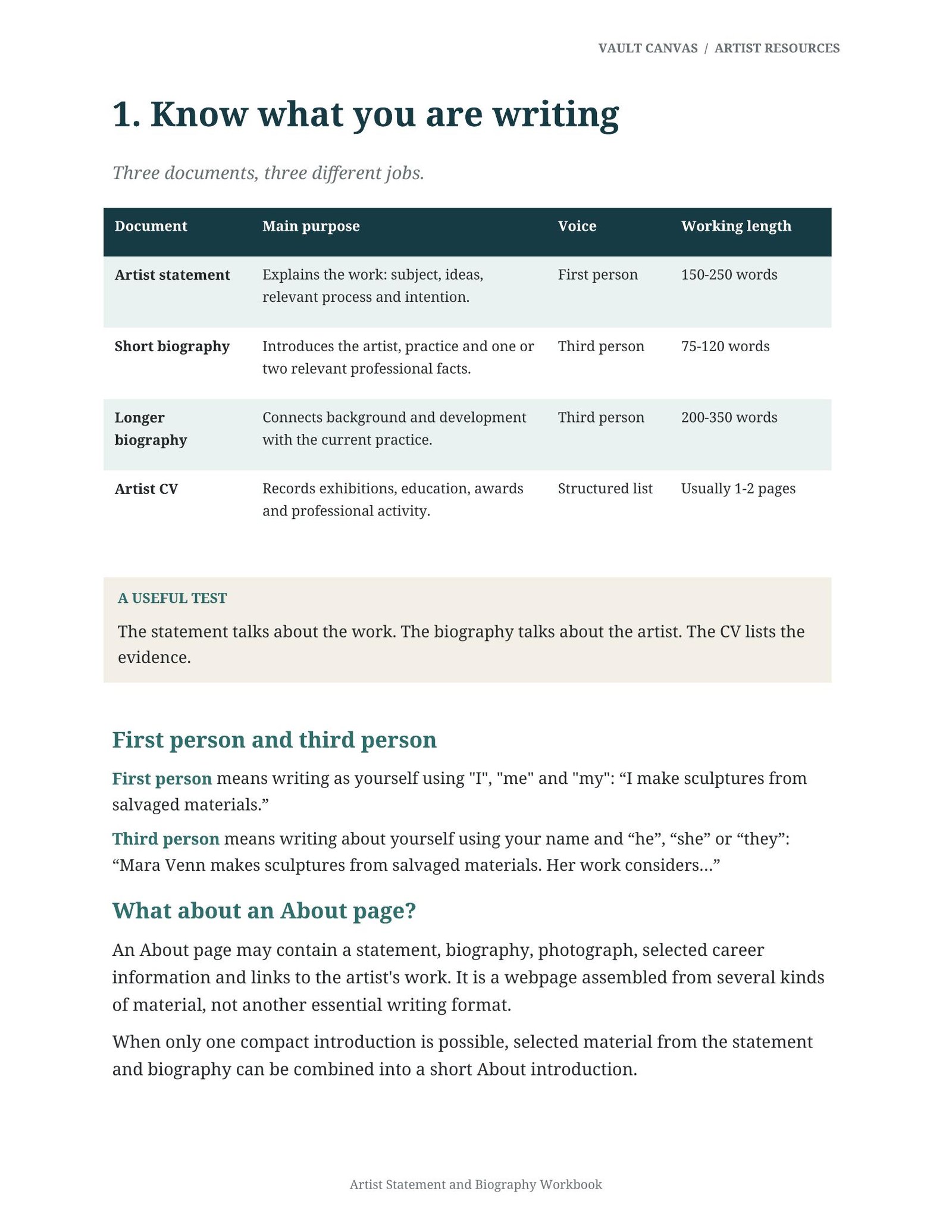
- First person; explains the work; normally 150–250 words.
- Short biography
- Third person; introduces the artist and practice; normally 75–120 words.
- Longer biography
- Third person; connects professional development with the current practice; normally 200–350 words.
- Artist CV
- A separate structured record of professional activity.
How to write each document
1. Gather accurate source material
Collect the facts before drafting: materials, working methods, recurring subjects, training, exhibitions and any recognition. Accurate notes make the writing faster and prevent vague claims.
2. Identify what the artist makes
State the medium, scale and form plainly. A reader should understand what the work physically is before reading anything about its meaning.
3. Select two or three specific concerns
Choose a small number of concerns the work genuinely returns to. A statement that tries to cover every possible theme reads as unspecific.
4. Include only process that helps explain the work
Describe technique where it changes how the work is understood. Leave out procedural detail that adds nothing for the reader.
5. Write the statement in the first person
Use “I”, “me” and “my”. The statement is the artist speaking directly about the work, so it should read in the artist’s own voice.
6. Write biographies in the third person
Use the artist’s name and “he”, “she” or “they”. Third person allows galleries, publications and open call panels to reuse the text without rewriting it.
7. Select professional evidence rather than reproducing the entire CV
A biography carries a few relevant facts, not a complete list. Keep the full record in the artist CV and choose only what supports the current practice.
8. Read the writing aloud and revise it
Reading aloud exposes long sentences, repetition and borrowed art-world phrasing. Revise until the writing sounds like plain, confident description.
9. Keep dated master versions and tailor copies for particular uses
Maintain one dated master of each document, then adapt shortened copies for exhibitions, websites, portfolios and open calls rather than rewriting each time.
Related formats
- An exhibition wall text is normally a 100–200-word adaptation of the artist statement, focused on the exhibition or body of work.
- An individual artwork label is a different format containing the artist, title, year, medium and dimensions, sometimes with a short interpretive text.
- A compact About introduction may reuse statement and biography material.
- A complete website About page may also include a portrait, separate sections, selected recognition, links to the work and a contact route.
This resource does not claim to be a complete artwork-label or website About page template.
Artist statement and biography questions
Related Journal guidance
The workbook provides a practical drafting structure. Our Studio Journal guide explains how to make an artist statement specific, readable and appropriate for exhibitions, websites, portfolios and open calls.
Read: How to write an artist statementTo see where the finished statement and biography sit on a public artist page, alongside current practice, recognition and contact routes, read the companion guide below.
Read: How to write an artist About pageKeep the source material behind your writing organised
Statements and biographies are easier to maintain when artwork details, series descriptions, themes, techniques, exhibitions and professional development are recorded as the practice evolves. Vault Canvas keeps that material connected, helping artists prepare accurate professional writing without reconstructing their history each time.
Explore Vault Canvas