
How to Write an Artist Statement: Examples, Structure and Practical Tips
A practical, plain-language guide to writing an artist statement that works for exhibitions, websites, portfolios, gallery submissions and open calls — with structure, examples and common mistakes to avoid.
28 min read
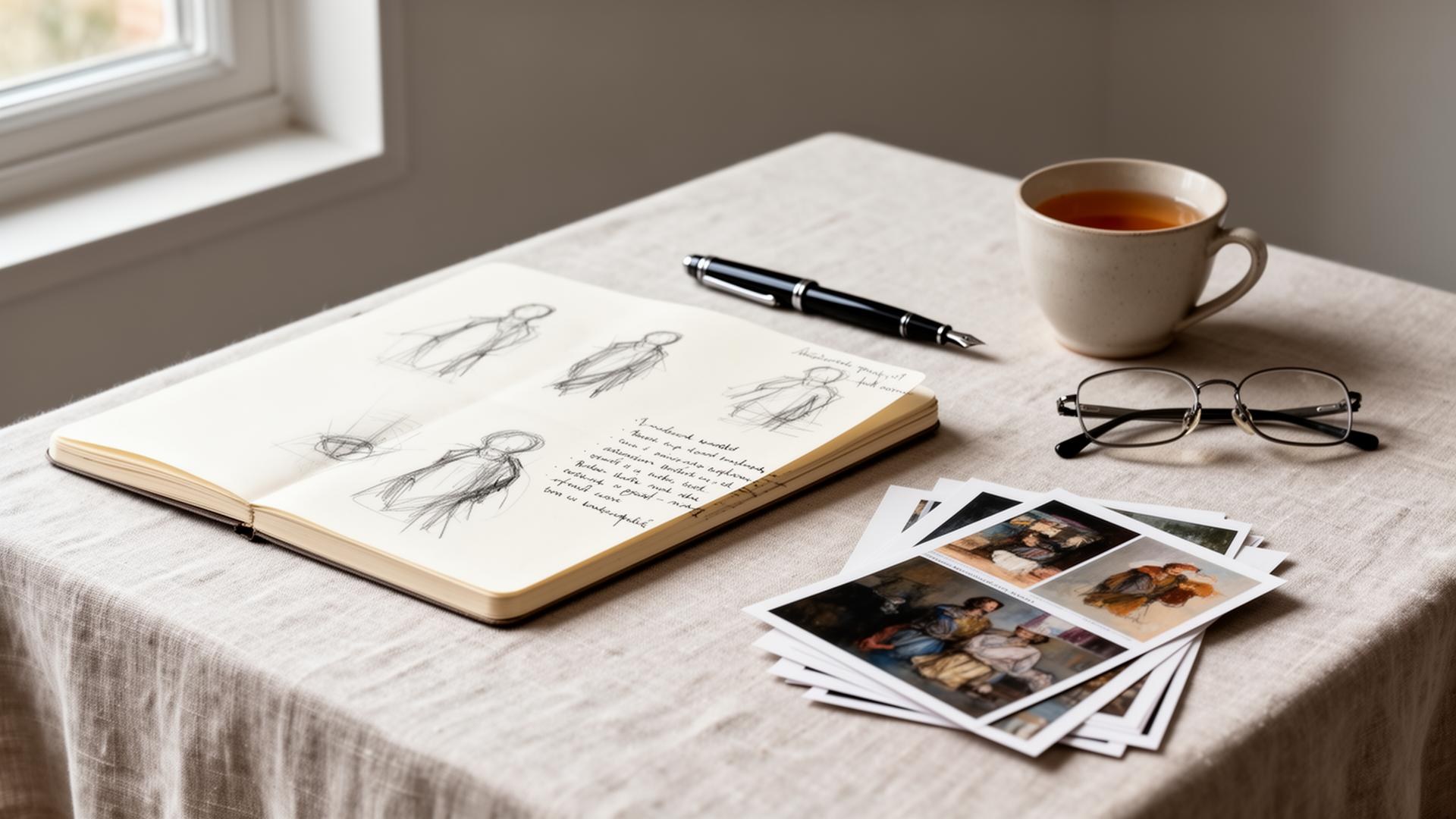
Writing an artist statement can be surprisingly difficult. You may understand your work instinctively, yet explaining what you make, why you make it and what you want the viewer to notice in a few hundred words is a very different task.
A strong artist statement should be short, specific and written in your own voice. It should explain the subject of your work, the ideas behind it and the parts of your materials or process that matter — without becoming an academic essay, a biography or a list of techniques.
This guide explains how to write an artist statement step by step, with practical examples, and how a statement differs from the five other texts artists are asked for — the exhibition statement, the artwork narrative, the gallery or open-call submission text, the biography and the CV — so one core text can be adapted across contexts without pasting the same paragraph everywhere. The aim throughout: a clear, plain-English account of your practice that helps the reader understand the work without trying to explain everything about it.
What Is an Artist Statement?
An artist statement is a short, first-person piece of writing that describes your work and your reasons for making it. It is not a biography, not a CV, not a press release, and not a manifesto. It is a single piece of writing — usually 150–250 words for a general or master statement — that sits alongside the work and gives the reader enough context to engage with what they are looking at.
A statement is read by exhibition visitors, open-call jurors, gallery directors, collectors, journalists and curators. In each case it does one small, useful job: it provides relevant context — what the work is, what it concerns, how it is made — while leaving room for the viewer's own interpretation. It supports the looking; it does not direct it.
The Six Texts an Artist Is Asked For
Artists are often asked for "a statement", "a short bio", "a description of the work" or "a CV" without much guidance about which is which. These are six different documents. They do different jobs, are read by different audiences in different situations, and should not be merged.
| Text | Voice | Length |
|---|---|---|
| Practice statement | First person | 150–250 words |
| Exhibition statement | First person (artist) or third (curator) | 100–200 words |
| Artwork narrative | First person or neutral | 50–150 words |
| Submission text | As the recipient requests | The stated limit |
| Artist biography | Third person | 100–250 words |
| Artist CV | Structured list | 1–2 pages |
The purposes summarised in one line each: the practice statement covers the wider body of work (website, portfolio, reference text); the exhibition statement covers one exhibition or selected body of work (wall text, handout, catalogue); the artwork narrative covers one particular work (detail pages, labels, catalogue entries); the submission text is a tailored response to a gallery or open-call brief; the biography is factual prose about the artist (programmes, press, profiles); the CV is the professional record (exhibitions, education, awards).
Practice statement. The general or master statement covered by most of this guide: the concerns, materials and direction of your wider body of work, in the first person. It changes only when the work changes direction, and it is the source text from which most of the others are adapted.
Exhibition statement. Written for one exhibition or selected body of work. It leads with the purpose and context of that show and links back to the wider practice in a sentence or two. It may be written by the artist in the first person, or by a curator or organiser in the third — both are normal, and an exhibition text should make clear whose voice it is rather than imposing a single convention. When the artist writes it, the guidance in this article applies; when the organiser supplies or edits the text, check it for accuracy and ask for changes where it misrepresents the work. Visitors read it standing up, so it omits anything that does not help them read the work in the room.
Artwork narrative or description. Writing about one particular work: what it shows, what it is made of, and anything specific the reader could not see at a glance. It appears on detail pages, beside labels, in catalogues and inventory records, and should add information the wider statement does not carry. How to Write Artwork Descriptions covers this in full.
Gallery or open-call submission text. A tailored response to a specific brief. Its length, emphasis and sometimes its subject are set by the recipient, and the stated word limit always takes priority. It is judged partly on whether you followed instructions.
Artist biography. Third-person, factual prose about the artist: training, location, direction of the practice, selected exhibitions. It talks about the artist rather than the work; Artist CV and Biography covers it in depth.
Artist CV. The structured professional record — exhibitions, education, awards, residencies, collections — in list form, kept current and dated.
A useful test: if a sentence describes where you studied or what you have exhibited, it belongs in the biography or CV; if it describes what the work is, why it exists or how it is made, it belongs in the statement; if it describes one piece, it belongs in the artwork narrative.
Why one paragraph should not be copied everywhere
Each context has a different reader, purpose and amount of space. A wall text needs the show first and the practice second; a submission panel needs evidence you read the brief; a portfolio reader has chosen to sit with a longer document. The same paragraph pasted into all of them answers none properly, and a text that ignores its context can read as carelessness.
Adaptation is not rewriting from scratch: the core account of the practice stays stable; what changes is the lead, the emphasis and the length. The worked examples later in this guide show one practice statement adapted into an exhibition statement and an artwork narrative.
Word lengths throughout this article are practical guidance, not universal rules. Where an organiser, gallery, publisher or platform states its own requirement, that requirement always takes priority.
What Should an Artist Statement Include?
A statement does not need to cover everything the artist could possibly say about their work. It needs to cover the small number of things a stranger needs to read the work clearly.
Subject matter. State, plainly, what you make. Paintings of moorland edges. Sculptures using discarded shipyard steel. The subject is the easiest thing to get specific about and the most common thing artists are vague about. "I explore the landscape" is not subject matter; "I paint coastal woodland on the Pembrokeshire shoreline" is.
Themes and ideas. State the concerns the work engages with — memory, absence, repair, inheritance, attention, the experience of a particular place. Named, not implied, and kept few: two or three is usually enough.
Materials and process. State, briefly, what the work is made of and how — oil on linen with extended drying between layers; charcoal drawings worked over weeks. Include only what the reader could not work out from the image alone, not every technical step.
Influences. A short, honest mention of what feeds the work — a place, a tradition within your medium, a recurring question. One specific, true influence is more useful than five fashionable ones.
What the finished work holds. State what remains important in the completed work. Not "I hope to provoke a conversation" — that is generic. Something specific: "the paintings hold a record of how each surface was built", "the finished objects carry the wear of their first working life". This is the sentence the reader will remember.
A Practical Writing Process
Most weak statements are not badly written so much as badly prepared — drafted from memory in front of a blank page. A short, repeatable process produces better material before the writing starts.
1. Gather accurate source material. Before drafting, collect what you already know about the work: notes made when pieces were finished, titles and working titles, materials lists, lines from past statements that still ring true, and the record of where the work has been shown. You want facts about themes, materials, process and context — not phrases. A statement built from real notes is specific by default; one written from memory tends towards the generic.
2. Identify the two or three concerns that genuinely recur. Look for what repeats across the work, not what sounds impressive. The concerns that appear again and again are the ones to name. Two or three is enough; a statement listing eight themes convinces no one.
3. Begin with what you make and how. Open with a plain description of medium, subject and scale. It grounds everything that follows and stops the draft opening with an abstract claim.
4. Connect visible choices to intention. For each theme, point to something the reader can see: the thin layers, the retained frayed edges, the repeated motif. If a sentence could have been written without looking at the work, cut it or anchor it to something visible.
5. Remove vague or habitual jargon, inflated claims and anyone's-work language. No word is automatically wrong — "explore" or "interrogate" may genuinely be the right verb for what you do. The problem is vague, habitual or unjustified use: words reached for out of habit rather than because they say something specific about this work. Cut unsupported promotional claims ("unique", "innovative") and any sentence that could describe many other artists. Read the draft aloud; cut anything you could not defend in plain conversation.
6. Tailor and proofread for the intended use. Check the recipient's word limit and requirements, adjust the lead and emphasis for the context, then proofread names, dates and titles. What goes to an open call is not what goes on the wall.
7. Keep dated versions. Save each final version with a date and its intended use — statement-website-2026-03, statement-held-ground-exhibition-2026-06 — and never overwrite the only copy. Old versions are a record and useful raw material for the next revision.
How to Structure an Artist Statement
A reliable structure for a 150–250 word statement:
- Opening sentence. What you make and where it sits — medium, subject, scale. One sentence.
- Themes. Two or three lines on the ideas the work is engaging with.
- Process. Two or three lines on materials and how the work is made, only the parts that serve the themes.
- Influences (optional). One line on what feeds the practice, if it adds something.
- What the work holds. One closing sentence on what the finished work holds or brings into focus — without telling the viewer what to think or feel.
That is the whole statement. Five short paragraphs at most, often three. A good statement reads aloud in under a minute.
How Long Should an Artist Statement Be?
As a working default, aim for 150–250 words for a general or master artist statement — a practical working length rather than a universal rule: long enough to name your subject, concerns and process, short enough to be read in full.
Where an exhibition, gallery, open call or grant states its own word limit, that instruction always takes precedence over any general recommendation, including this one. Beyond that, the working artist keeps a small number of dated versions on file rather than one document edited indefinitely.
As a rough working guide — all ranges, with any stated requirement taking priority: practice statement 150–250 words; exhibition wall text or handout 100–200 words; artwork narrative 50–150 words; open-call submission stay within the stated limit; website statement 150–250 words; gallery submission follow the gallery's requirement where given, otherwise somewhere around 250–300 words is a workable range; printed portfolio whatever the document's design allows, commonly 250–400 words; short profile or caption 40–80 words.
Write the longest version first and edit down — not the other way around.
Artist Statement Examples
The best artist statement examples show how an artist turns the ideas behind their work into clear, specific language. They should not be copied as templates — a statement needs to sound like the artist who wrote it. Every example in this guide is fictional, written for this article; no living artist's statement is quoted or imitated. Notice the same structure in each: what the artist makes, what the work concerns, how it is made, and a clear intent. The wording changes with each practice; the structure stays simple.
Landscape artist
I paint the moorland edges of north Devon, working on stretched linen in oil. The work is concerned with the slow erosion of boundary between cultivated land and open moor — the places where one quietly becomes the other. Each painting is built over several weeks, in thin layers that allow earlier states to remain visible, so the surface carries a record of the time spent looking. The work is not a depiction of the landscape so much as an account of attention paid to it.
Abstract artist
My paintings are large-scale, oil on cotton duck, built up over months in opaque and translucent layers. I am interested in what happens at the edge of a colour field — how a boundary can read as both an end and a beginning. The decisions are made over long periods of looking, and the final surface holds the trace of every earlier state. The paintings are made to be lived with, and I hope they reward sustained looking.
Figurative artist
I draw figures in transitional domestic spaces — hallways, landings, kitchen thresholds. The work is in charcoal and graphite on heavy paper, made directly from observation over multiple sittings. I am interested in the quiet authority of the body at rest, and in how an unguarded posture can describe a person more accurately than a portrait pose. I want the viewer to meet the figure as one might meet a person on a stair — briefly, without ceremony, and with the full weight of their presence.
Vague Versus Specific
The single most useful editing skill is replacing vague sentences with specific ones. Three pairs, using fictional practices:
Vague: "My work explores themes of memory and place." Specific: "I make small sculptures from rope and timber salvaged from former industrial shoreline sites, where traces of manual work remain embedded in the material."
Vague: "I am passionate about colour and its emotional possibilities." Specific: "Each painting is built from thirty or more thin glazes, so that the final colour is mixed by the eye rather than on the palette."
Vague: "My practice is inspired by nature and the world around me." Specific: "I draw the same half-mile of canal towpath in every season, in charcoal, from the same four positions."
The specific versions name things a reader could check against the work itself. That is the whole test.
Full Artist Statement Example
A longer statement gives room to connect subject, themes, process and intent without becoming an essay. The following fictional example shows the elements working together in a complete statement suitable for a website, portfolio or gallery submission.
I make landscape paintings concerned with the places where the natural and human-made environment meet. Paths, walls, field boundaries and waterways recur throughout the work, not simply as features of a landscape but as structures that divide, connect and direct our experience of place.
I begin with places I have walked through and observed, using photographs, sketches and remembered details as starting points rather than as images to reproduce. During the painting process the original landscape is simplified. Unnecessary detail is removed and shapes, tonal divisions and edges become increasingly important.
I work in layers, allowing earlier marks and colours to remain partly visible beneath later decisions. This creates surfaces that hold some evidence of how the painting developed rather than presenting the landscape as a single fixed view.
I am particularly interested in the point at which a recognisable landscape begins to move towards abstraction. A wall may become a line across the composition; a path may become a division of light and dark; a distant field may be reduced to little more than a block of colour.
The finished paintings are intended to retain enough of the original place to feel familiar while leaving space for the viewer's own experience and memory of landscape.
Note what these examples share: a specific subject, a small number of named themes, a brief account of process, and a single closing intent. None of them reach for fashionable shorthand, and none name another artist.
Artist Statement Example: From Weak First Draft to Finished Statement
The following worked example uses a fictional Vault Canvas artist, Mara Venn. Mara is not a real artist: her places, exhibitions, training and achievements are invented solely to demonstrate the writing process. The example shows how the same raw material reads first as a weak draft and then as a finished statement.
1. Raw source notes
Before drafting, Mara gathered a short selection of source material about the work:
- Small sculptures and wall-based assemblages.
- Salvaged rope, worn cloth, weathered timber and cast plaster.
- Repair, erosion and repeated handling.
- Manual work that has disappeared but left physical traces.
- Wrapping, binding, casting and partially covering materials.
This is what useful raw material looks like before drafting: specific objects, materials and concerns, written down plainly.
2. Weak first draft
"My work explores the relationship between past and present and invites the viewer to consider memory, place and identity. I have always been inspired by the coast and use a wide variety of mixed media in innovative ways. My artistic journey began when I was young, and I have continued to develop my unique practice through many different experiences."
Why this draft is weak:
- The opening could describe many artists.
- "Memory, place and identity" is too broad without specific evidence.
- "Innovative" and "unique" are unsupported promotional claims.
- "Artistic journey" gives no useful account of the practice.
- The draft does not name the actual materials or meaningful processes.
3. Improved practice statement
"I make small sculptures and wall-based assemblages from salvaged rope, worn cloth, weathered timber and cast plaster. The materials are collected or sourced around former industrial shoreline sites, where evidence of manual work remains embedded in buildings, paths and discarded objects.
I am interested in repair, erosion and the marks left by repeated handling. Many of the materials have already completed one practical life before entering the studio. I retain frayed edges, indentations and areas of wear rather than restoring them to an imagined original condition.
Each work begins with a found object or a particular material relationship. I wrap, bind, cast and partially conceal elements, often rearranging them several times. Plaster takes impressions from rope and cloth, turning flexible surfaces into fixed records. Joins and repairs remain visible.
The finished works sit between object, fragment and record. They do not reconstruct the industries associated with the shoreline, but hold physical traces of labour, damage and continued use."
4. Why the improved version works
- It identifies the work immediately.
- It replaces generic language with specific subjects, materials and concerns.
- It includes only process details that help the reader understand the work.
- It connects materials and process with the artist's ideas.
- It ends with a clear account of what the work holds without telling the viewer how to feel.
5. The same statement adapted for an exhibition
When Mara's recent assemblages were selected for a fictional two-person exhibition, Second Working, she did not paste the practice statement into the handout. She adapted it:
"The twelve assemblages in Second Working are made from rope, cloth and timber recovered from a single stretch of decommissioned dockyard, collected over one winter. Each material had already completed a working life before entering the studio, and each has been left visibly worn — frayed, indented, repaired — rather than restored. The works continue my wider interest in the traces manual work leaves behind, gathered here around one place and one winter's collecting."
Four things changed and nothing was invented: the lead sentence is now about this exhibition, the themes are narrowed to the twelve works in the room, the process is compressed to what visitors cannot see for themselves, and one closing sentence links back to the wider practice.
6. An artwork narrative for one work
An artwork narrative writes about one piece, adding what the wider statement cannot. Here is Mara's narrative for a single fictional work, Ballast III:
"Ballast III (2025) is built around a length of mooring rope recovered from the north quay, its strands partly unlaid by years of load. The rope is wrapped around a cast-plaster core taken from a mould of the same rope, so the work carries both the material and its own impression. A section of tarred cloth, bound and re-bound until the joins held firm, closes the base. The title refers to the weight ships once carried in place of cargo."
Note what this does not do: it does not repeat the practice statement's general account of repair and erosion. The statement supplies the context; the narrative supplies this object's particulars. See How to Write Artwork Descriptions for more.
Short Artist Statement Example
A short artist statement — sometimes called a one-paragraph or "elevator" statement — compresses the same five elements into roughly 60–100 words, for use in listings, social bios, press material or wherever space is tight. It is still a practice statement, only shorter — it is not the right text for an individual exhibition label. Beside a single work, the choices are the exhibition wall or introductory text (about the show as a whole) or a narrative label about that particular piece — the artwork narrative covered earlier, not a condensed account of the whole practice.
I paint coastal woodland on the Pembrokeshire shoreline in oil on linen, working in thin layers over several weeks. The paintings are concerned with the quiet boundary between tide and tree line, and with what stays the same in a place that is always changing. I want the work to slow the viewer's looking and hold attention longer than a photograph would.
The short version keeps subject, theme, process and intent, and drops influences and optional material. A good rule: keep sentences doing more than one job; cut the rest first.
Artist Statement for an Exhibition
An exhibition statement sits beside the work — on a wall panel, in a handout, in a catalogue or on a gallery website. Visitors read it standing up, often in low light, while moving through other people; it has to be readable in under a minute.
Keep it short — 100–200 words for a solo show, shorter for group shows. Lead with what the show is about, not the general practice. Cut process detail unless it is essential to reading the work, and avoid quoting critics or curators — their words belong in the catalogue essay. If the exhibition has a specific concept, write one short paragraph about that show, then a shorter one linking it to the wider practice, as in the worked example above.
For the practical side of the show itself, see preparing artwork for an exhibition.
Artist Statement for an Open Call
Open-call submissions are read against a stated word limit, often on screen and under time pressure, so clarity and brevity carry more weight than usual. UK artists will recognise the contexts: regional open exhibitions, artist-led space submissions, museum and trust open calls, and contemporary art prizes. The wider mechanics are covered in Open Calls for Artists.
A submission text is a tailored response to a brief, not a shortened practice statement. Read the brief twice and follow its stated voice and format. Where the call sets a limit, treat it as a maximum and stay within it: if the call asks for up to 150 words about the work, send no more than 150 words about the work — not 250, and not 150 words about yourself. Lead with what the work is in one specific sentence, name the themes plainly, keep process to one short sentence, close with intent. If the call has a theme, link your practice to it without overclaiming — a statement retro-fitted to a theme tends to read as one.
Open-call submission example (≈150 words). I make small sculptural works using salvaged industrial material — copper offcuts, steel from disused shipyards, weathered wood from estuary defences. The pieces submitted for this open call are drawn from a series begun in 2024, made entirely from objects collected within a two-mile stretch of the Tyne estuary. Each work begins with the object itself, and the making is a process of attentive reduction rather than addition. I am interested in the embedded histories of materials that have already done a working life, and in what it means to give them a second, slower one. I want the finished pieces to feel both old and newly attended to, as if they had always been waiting to be seen this way.
Artist Statement for a Gallery
A gallery submission statement is read by a director or curator deciding whether to take the practice further — a studio visit, a group show, eventually representation. Galleries are looking for clarity of practice: a muddled statement makes that judgement harder, a clear one lets the work do the talking.
Where the gallery states a length or format, follow it exactly. Where it does not, a working range of around 250–300 words is a reasonable guide — accompanied by, never merged with, a separate one-page biography, and written in the artist's own voice rather than press-release prose. It sits inside a package the gallery can read quickly: statement, biography, CV, image list and the portfolio covered in How to Create a Professional Artist Portfolio. It should also be consistent with wall texts and catalogue copy elsewhere — a gallery should not find three different accounts of the same practice.
Artist Statement for Your Website
A statement on an artist's website is often the first piece of writing a collector, curator or journalist reads after seeing the work.
There is no single correct placement. A dedicated Statement page, a statement section within the About page, and a short contextual statement beside the work itself are all valid choices — pick whichever suits the structure of your site, and keep the statement clearly separated from the biography wherever they share a page. Around 150–250 words is a sensible working length on screen. Date the statement and link to the relevant work pages so a persuaded reader can move straight to the work. The wider architecture is covered in How to Build an Artist Website; if statement and biography are combined, writing an artist About page sets out a sensible order. For a printed or PDF portfolio, the same text serves with a sentence or two placing the current body of work in the longer arc of the practice — the Artist Portfolio Examples guide covers the surrounding pages.
Using AI When Drafting a Statement
Used carefully, AI tools can help with the drafting process: questioning your source notes ("which of these themes actually recur?"), organising raw material, compressing an overlong draft to a word limit, or editing a version you wrote yourself. Used carelessly, they produce exactly the generic statement this guide warns against — fluent, plausible and interchangeable. Two rules keep the tool useful:
- It must only work from your material. Never let it invent experiences, intentions, influences, exhibitions or claims. Every sentence in the final text must be true and verifiable against the actual work.
- The final statement must be recognisably your voice. Read the result aloud. If you would not say it in conversation, rewrite it. A statement a panel could attribute to anyone has failed, however polished it is.
Common Artist Statement Mistakes
The recurring failures, in roughly the order they appear:
- Jargon and theory-speak. No word is banned — "explore", "interrogate" or "liminality" may be exactly the right term for the work. The failure is vague, habitual or unjustified use: reaching for the fashionable word instead of the accurate one. If you would not use it in conversation and cannot say precisely what it means in your work, cut it.
- Over-explaining. A statement that explains every motif and every formal decision leaves the viewer nothing to look at. The work has to do some of the work.
- Biography instead of statement. "I was born in 1978 and studied at the Slade…" is a biography. It belongs on the CV page, not the statement.
- Vague language. "My work explores themes of identity, place and memory" tells the reader nothing. Replace every vague noun with something specific.
- Self-promotion. A statement is not a press release. Drop the awards, press mentions and prizes — they belong in the CV or biography.
- Generic intent. "I hope to provoke a dialogue" or "I invite the viewer to question…" is the boilerplate ending of failed statements everywhere. Find one true sentence about what your work is doing.
- One paragraph pasted into every context. The wall text, the open-call form and the gallery submission have different readers and jobs. Adapt the lead, emphasis and length each time.
- Length and voice drift. Most failing statements are too long, or drift between first and third person. Pick one voice — almost always first — and hold it.
- Disconnect from the work. A statement that describes work the artist no longer makes, or that contradicts the images on the next page, is worse than no statement at all.
How Artist Records Help You Write Better Statements
Strong statements are rarely produced in a single sitting in front of a blank page. They are written from accumulated notes — descriptions made when a work was finished, working titles, materials lists, recurring themes, lines from past statements that still ring true.
Artists who keep accurate records — when each piece was made, what it was made from and about, where it has been shown — find the statement easier to write because the raw material is already there. The record-keeping behind this is covered in Artwork Management for Artists and Artwork Archive Database and Record System; the same notes feed artwork descriptions and the biography and CV.
None of this requires software: a notebook per series, a folder of dated drafts and a spreadsheet of works is a complete system. What matters is that the information exists in one place when a deadline arrives.
How Vault Canvas Helps Artists Develop Stronger Statements
Vault Canvas is built around the same principle: statements are easier to write when the underlying information about the work is already organised. Each artwork carries its title, year, medium, dimensions, edition, location, exhibition history and provenance — alongside private notes about what the work concerns and how it sits within a series.
When a statement is needed for an exhibition, open call, gallery or website, the raw material is already there: the consistent subject across recent work, the recurring materials, the series titles, the shows the work has been part of. Vault Canvas also includes AI-assisted drafting and narrative tools that can help develop or edit a statement directly from those records — questioning, organising and compressing the artist's own material rather than inventing content. The responsibility stays with the artist: review every claim against the actual work, and make sure the final text remains recognisably your voice. Used that way, the archive and the statement evolve together.
Artist Statement Checklist
Before you publish, print, or submit a statement, check the following:
- It is the right text for the context (statement, exhibition text, artwork narrative, submission, bio or CV)
- The voice fits the document — first person for a practice statement; an exhibition statement by the artist (first) or organiser (third), clearly attributable; a submission text in whatever voice and format the recipient requested
- Opening sentence states what you make in plain language
- Two or three themes named clearly — the ones that genuinely recur in the work
- Materials and process described briefly, only where they serve the themes
- A closing sentence states what the finished work holds or investigates
- Every sentence is true and verifiable against the work — nothing invented
- No theory-speak used vaguely or out of habit — specialised terms only where they are the accurate word
- No biographical information, awards or press quotes
- No vague, habitual or unjustified jargon — every word earns its place and says something specific about this work
- Length appropriate to context (150–250 words as a default; any stated word limit takes precedence)
- Reads aloud comfortably in under a minute, in your own voice
- Saved as a dated, labelled version for the specific use (website, exhibition, open call, gallery, portfolio)
- Earlier versions kept rather than overwritten
- Reviewed recently — at minimum whenever the work, context or intended use has changed