
Free resource
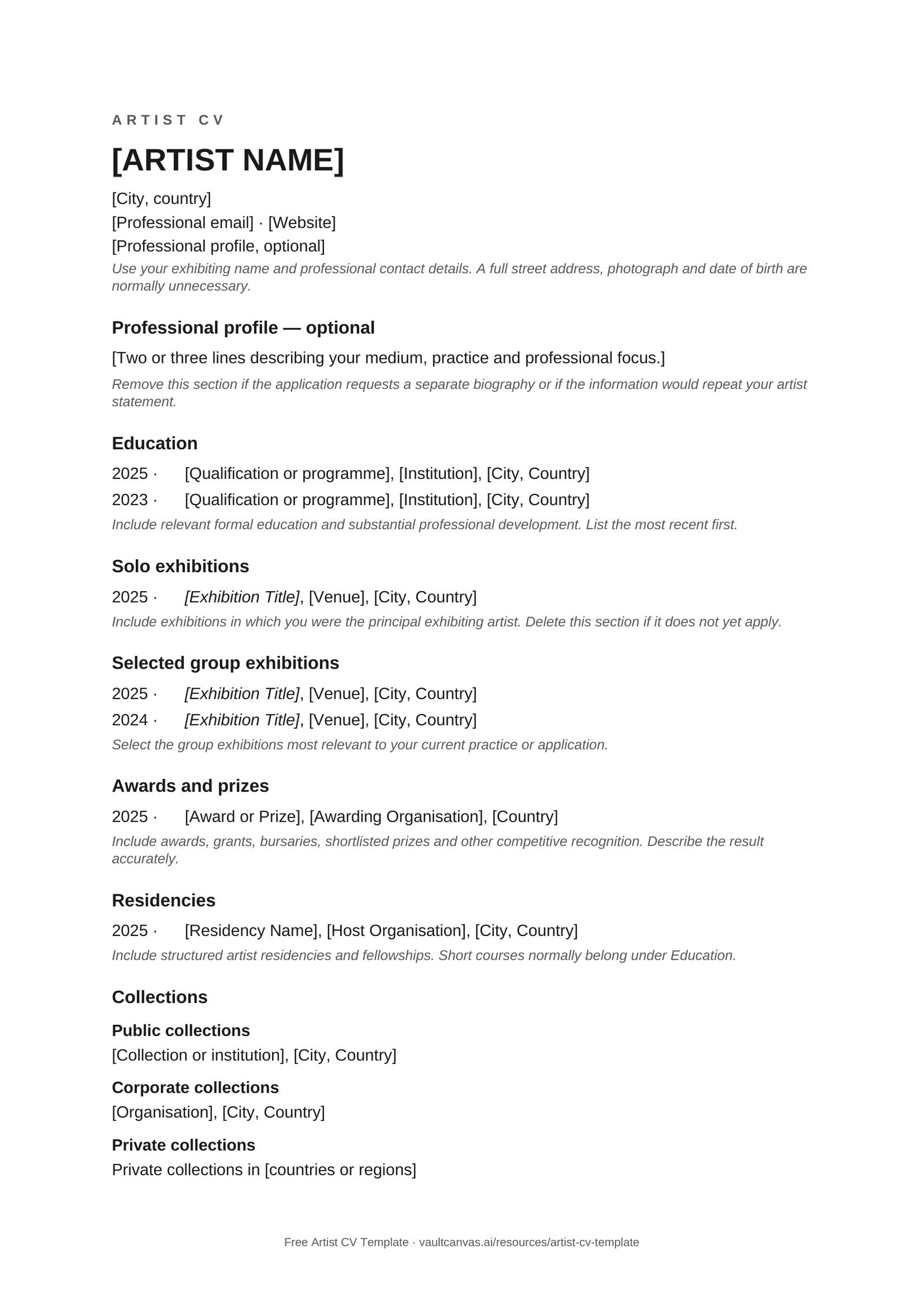
Artist CV Template
Present your exhibitions, education, awards and professional experience in a clear format designed for practising visual artists.
No email required. Free to use and adapt.
Internationally suitable · A4 · Editable in Word, Pages and Google Docs
A professional structure without the guesswork
The template gives each part of your practice a clear place, with example formatting and short instructions you can delete as you complete it.
See what a completed artist CV looks like
The worked example follows the same structure as the editable template. It shows how a fictional mid-career painter might select, order and format professional information without overcrowding the document.
Mara Ellison is a fictional artist created solely to demonstrate the template. All exhibitions, awards, collections and publications in the example are fictional.
- Put the most recent activity first within each section.
- Separate solo and group exhibitions so the distinction is immediately clear.
- Select relevant professional experience rather than recording every event.
- Use one consistent format for dates, venues and locations.
- Keep descriptions brief; an artist CV is a record, not a biography.
How to build your artist CV
1. Start with your professional identity
Use the name under which you exhibit. Add your location, website and professional email address. A full postal address, portrait photograph, date of birth and personal social accounts are normally unnecessary.
2. Add a short profile only when it helps
A two- or three-line profile can establish your medium, subject and location. Leave it out if an application asks for a separate biography or artist statement.
3. List education and development clearly
Include relevant degrees, diplomas, residencies, masterclasses and sustained professional training. Do not pad the section with unrelated qualifications.
4. Separate solo and group exhibitions
A solo exhibition presents your work as the principal artist. Group exhibitions include work by multiple artists. List each category in reverse chronological order, with the year first.
5. Be selective
Your CV does not have to contain everything you have ever done. Prioritise exhibitions, awards, collections, publications and professional activity that support the opportunity you are pursuing.
6. Describe collections accurately
Name public and corporate collections where permitted. For private collections, use a general description such as “Private collections in the UK, Ireland and Germany” unless the collector has agreed to be named.
7. Keep formatting consistent
Use the same order for every entry: Year · Exhibition or item title, venue or publisher, city, country. Use italics consistently for exhibition and publication titles. Avoid decorative icons, rating bars, multiple columns and unnecessary colour.
8. Maintain a master version
Keep one complete CV as your private master record. For applications, make a shorter copy containing the most relevant information. Review the master document whenever you complete an exhibition, receive an award or gain significant coverage.
Artist CV questions
Learn how to write each section
The template provides the structure. Our Studio Journal guide explains what selectors, galleries and curators expect from an artist CV and how it differs from an artist biography.
Read: How to write an artist CV and biographyKeep the record behind your CV organised
A CV is easier to maintain when exhibitions, awards, collections and supporting documents are recorded as your practice develops. Vault Canvas helps artists keep those records together and turn documented activity into professional materials when needed.
Explore Vault Canvas