
How to Sell Artwork Online
A practical, platform-agnostic guide to selling original artwork online — covering presentation, documentation, provenance, certificates, pricing, listings, buyer trust, delivery and the preparation that determines whether a listing actually sells.
23 min read
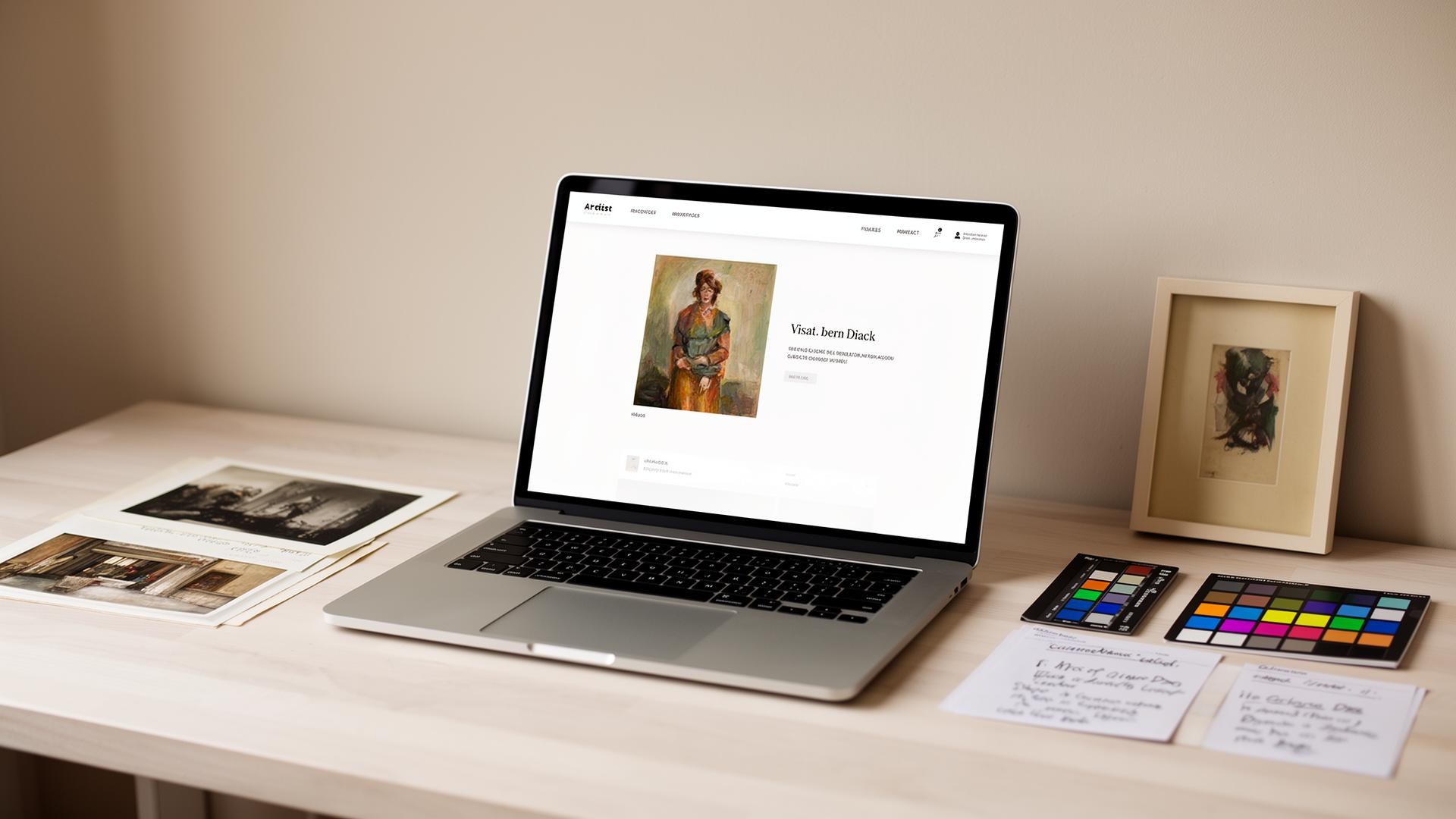
Selling artwork online gives artists more ways than ever to reach collectors, but successful online selling involves much more than uploading a photograph and adding a price. Whether you sell through your own website, an online gallery, an art marketplace or social media, buyers need enough information and confidence to purchase work they may never have seen in person.
If you want to sell paintings or other original artwork online, start by getting the fundamentals right: professional images, accurate dimensions, consistent pricing, a clear artwork description, delivery information and reliable records. You then need to decide where to sell your work and which channels best suit your practice.
For UK artists, that might mean selling directly through your own website, using selected UK or international art platforms, working with online galleries, or combining several channels. The right choice depends on whether your priority is control, reach, credibility, simplicity or access to an existing audience of buyers.
This guide explains how to sell artwork online step by step — from preparing and photographing your work to choosing where to sell, setting prices, writing listings, building buyer trust, handling payment and delivery, and maintaining provenance after the sale.
The aim is not simply to make an online sale. It is to build a professional, repeatable system that makes your artwork easier to discover, understand and buy.
Selling Art Online Starts Before You List the Work
Most artists treat listing as the start of the selling process. It is closer to the middle. By the time a piece appears on a website, the work that determines whether it sells has already happened: the photography, the dimensions, the materials, the price, the story, the inventory record, the certificate. A buyer who reaches the listing is not choosing between your painting and another painting. They are choosing whether to trust you with several hundred — or several thousand — pounds of their money, sight unseen, on the basis of pixels on a screen.
Everything in this guide is in service of that decision. A good listing is not persuasive copy or a clever discount. It is a small body of evidence that says: this work is real, this work is mine, this work is documented, and you can buy it from me without worrying. Artists who treat the listing as the finish line tend to sell sporadically. Treating the listing as the visible part of a wider professional process creates a more convincing buying experience. Accurate records, consistent presentation and clear documentation reduce uncertainty and give collectors more confidence in both the artwork and the artist behind it.
The practical implication is that the time spent before you list — photographing properly, writing accurate records, assigning inventory numbers, preparing certificates — is the time most likely to produce a sale. Listing work without that groundwork creates unnecessary barriers for buyers, particularly when important information is missing or inconsistent.
What You Need Before Selling Paintings Online
Before any artwork goes on a website, marketplace or social feed, the following should exist for every piece. None of it is optional if you want the sale to feel professional to the buyer.
Professional photographs
At minimum, every artwork needs a clean, evenly lit, colour-accurate photograph of the full piece, square to the camera, with no perspective distortion and no visible reflections. For framed work, photograph both the framed and unframed states. For unframed work, photograph the work flat, and again held or hung so the scale reads. Natural diffused daylight against a neutral wall is enough; you do not need a studio. What you do need is consistency — the same lighting and colour balance across every piece in your inventory. Mixed colour temperatures across listings make a collection look amateur even when the individual images are technically fine. For a fuller treatment, see How to Photograph Artwork.
Accurate dimensions
Record height × width × depth in centimetres and inches, unframed and framed. Get this right once and never re-measure. Inaccurate dimensions are one of the most common sources of post-sale disputes and refund requests, and a 2 cm error on a stated dimension is enough for a buyer to feel they have been misled.
Medium and materials
State the medium plainly: "Oil on linen", "Acrylic and graphite on birch panel", "Watercolour on Arches 300 gsm cold-pressed paper". Avoid romantic but vague language like "mixed media on board" when you can specify. Collectors who buy online cannot inspect the work, so the materials description is doing the work that a physical viewing would normally do.
Artwork story and context
Every work benefits from a short statement — three or four sentences — that places the piece in its series, names its concerns, and describes what is actually being looked at. This is not marketing copy. It is the small amount of context that lets a remote viewer read the work the way you intend. The story should be specific to the piece, not a generic artist statement copied across every listing. For practical guidance on the writing itself, see How to Write Artwork Descriptions That Help Sell Your Art.
Pricing
The price needs to be set before the work is photographed for sale, not negotiated at the point of enquiry. Online buyers expect to see a price; absent prices send most browsers away. Pricing should be coherent across your inventory and consistent with what a gallery would charge for similar work. For a longer treatment of how to arrive at the figure, see How to Price Your Art.
Inventory records
Every work needs a permanent inventory number, an archive reference, and a record that travels with it for the rest of its life — through the sale, through any later resale, through any future exhibition loan. Without this, you have no way to confirm that a work attributed to you decades from now is actually yours. The inventory record is the backbone of provenance; everything else in this guide sits on top of it. A purpose-built system makes this far easier than a spreadsheet — see Artwork Archive: How to Create a Digital Archive, Database and Record System for Your Artwork.
Where to Sell Art Online
There is no single right channel. Most artists who sell consistently online use a small combination — typically a primary destination (their own website or a representing gallery's site), supported by one or two visibility channels (social media, a portfolio platform, occasionally a marketplace). What follows is an honest summary of each, with no platform endorsements.
Where to Sell Art Online in the UK
For artists looking to sell art online in the UK, there is no single best platform. The strongest approach is usually a combination: your own artist website as the long-term home for your work, supported by selected online galleries or marketplaces and social media used to build visibility and relationships with collectors.
Your own website gives you the greatest control over presentation, pricing and the collector relationship, without paying sales commission to a third-party platform. The challenge is generating traffic. Online galleries and art marketplaces can put your work in front of an existing audience, but commission, exclusivity, pricing-parity rules and responsibility for shipping vary considerably. A carefully chosen platform that suits your work is generally more useful than listing the same paintings across multiple sites.
UK buyers should be able to see prices clearly in pounds, dimensions in centimetres, framing status, delivery costs and straightforward information about returns. For original artwork, buyers also benefit from knowing that the work is properly documented and will be supplied with appropriate provenance information and a certificate of authenticity.
The best place to sell paintings online therefore depends on what you need most: control, an existing audience, curatorial credibility or simplicity. The sections below compare the main routes and explain where each fits within a professional art practice.
Choosing the Right Place to Sell Your Art Online
Different online selling channels solve different problems. Rather than listing work everywhere, choose the route that best matches what you need from it.
Building your own brand and collector relationships Your own artist website gives you the greatest control over how your work is presented, priced and sold.
Reaching an established audience of art buyers A curated online gallery can introduce your work to collectors who are already actively looking for art.
Accessing a large marketplace audience An established art marketplace can provide greater reach, although fees, competition and presentation vary considerably between platforms.
Building visibility and direct relationships Social media can help collectors discover your work, but it works best when interested buyers can continue to your website or another professional place to view the artwork properly.
Testing demand before investing in a full website A carefully chosen marketplace or portfolio platform can provide a relatively simple way to begin presenting and selling work online.
No single option is best for every artist. Your own website provides the greatest control, while galleries and marketplaces can provide access to audiences you may not yet have. Many artists ultimately use a combination, with one central artwork record keeping titles, dimensions, prices, availability and provenance consistent wherever the work appears.
Selling Artwork Through Your Own Website
A website you control is the only channel that does not depend on someone else's policy, algorithm or commercial future. It carries no commission, hosts your full archive, and lets you present the work exactly as you intend. The trade-off is traffic: a new website has no audience, and you will need to drive collectors to it through every other channel you use. For most serious practices, a personal website is the long-term centre of gravity, even when sales close elsewhere.
Selling artwork from your own website rests on three foundations: a portfolio that presents the work properly, a checkout that buyers trust, and a quiet way of staying in touch with collectors who are not yet ready to buy. A professional portfolio is a prerequisite, not an upgrade — see How to Create a Professional Artist Portfolio and What Makes a Good Artist Website? for the underlying structure and design decisions. An artist website for selling art needs clear pricing, accurate availability, a single visible point of contact, and a checkout that handles cards without bouncing the buyer to a clumsy third party.
The quieter foundation is a small mailing list. Most online sales close to people who have followed the work for months — not strangers who arrived for the first time. A short, infrequent email when new work is ready is one of the most reliable sales tools an independent artist has. For the practical mechanics, see Email Marketing for Artists.
Selling Art on Marketplaces and Online Galleries
Marketplaces and online galleries are often grouped together, but they behave differently and reward different kinds of practice.
Online marketplaces
Marketplaces aggregate buyers and handle payments and discovery in exchange for commission, typically between 20% and 50% of the sale price. They work best for artists with a coherent, recognisable body of work and clear pricing. They work poorly for artists who treat them as a dumping ground for unsold pieces, because marketplace search algorithms penalise inconsistent inventory. Read each marketplace's exclusivity, pricing-parity and content-licensing terms before listing — they often constrain what you can do elsewhere. For the question of where to sell artwork online as a beginner, a single well-chosen marketplace alongside your own site is usually a better starting point than spreading work across four.
Online galleries
Online galleries operate on a consignment model similar to physical galleries: they curate, present, take a commission, and often handle shipping. Commissions are typically 30%–50%. The advantage over a marketplace is curation and trust — buyers expect a level of editorial standard. The disadvantage is that you are still subject to a gallery relationship, with all the contractual considerations that entails. For the underlying mechanics that apply equally to online galleries, see Gallery Consignment for Artists.
Artist Portfolio Platforms
Portfolio platforms host your work, sometimes with a built-in shop, and are commonly used by artists who do not want to run their own website. They are a reasonable middle ground, but most do not give you the same control over presentation, SEO and customer relationship that a website does. They are best treated as a supplementary public face rather than the centre of your online practice. Where they are useful, they are useful as an early-career staging post or as a parallel portfolio kept for institutional viewers.
How to Make Your Artwork Look Professional Online
Once you have decided where to list, the standard of presentation matters more than the channel. Every artwork should be supported by the same set of images and the same structure of information.
Primary image
The primary image should show the full work, square-on, against a clean background. This is the image collectors will see first and remember.
Detail shots
At least one close-up image showing brushwork, surface, edges or texture. This is the image that convinces a remote buyer the work is real, made by a person, and worth its price.
Framed views
If the work is framed or has a planned framing, show it framed. If the framing is in progress, say so plainly. Never imply a state of presentation the work does not currently have.
Installation views
A photograph of the work hung in a domestic or gallery setting, even a simple staged mock-up, helps buyers read scale. Scale is the single most underestimated factor in online buying decisions. A 40 × 50 cm painting and a 140 × 150 cm painting read identically on a phone screen; the installation view is what makes the difference legible.
Consistent information
Every listing should carry the same fields in the same order: title, year, medium, dimensions (unframed and framed), edition information if applicable, price, framing status, condition, provenance note, and a short description. Consistency across listings is itself a trust signal. Buyers notice when one listing has framed dimensions and the next does not, or when prices appear and disappear arbitrarily.
Pricing Artwork for Online Buyers
Online pricing follows the same principles as any other channel — based on size, medium, time invested, market position and sales history — but it carries one additional discipline: parity. The price a collector sees on your website should be the same price they see in a gallery, on a marketplace and in a private enquiry. Discrepancies between channels destroy trust faster than any other single mistake.
Keep pricing consistent wherever the work appears. Avoid undercutting a gallery by offering the same artwork for less through your own website, and do not charge online buyers more simply because the sale is direct. If you offer discounts or special pricing, use them carefully and consistently. Frequent discounting of original artwork can undermine confidence in your established prices and create uncertainty for previous buyers and gallery partners.
For a full treatment of how to set the original figure, see How to Price Your Art.
Writing Artwork Listings That Help Buyers Decide
A good listing is short, specific, and free of decoration. It opens with a single sentence that places the work — its series, its concern, its subject. It states the materials and dimensions clearly. It describes what the work is doing, not what the artist hopes the viewer will feel. It closes with a plain note on presentation: framed and ready to hang; supplied with certificate of authenticity; shipped from the studio with tracked, insured carriage.
Avoid: superlatives ("stunning", "breathtaking"), instructions to the viewer ("invites you to…"), generic atmosphere words used across every listing, and promotional language. Buyers spending real money respond to specificity, not enthusiasm. The listing should sound like a museum label written by the artist, not a marketing email.
A useful test: read the listing aloud. If it could equally describe four other paintings in your inventory, it is not specific enough. For a fuller method, see How to Write Artwork Descriptions That Help Sell Your Art.
Building Buyer Trust With Provenance and Certificates
Trust is what closes the sale online. The buyer cannot inspect the work, cannot meet the artist, and cannot rely on a gallery's reputation as a proxy. Everything that follows is what replaces that physical reassurance.
Provenance
Provenance is the documented history of ownership of a work, beginning with its creation by you. It is the single most important trust signal in the secondary market and an increasingly important one in the primary market. A first sale that starts with clean provenance — dated, archived, with a recorded buyer — protects the work's value for the rest of its life. For a full guide, see What Is Artwork Provenance?.
Artwork records
Every piece should have a permanent record in your archive containing: archive reference, title, year, medium, dimensions, photographs, exhibition history, sale history and current location. This record is yours; a copy of the relevant fields travels with the work to the buyer. The record outlasts websites, platforms and gallery relationships, and is the artist's primary defence against attribution disputes.
Certificates of authenticity
Every original work sold online should ship with a certificate of authenticity, signed by you, carrying the title, year, medium, dimensions, archive reference and a small reference image. The certificate is short and formal. It is not a marketing document. Done properly, it is the document that proves, decades from now, that the work is yours. For the practical mechanics, see Certificates of Authenticity for Original Artwork.
Consistent inventory numbers
Use a single, consistent inventory or archive numbering system across every piece, every channel, every certificate and every record. A buyer who can match the number on the certificate to the number on the listing to the number in your archive is a buyer who can verify the work. A buyer who cannot is a buyer who quietly walks away.
Ownership history
Once a work is sold, record the buyer's name and date in the artwork's record, with their consent for any future provenance use. This is not optional record-keeping — it is the first entry in the work's ownership history, and the absence of it is one of the most common reasons works lose provenance over time.
Handling Enquiries, Payments and Delivery
Enquiries should be answered the same day where possible, in plain language, without sales pressure. Most collectors are testing whether you respond like a professional. A short, accurate reply that confirms availability, price, framing status, shipping cost and timeline is enough.
Payments should be taken through a method that protects both sides. For website sales, use a reputable payment processor that handles card payments and basic fraud screening. For direct sales, bank transfer is acceptable for established collectors, but be cautious about overpayment scams and any request to refund a difference — these are nearly always fraudulent. Hold the work until funds have cleared.
Shipping original artwork requires care. Unframed works on paper may be shipped flat or, where appropriate, carefully rolled using archival protective materials. Paintings, stretched canvases and framed works require packaging suited to their size, surface, glazing and value. Stretched canvases and framed works need a fitted box with corner protection, glassine surface protection, and double-walled cardboard. For larger works, a fine art shipper is worth the cost. Consider appropriate transit insurance, particularly for higher-value work shipments for the full sale value, use a tracked service, and require a signature on delivery. Include the certificate of authenticity, a delivery note with the inventory number, and a short care card.
After delivery, confirm that the artwork has arrived safely and give the buyer clear information about returns, damage in transit and how to contact you if there is a problem. If you sell directly through your own website, make sure your terms and returns policy comply with the consumer laws that apply to your location and your buyer. Clear policies reduce uncertainty before purchase and help both artist and collector understand what happens if something goes wrong.
Common Mistakes When Selling Art Online
A short list of the recurring mistakes that prevent online sales:
- No price on the listing. Hidden prices send most browsers away within seconds.
- Inconsistent photography across the inventory — different colour temperatures, different backgrounds, mixed crops. The inventory looks unprofessional even when the work is excellent.
- Inaccurate or missing dimensions. A 2 cm error is enough to trigger a refund request.
- Vague materials descriptions. "Mixed media" tells the buyer nothing.
- Promotional language in place of specificity. "Stunning" is not a description.
- No certificate of authenticity. Sends a quiet signal that the artist is not yet operating professionally.
- No inventory record. The work has no provenance starting point, and its long-term value is reduced.
- Channel price discrepancies. Different prices on website, marketplace and gallery. Trust is gone the moment the buyer notices.
- Discounting original work. Devalues every prior sale.
- Slow or evasive enquiry replies. Collectors test this. A 48-hour silence is usually a lost sale.
- Shipping without tracking or insurance. One damaged delivery without recourse is enough to end an online practice.
- No record of who bought the work. The first entry in the work's provenance is missing forever.
How Vault Canvas Helps Artists Sell Artwork Online
Selling original art online works better when the practical scaffolding around each piece is already in place. Vault Canvas is built around that scaffolding rather than around the sale itself.
Each artwork has one record that holds its archive reference, title, year, medium, dimensions, photographs, description, price, framing status, provenance notes and current location — the same fields a serious listing or certificate will need. From that record you can issue a signed certificate of authenticity, save buyer enquiries and sale records, and keep a clean ownership history without copying information between spreadsheets, photo folders and email threads. When a piece sells through your own website, an online gallery, a marketplace or a direct message, the documentation that goes to the buyer is consistent with the documentation that stays in your archive.
The aim is simple: when a collector lands on a listing, every supporting detail they might quietly check — dimensions, materials, framing, provenance, the certificate that will arrive with the work — is already accurate and ready. The artist spends the time on the work and the relationship, not on reassembling records for each sale.
Checklist for Selling Artwork Online
For every artwork before it goes online:
- Archive reference assigned and recorded in your inventory system
- Professional photographs: full work, detail, framed (if applicable), installation view
- Dimensions recorded in cm and inches, framed and unframed
- Medium and materials stated specifically
- Short, work-specific description written
- Price set and consistent across channels
- Framing status accurately described
- Certificate of authenticity prepared, signed and ready to ship
- Inventory record updated with current status and location
- Shipping method, packaging and insurance confirmed
- Returns and care information ready to include with the work
- Post-sale process in place to record buyer and date in the work's record
When all twelve are in place, the listing is ready. Until they are, the listing is unfinished.
Frequently Asked Questions About Selling Art Online
Building a Sustainable Online Sales Practice
Selling artwork online is not a one-off event but a quiet, repeatable discipline. The artists who sell consistently are the artists whose archive, photography, pricing and paperwork are in order before any single piece needs to go up. New work is photographed in the same session it dries; dimensions, materials and an archive reference are recorded the same week; the certificate template is filled out and signed before the listing goes live. When the process is consistent, listing becomes a five-minute job rather than a half-day scramble, and the next sale is never blocked by missing documentation.
The collectors who buy once and never return are usually the collectors who experienced a small inconsistency — a price that quietly changed, a shipment that arrived without a certificate, an enquiry that took four days to answer. The collectors who buy again, and recommend the work to others, are the collectors whose first purchase felt indistinguishable from buying from an established gallery. That standard is achievable from a one-person studio. It is almost entirely a function of the preparation described in this guide, applied to every piece, every time.
Treat the online practice the way you would treat a long exhibition that never ends. Hang it carefully. Keep it tidy. Document everything. The sales follow.