
How Certificates of Authenticity Work for Original Artwork
What a Certificate of Authenticity is, what it should include, who should issue one, and how it shapes an artwork's value, provenance and resale. With a worked example.
14 min read
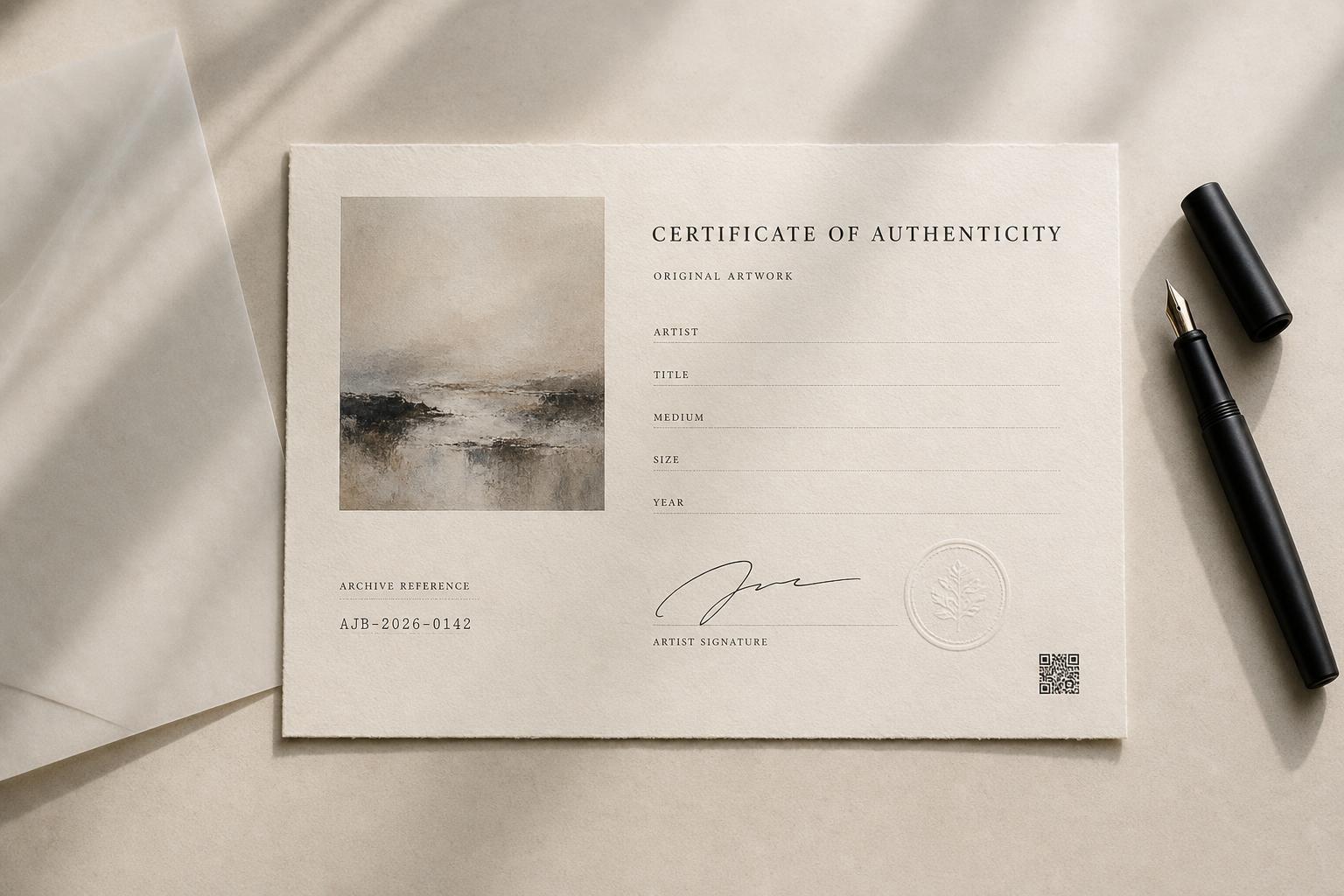
A Certificate of Authenticity for artwork is a signed document that identifies an original work and confirms who created it. For artists, it provides a clear record to give to the buyer; for collectors and galleries, it helps connect the physical artwork with the artist's records and its developing provenance.
A good Certificate of Authenticity should identify the artwork precisely, include the information needed to distinguish it from other works, and remain with it when ownership changes. Used consistently, certificates become an important part of an artist's professional documentation rather than simply another piece of paperwork.
This guide explains what a Certificate of Authenticity is, what it should include, who should issue one and how to create one properly. It includes a completed example, a reusable Certificate of Authenticity template for artists, and explains how a certificate can be generated directly from a digital artwork record.
What Is a Certificate of Authenticity?
A Certificate of Authenticity — often shortened to CoA — is a signed document issued by the maker, or their authorised representative, confirming that a specific artwork is genuine and identifying it precisely. It names the artist, the title, the year, the medium, the dimensions and a unique reference number. It is signed by hand and dated.
A CoA is not the same as a receipt and not the same as a provenance record. A sales invoice records that money changed hands. A provenance record traces the work's full history — every exhibition, every owner, every condition report. A Certificate of Authenticity sits between the two: it is the artist's statement, in writing, that this object is the work it claims to be.
Originals, limited editions and open editions
For unique works such as paintings and drawings, the CoA covers a single object. For editioned work it covers a specific impression: a limited edition CoA names the edition size and the impression number (for example, 7/25). For an open edition or a giclée print sold without a fixed edition size, the CoA should say so clearly — buyers are entitled to know that more impressions may exist.
Why Certificates of Authenticity Matter
A CoA matters because it answers, on paper, the first question any future owner will ask: is this what the seller says it is?
For collectors, the certificate is the easiest single document to check. It confirms the work's identity, ties it to the artist, and gives a reference number that can be cross-checked against the artist's records.
For artists, issuing a CoA is part of running a professional practice. It supports your copyright position, makes it harder for someone to misattribute or fake your work, and gives buyers something they can hand on with confidence. For galleries, the certificate underpins resale — a work with a clean CoA is easier to consign, price and insure than one without.
What Information Should a Certificate of Authenticity Include?
A CoA does not need to be long, but it does need to be complete. There are three layers: what must be there, what should be there, and what strengthens the document further.
Required fields
- Full name of the artist.
- Title of the work, exactly as it appears in the artist's records.
- Year of completion.
- Medium and support (for example, "oil on linen").
- Dimensions in centimetres or inches (height × width, plus depth for three-dimensional work).
- Edition status — unique work, limited edition with impression number, or open edition.
- A unique catalogue number or CoA reference.
- A short statement of authenticity in the artist's own words.
- Handwritten signature of the artist.
- Date of issue.
- Name and contact details of the issuing party.
Recommended fields
- A thumbnail or small image of the work.
- The name of the first owner and the date of sale, if different from the date of issue.
- A brief materials note (for example, "lightfast pigments on Belgian linen, oil-primed").
Optional strengthening fields
- An embossed seal, holographic mark or watermark.
- A QR code or reference linking back to the artist's records or artwork inventory.
- A reference to the artist's wider artwork documentation.
The more an artist can lock the certificate to their own records, the harder it is to copy and the more useful it becomes years later.
Should a Certificate of Authenticity Include an Image of the Artwork?
Yes — wherever practical, include a small image. A thumbnail makes the certificate self-verifying: anyone holding it can compare the picture on the document to the painting on the wall. It does not need to be large; a clear thumbnail at roughly 5–8 cm is enough to confirm composition, colour and signature placement.
Where possible include a second, smaller image of the verso or of a distinctive detail; for sculpture, two angles are better than one. The aim is to make it harder to attach the certificate to a different object later.
Example Certificate of Authenticity
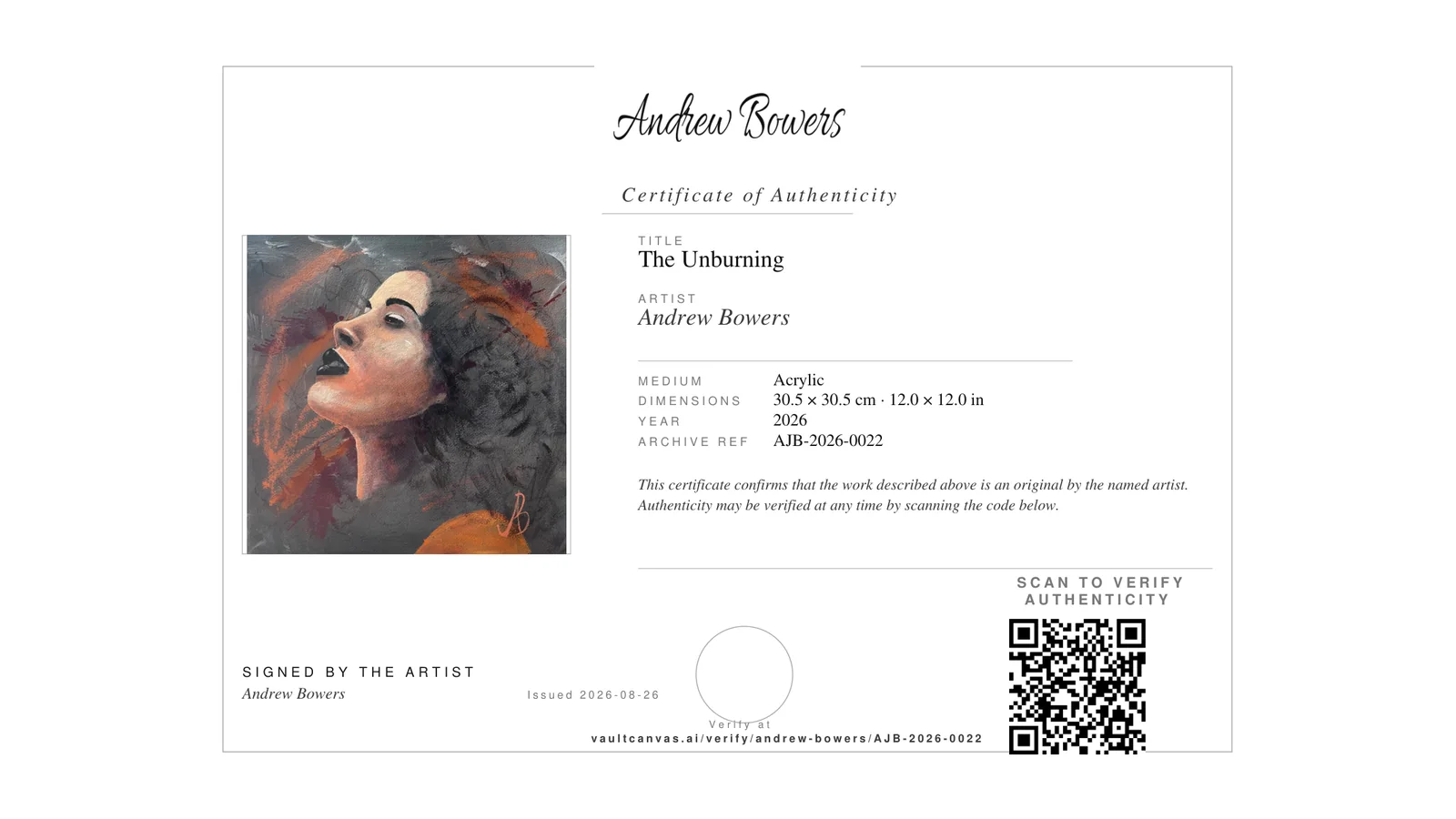
The specimen below shows what a completed Certificate of Authenticity can look like for a hypothetical painting. A reusable certificate of authenticity template follows the example.
Why each field matters
- Artist — names the person legally responsible for the work and, in most jurisdictions, the copyright holder.
- Title — must match the title on the artist's records and the sales invoice exactly. Mismatched titles are a common source of later dispute.
- Medium — tells conservators what they are dealing with and prevents confusion between, say, oil and acrylic on the same support.
- Dimensions — distinguish the work from any similar piece and are essential for shipping, framing and exhibition planning.
- Catalogue number — the artist's own unique reference, linking the certificate to the studio's records.
- Edition status — makes clear whether the buyer is acquiring a unique work, a numbered impression or an open edition.
- Statement of authenticity — the artist's plain-English confirmation in their own voice; this is what makes the document a certificate rather than a label.
- Signature — must be handwritten. A printed or scanned signature carries almost no weight.
- Issuing party — identifies who stands behind the document; without this, the certificate is anonymous.
Certificate of Authenticity Template for Artwork
Artists do not need to design a new Certificate of Authenticity from scratch for every work. Using a consistent certificate of authenticity template helps ensure that the same essential information is recorded each time and reduces the risk of leaving out details that may matter to a future buyer, gallery or collector.
The template below can be adapted for original paintings, drawings, sculpture and other unique artworks. For limited edition prints, include the edition size and individual impression number.
CERTIFICATE OF AUTHENTICITY
Artist: Full name of artist
Artwork title: Title of artwork
Year: Year completed
Medium and support: For example, acrylic on canvas, oil on linen or mixed media on panel
Dimensions: Height x width x depth where applicable
Edition status: Unique original, limited edition or open edition
Edition number and size (if applicable): For example, 7/25
Catalogue or artwork reference: Unique reference number
Statement of authenticity: I confirm that the artwork described above is an authentic work by my hand. The information recorded on this certificate corresponds with my studio records and this certificate should remain with the artwork as part of its permanent documentation.
Image of artwork: Insert a clear thumbnail photograph of the artwork
Artist's signature: Handwritten signature
Date of issue: Date
Issued by: Artist or studio name and contact details
Certificate reference: Unique CoA reference
How to Use This Certificate of Authenticity Template
Complete the certificate when the artwork is first sold or transferred and make sure the title, dimensions, medium and reference number match your artwork inventory and sales documentation. Sign the finished certificate by hand and give the original to the buyer.
Keep a copy with your own artwork records. If the work is subsequently resold, the certificate should remain with the artwork alongside invoices, exhibition records, condition reports and other documents that contribute to its provenance.
For a limited edition, the certificate should identify both the total edition size and the number of the individual impression. For example, a print numbered 7/25 should have the same number recorded on its Certificate of Authenticity.
Generate a Certificate of Authenticity from Your Artwork Record
A certificate template works well when you are creating documents manually. Another approach is to create the Certificate of Authenticity directly from the artwork's permanent record.
With Vault Canvas, the artist first creates an artwork record and enters the information that identifies the work, such as its title, artist, medium, dimensions, year, image and archive reference. Once that information is recorded, Vault Canvas can produce a professional Certificate of Authenticity from those details, without the artist having to re-enter the same information into a separate document.
The certificate can be previewed at A4 or A5 before anything is saved, and generated and saved at either size whenever it is needed. Only the latest saved certificate is retained for an artwork, and it can be regenerated and replaced freely as the record changes. Three printed areas are independently optional: a fingerprint area, a seal area, and the artist's uploaded signature image. The uploaded signature is off by default; the handwritten signature line is always printed, so the finished document is signed by hand.
The certificate draws on the current artwork and artist details held in the record, and its QR code links to the artwork's public details page where one is available. A single signed scan of the finished certificate can optionally be kept privately alongside the record, and viewed, replaced or removed at any time.
Vault Canvas produces the document from the artist's own records; it does not independently authenticate the artwork. That distinction matters, and is covered in Authenticating Artwork: A Practical Guide for Artists, Buyers and Collectors. The certificate can then be downloaded and supplied with the artwork when it is sold or transferred, and because it is generated from the artwork record it forms part of the same documentation system rather than existing as an unrelated file.
Create the Record Once, Use It Again
The same principle extends beyond Certificates of Authenticity. Information held in the artwork record can be reused to create exhibition materials such as entry labels, hanging labels, room cards, exhibition signage and QR assets.
This reduces repeated data entry and helps keep titles, dimensions, reference numbers and other artwork information consistent across the documents associated with the work.
How Certificates of Authenticity Relate to Provenance
A Certificate of Authenticity is the first piece of an artwork's provenance, not the whole of it. The CoA confirms that the work is genuine at the point it leaves the artist. Provenance is the longer record that grows around the work afterwards — the chain of ownership, the exhibition history, the condition reports, the photographs on file.
The two work together. A CoA without provenance proves origin but says nothing about what has happened since. A provenance record without a CoA is missing its foundation. For a fuller view of how the record fits together, see What Is Artwork Provenance? A Practical Guide for Artists, Collectors and Galleries.
Who Should Issue a Certificate of Authenticity?
The short answer is: the person best placed to vouch for the work.
For a living artist, that is almost always the artist themselves. A CoA signed by the maker carries more weight than one signed by anyone else, and should be issued at — or close to — the point of first sale.
When the artist is no longer living, the role passes to the estate or foundation set up to manage the artist's catalogue. Estates often work with archivists and scholars to confirm authorship before issuing certificates for older works.
For prints and editioned work, the publisher or the gallery that produced the edition typically signs alongside the artist. A gallery may also issue a CoA on behalf of an artist they represent, provided the artist has authorised it. For historical or disputed work, a third-party authenticator — a specialist scholar or recognised committee — may be needed; the artist or estate then issues the certificate on the back of that opinion.
In every case the test is the same: is the issuing party qualified to make the statement, and are they identified on the document?
Do Artists Need a Certificate of Authenticity?
For practical purposes, yes. There is no law in most jurisdictions that requires a CoA, but the secondary market, insurers and serious collectors expect one. Selling an original work without a certificate is technically possible; doing so repeatedly erodes the credibility of your catalogue.
There are a few situations where a CoA is essential rather than just useful:
- The work is being sold through a gallery, dealer or online marketplace.
- The work is part of a limited edition.
- The buyer is acquiring the work as an investment as well as an object.
- The work may be shown publicly or lent to an institution in future.
For very small, informal sales — a study sold directly from the studio to a friend — a clear signed invoice plus a catalogue entry in your artwork inventory may be enough in the moment. Even then, issuing a CoA later is almost always worth the few minutes it takes. For the wider context of online sales, see selling artwork online.
Common Certificate of Authenticity Mistakes
Most problems with certificates are not dramatic forgeries; they are small omissions that make the document harder to rely on later. The most common mistakes are:
- Missing dimensions. Without measurements, the certificate cannot be tied to a specific physical object.
- Missing catalogue number. No reference number means no link back to the artist's records.
- Missing edition information. Buyers cannot tell whether the work is unique, numbered or open-edition.
- Photocopied or digital signatures. A signature should be handwritten on the original document; scanned or printed signatures undermine the whole point.
- Inconsistent titles across artwork, invoice and CoA. A title that differs from the sales invoice creates doubt years later.
- No link back to artist records. A certificate that cannot be cross-checked against the artist's own catalogue is weaker than one that can.
- Losing the artist's own copy. Always retain a signed duplicate; if the buyer's copy is lost, you can re-issue from your records.
- Laminating the original certificate. Lamination is irreversible, damages the paper over time and makes future verification harder. Use a sleeve, not a laminator.
None of these are difficult to avoid. They simply require a consistent template and the discipline to use it for every work.
How Certificates of Authenticity Affect Value and Resale
Two near-identical works can sell at very different prices on the strength of their paperwork. The reasons are practical.
At primary sale, a clean CoA rarely adds a premium on its own, but it removes the discount a cautious buyer would otherwise apply.
At resale, the difference is sharper. A work with a complete certificate and a clear chain of ownership can be consigned to a gallery or auction house with little friction. A work without one will face questions about attribution, may need a third-party authentication report (paid for by the seller), and will often sell at a noticeable discount.
If a certificate is lost, the work is not necessarily ruined — but the seller carries the burden of rebuilding the record. A living artist can re-issue from their own copy; an estate may charge for a replacement. Where neither is reachable, the work may be unsellable at its previous level until an authentication can be obtained.
A small piece of paper, issued correctly at the start, removes a great deal of work and discount later on.
Frequently Asked Questions
Continue Reading
Read What Is Artwork Provenance? A Practical Guide for Artists, Collectors and Galleries — the wider record a CoA sits inside. For the underlying system that holds every certificate, image and ownership record together, see Artwork Archive: How to Build a Digital Record System. For the systems that make these documents possible, see artwork documentation and artwork cataloguing. The ::pillar{slug="archive-documentation"} hub collects every related guide.
For related reading in this Studio Journal, see Limited Edition Prints and Copyright for Artists.