
What Is Artwork Provenance? A Practical Guide
What artwork provenance is, what a provenance record contains, how artists build it from the studio and how collectors verify it before they buy.
18 min read
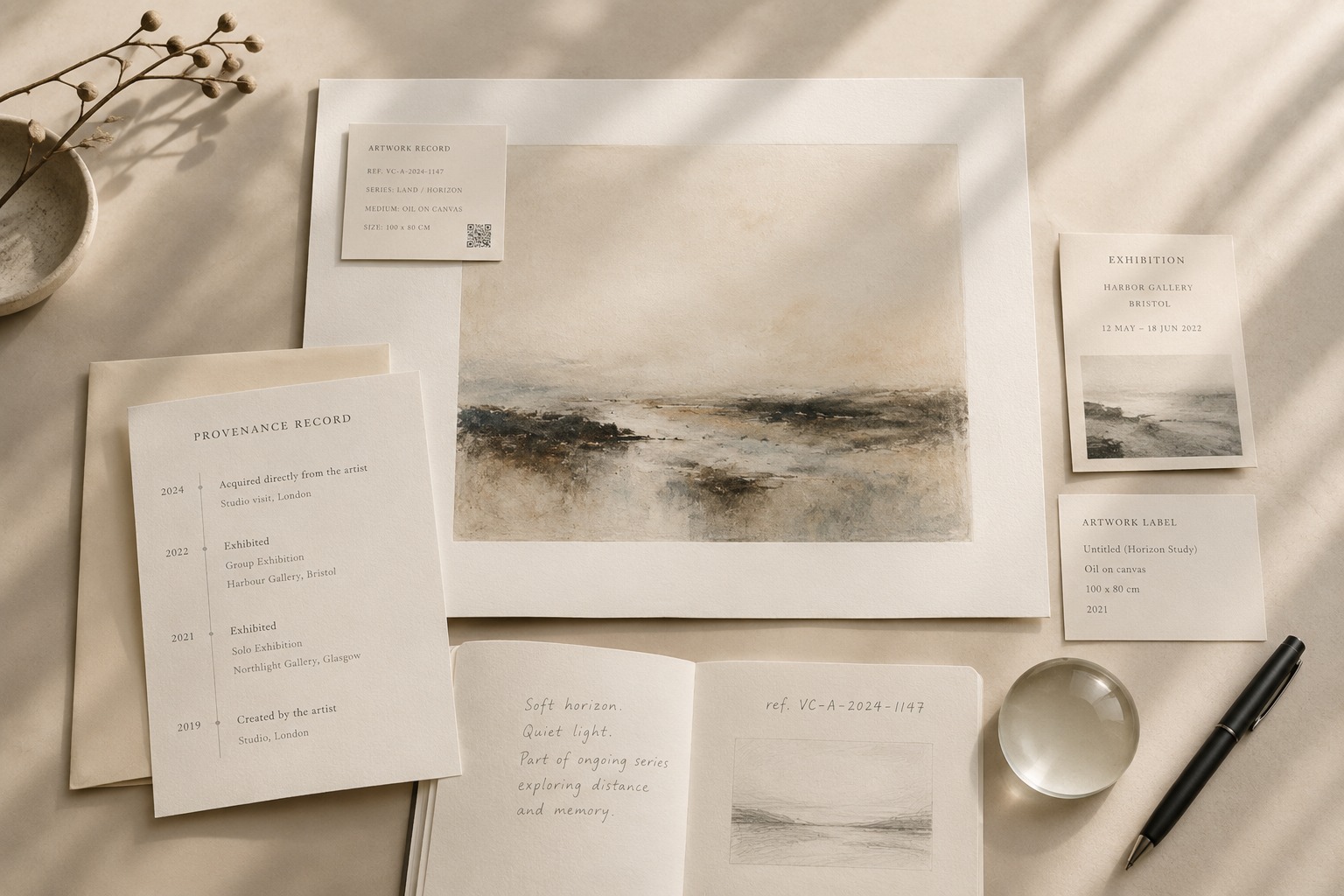
Artwork provenance is the documented history of an artwork — who made it, who has owned it, where it has been shown, and how it has been looked after. For artists it is part of professional practice. For collectors and galleries it is the foundation of trust, value and resale.
This guide explains what provenance is, why it matters, what counts as provenance evidence, how artists build provenance records from the studio, how collectors should keep those records after purchase, and how strong artwork archive records support insurance, exhibitions, resale and long-term legacy planning.
What Is Artwork Provenance?
Artwork provenance is the verifiable record of an artwork's origin and ownership over time. It links the work back to the artist who made it and forward through every collector, gallery and exhibition that has handled it since. In plain English: provenance is the artwork's history, written down in a way that a future buyer, insurer, curator or court can verify.
A complete provenance record usually combines several documents: a Certificate of Authenticity, a sales invoice, an exhibition history, photographs, and any condition reports produced along the way. Together they form a continuous, traceable history — what the trade calls a chain of ownership.
Provenance is not marketing. It is paperwork. The quality of that paperwork — how complete it is, how consistent it is, how easy it is to verify — is what gives a work credibility in the long term. Strong art provenance records turn an artwork from "interesting object" into "documented asset". Weak records do the opposite, even when the work itself is excellent.
It is worth being precise about three closely related terms. Artwork history is the broad story of a piece — its making, its showings, its travels. Artwork ownership history is the narrower chain of who has held legal title. Art provenance records are the documents that prove both. The three overlap, but a provenance record is specifically the evidence, not the story.
Why Provenance Matters
Provenance matters because it answers the three questions every serious buyer eventually asks: Is this work genuine? Who has owned it? Is it in the condition the seller claims? Without a documented answer to each, an artwork is harder to sell, harder to insure, and harder to value.
For artists, provenance protects the integrity of your catalogue. Works leave the studio and may not return for decades; a clear record means a piece can always be traced back to you, even by someone who never met you. It also makes life simpler for galleries representing you, for auction houses considering your work in the future, and for collectors who want to lend a piece to an exhibition.
For collectors, provenance is risk management. A painting without a credible history is a painting that could be misattributed, restored without disclosure, or stolen. A well-documented work is one a future buyer, insurer or institution can verify independently. Good art collector records also make estate planning, gifting and lending simpler, because the documents needed for each are already on file.
For galleries and estates, provenance underpins everything from pricing to consignment to resale. It is the connective tissue between the artist's studio and the secondary market, and the practical basis for trust.
Artwork Provenance vs Certificate of Authenticity
Provenance and a certificate of authenticity are often spoken about as if they were the same thing. They are not. A certificate of authenticity for artwork is one document inside a wider provenance record.
A Certificate of Authenticity (CoA) is issued by the artist or the artist's estate. It states that a specific work is genuine, identifies the work in detail (title, year, medium, dimensions, edition, catalogue number), and is signed by the artist or an authorised representative. It is the single most important authentication document — but on its own it does not tell you who has owned the work since, where it has been shown, or what condition it is in today.
Provenance is the full file. It includes the CoA, the original sales invoice, every subsequent transfer of ownership, exhibition and publication history, condition reports and photographs. A CoA proves authorship; provenance proves history.
In practice the two work together. A CoA without provenance is a single point of evidence that is hard to corroborate. Provenance without a CoA leaves the most basic question — did the artist really make this? — unanswered. For more on the document itself, see How Certificates of Authenticity Work for Original Artwork.
What Counts as Provenance Evidence?
A working provenance record is usually a small bundle of documents and data rather than a single file. The exact contents vary by artist and work, but the core elements are:
- Artist and title — full name, work title, year of completion.
- Medium, support and dimensions — what the work is made of and how big it is.
- Edition information — for prints, sculptures or photographs, the edition size and the specific edition number.
- Catalogue or inventory number — a unique identifier issued by the artist (see catalogue number).
- Certificate of Authenticity — signed by the artist, confirming the work is genuine.
- Original sales invoice — the first transaction record from artist or gallery to first owner.
- Chain of ownership — every subsequent owner, with dates of acquisition where known.
- Exhibition history — where the work has been shown, with venue and dates.
- Publication history — any catalogue, monograph or press the work has appeared in.
- Condition reports — written assessments at key moments, especially before and after loans, shipping or sale.
- Photographs — high-quality images of the work, ideally including verso (back) and any signatures or labels.
- Shipping and import documents — relevant where the work has crossed borders, especially for insurance and resale.
These records sit inside the artist's wider artwork documentation and are organised through artwork cataloguing — the ongoing activity of recording and maintaining them in a structured artwork inventory.
Example of an artwork provenance record
Below is a hypothetical record for a single painting. It is not a template to copy line for line; it shows the shape of a complete entry.
Sample artwork: Low Water, Late Autumn (2023)
- Artist: Elena Marsh
- Title: Low Water, Late Autumn
- Year: 2023
- Medium: Oil on linen
- Dimensions: 80 × 60 cm
- Catalogue number: EM-2023-007
- Certificate of Authenticity: Issued by the artist, signed and dated 14 March 2023. Includes a thumbnail of the work and a unique CoA reference (EM-COA-2023-007).
- Sales invoice: Issued by Marsh Studio to Helena Park, 22 April 2023. Includes title, year, medium, dimensions, catalogue number, price paid and date of transfer.
- Chain of ownership:
- Elena Marsh (artist), 2023.
- Helena Park (private collector, London), 2023–2025.
- North Gate Gallery (consignment for resale), 2025–present.
- Exhibition history:
- Quiet Ground, North Gate Gallery, London, May–June 2024.
- Six Painters, Hereford Contemporary, October 2024.
- Condition reports: Initial report on completion (March 2023). Pre-loan report before Six Painters (September 2024). No restoration carried out.
- Photographs on file: Front, verso, signature detail, framed and unframed.
Each line above does specific work. The artist, title, year and catalogue number identify the piece unambiguously. The CoA confirms it is genuine and ties it to the artist's signature. The sales invoice is the legal record of first transfer. The chain of ownership lets a future buyer trace the work backward in an unbroken line. The exhibition history adds independent corroboration. The condition reports establish a baseline so that any later damage can be identified. The photographs make remote verification possible. Remove any one of these and the record weakens. Remove several, and the work starts to look uncertain.
How Artists Can Build Provenance Records From the Start
Provenance is much easier to maintain than to reconstruct. The work an artist does at the point of completion — before a piece ever leaves the studio — is what makes a strong record possible later. Artists who treat provenance as a by-product of normal practice rarely have to scramble; artists who leave it for later often find the gaps cannot be closed.
A practical studio workflow looks like this:
- Assign a catalogue number when the work is finished. Use a consistent scheme (initials, year, sequence) and never reuse a number.
- Photograph the work properly. Front, verso, signature, edges, any labels. Store originals in a digital archive you control.
- Record the metadata. Title, year, medium, support, dimensions, edition details, materials notes, location.
- Issue a Certificate of Authenticity for each unique work or edition, signed and dated.
- Write a baseline condition note. Even a few lines is enough — it gives any future condition report something to compare against.
- At point of sale, issue an invoice with the same title, year, medium, dimensions and catalogue number as the CoA. Keep a copy.
- Update the chain of ownership in your records when the work changes hands. Ask the gallery to share onward sales information where possible.
- Log exhibitions and loans as they happen, with venue, dates and condition notes on return.
- Keep a single source of truth. Resist the temptation to spread records across email, drives, spreadsheets and notebooks. One archive, one record per work.
Done consistently, this turns provenance into a by-product of normal practice rather than a separate task. For a wider view of how these records fit into a studio operation, see Artwork Management for Artists: A Complete Guide.
How Collectors Should Keep Provenance Records
For collectors, the work begins at the moment of purchase and continues for as long as the artwork is owned. The most common reason collector provenance is incomplete is not bad faith — it is that the documents existed at the point of sale and were simply not kept together.
A practical approach to keeping provenance records:
- Take delivery of the full document set. At minimum: Certificate of Authenticity, sales invoice, any condition report, and high-resolution images of the work front and verso. If anything is missing, ask for it in writing before completion.
- Store one master copy in a single archive. A dedicated folder per work — digital, and ideally backed up — with the same naming convention every time. Loose paperwork in drawers is how provenance gets lost.
- Keep originals safe. Signed CoAs and original invoices should be stored physically as well as scanned. Use acid-free folders or an archival box for important pieces.
- Update the record when anything happens. A loan to an exhibition, a re-frame, a conservation treatment, a change of address, a transfer to a family member: all of it belongs in the record, with dates.
- Maintain art resale documentation. Even if you have no plans to sell, the record you keep now is the record a future buyer or auction house will rely on. Gaps you allow today are gaps someone else will have to explain later.
- Plan for succession. Make sure at least one other person — partner, family member, executor — knows where the archive is kept and how it is organised. Provenance lost at probate is one of the most common ways otherwise valuable works lose value.
Good art collector records are not a luxury. They are how a collection retains its value and credibility across decades and owners.
Artwork History, Ownership and Resale Trust
Two near-identical works can sell at very different prices on the basis of provenance alone. The reasons are practical, not sentimental.
- Confidence reduces discount. A work with full documentation is easier to insure, easier to lend, and easier to resell. Buyers pay more for that ease.
- Exhibition history adds weight. A piece that has been shown and published carries independent corroboration that it matters.
- Notable previous ownership matters. A work owned by a respected collection or institution often commands a premium at resale.
- Gaps cost money. A missing CoA, an unclear ownership chain or no condition history will pull the price down even when the work itself is unchanged.
- Resale rights apply. In the UK and EU, some resales of work by living artists are subject to the Artist's Resale Right (ARR), which depends on having a verifiable history of authorship and ownership.
Beyond price, provenance is what makes the secondary market work at all. A buyer who can read a clean artwork ownership history is a buyer who can commit. A buyer who cannot will either walk away or insist on a discount that reflects the uncertainty. For more on how documentation feeds into pricing and cover, see Artwork Valuation and Insurance.
Resale trust is built quietly, over years, by routine record-keeping. There is no shortcut.
Common Provenance Problems
Most provenance problems are not dramatic forgeries. They are small, ordinary failures of record-keeping that accumulate over time. Knowing what they look like makes them easier to avoid — and easier to spot in a work you are considering buying.
- Missing documents. No CoA, no invoice, or a CoA that does not match the work in front of you. The most common single problem, and the hardest to fix retrospectively.
- Broken ownership chains. Gaps between owners with no explanation: "private collection, Europe" covering thirty years is a flag, not a fact.
- Unclear attribution. Works described as "attributed to", "circle of", "school of" or "after" require very different documentation from a fully attributed piece. Buyers should know which they are dealing with.
- Undisclosed restoration. Conservation work that is not recorded changes the condition and often the value of a piece. Restoration is not a problem; hidden restoration is.
- Unsupported claims. Exhibition or publication history that cannot be verified against a catalogue, press cutting or institution record. If a claim cannot be checked, treat it as decoration rather than evidence.
- Inconsistent details across documents. A CoA that lists 80 × 60 cm and an invoice that lists 80 × 70 cm is a small error that becomes a large problem on resale. Cross-check every document.
- Lost or unsigned CoAs. A CoA that has been replaced, reissued or never signed is much weaker than the original. Photograph and store the signed original.
- Records scattered across formats. Email, paper, spreadsheets, phone photos, gallery folders. Each piece may exist somewhere; collectively they are not a usable record.
A useful test: if the person responsible for the archive became unreachable tomorrow, could a stranger reconstruct the provenance of any given work from what is on file? If the answer is no, the record is not yet a record.
How to Prove Ownership of Artwork
Proving ownership of an artwork rests on the same documents that make up provenance, but the burden of proof is specific. To establish that you own a work — for insurance, resale, loan, gift, inheritance or dispute — you generally need:
- A signed Certificate of Authenticity that identifies the work in detail.
- The original sales invoice from the artist, gallery or previous owner, in your name, with the work clearly identified.
- Proof of payment, such as a bank transfer reference or card receipt, dated to the invoice.
- The chain of ownership showing how the work passed from artist to you, with dates.
- Photographs of the work in your possession, ideally including signature, verso and any labels.
- Any transfer or gift documentation if the work was inherited or received as a gift, including probate papers where relevant.
- Import and customs paperwork if the work was bought abroad.
For high-value pieces, an insurance valuation and an independent condition report add further weight. For inherited works, a clear paper trail from the original owner through to you is essential — a will or letter of wishes naming the piece, combined with the prior owner's records, is far stronger than recollection.
Where documents are missing, partial evidence still helps. Contemporary photographs of the work in your home, gallery correspondence, exhibition catalogues that name you as the lender, and statements from people who handled the original sale can all support a claim. But they are second-best to a complete file, and the time to assemble that file is before it is needed.
How Vault Canvas Helps Preserve Artwork Provenance
Provenance survives when records survive. Most of the problems above are problems of organisation rather than intention. Vault Canvas exists to make that organisation routine.
Each artwork in Vault Canvas has a single record that holds the things provenance depends on: images (front, verso, signature, framed, in-situ), the Certificate of Authenticity, the sales invoice, edition and catalogue information, exhibition history, condition notes, ownership transfers, sale records and any supporting documents. Records can be private to the artist or collector, shared with a buyer or estate, or surfaced publicly through a clean artwork page when that is appropriate.
For artists, this means the studio workflow described above — assigning a catalogue number, photographing the work, issuing a CoA, recording the sale, logging exhibitions — produces a provenance record as a by-product of normal practice. For collectors, it means the document set delivered at purchase has somewhere to live: a per-artwork archive that holds the CoA, invoice, condition reports and images together, alongside any later events such as loans, conservation or re-sale.
The system is deliberately conservative about what it makes public. Buyer details, invoices, prices, private notes and internal records stay private; public pages show only the artwork information the artist or collector chooses to share. For background on how the underlying archive is structured, see Artwork Archive Database: How to Build a Digital Archive Database.
The point is not the software. The point is that provenance is preserved by routine, and routine is easier when the tool fits the task.
Artwork Provenance Checklist
A short, practical checklist for artists and collectors. Most works do not need all of this on day one, but everything below should exist somewhere in the record before resale.
For each artwork, on file:
- Artist, title, year, medium, support, dimensions
- Edition details (where applicable)
- Unique catalogue or inventory number
- Signed Certificate of Authenticity (original and scan)
- Original sales invoice (artist or gallery to first owner)
- Proof of payment for the original sale
- Full chain of ownership with dates
- Exhibition history (venue, dates, role — solo, group, loan)
- Publication history (catalogue, monograph, press)
- Baseline condition report on completion or acquisition
- Condition reports before and after each loan, shipment or treatment
- High-resolution photographs: front, verso, signature, edges, labels, framed and unframed
- Conservation and restoration records, with practitioner details
- Insurance valuation and current cover note
- Shipping, customs and import paperwork where applicable
- Contact details for the artist or estate
- A clear note of where the originals are physically stored
- A named person who knows how to access the archive
If every artwork in a collection or catalogue can tick most of these, the provenance is in good shape. If most artworks cannot, the priority is not to chase perfection on one piece but to build a basic record for everything and then deepen it over time.