
Open Calls for Artists: How to Prepare a Strong Art Submission
A practical guide for artists on preparing strong open call submissions. Covers reading briefs, choosing artwork, preparing images, writing supporting materials and avoiding common mistakes.
19 min read
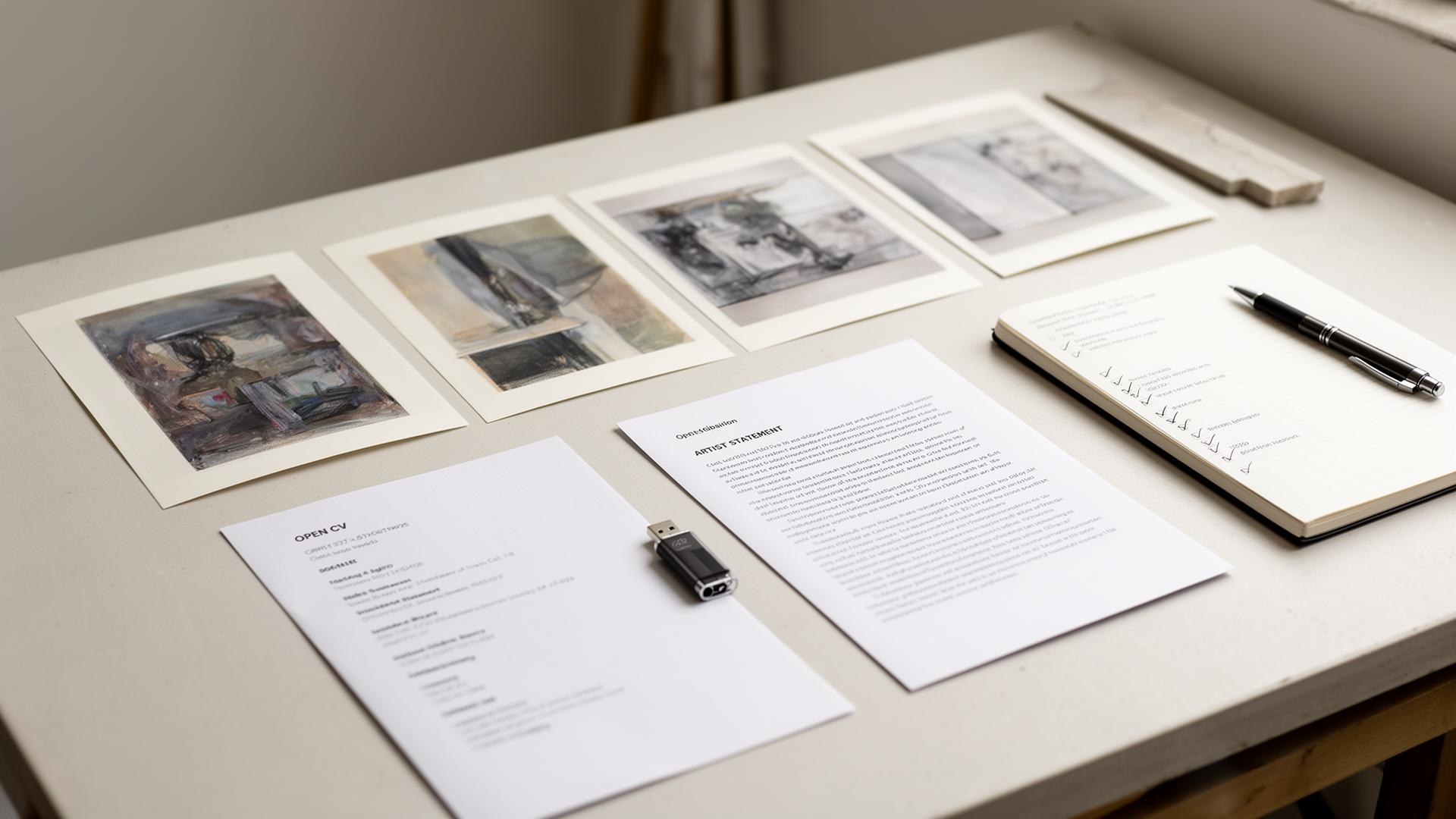
Open calls are a well-established route for artists to gain exhibition opportunities, prizes, residencies and gallery attention. A strong submission is rarely about the strongest artwork in isolation; it is about how clearly the work, the images, the statement and the supporting information align with what the open call is actually asking for. This guide is a practical, evergreen reference for artists preparing serious open call submissions, with particular attention to UK opportunities.
What Are Open Calls for Artists?
An open call is a public invitation from an organisation — a gallery, museum, prize, festival, residency, magazine or curated project — asking artists to submit work for consideration. Unlike a private invitation or a gallery's existing roster, an open call is theoretically accessible to any artist who meets the stated criteria. In practice, the format varies widely. Some open calls for artists are juried exhibitions with a single show as the outcome. Others are awards, publication features, residency placements, commissioning opportunities or themed group shows.
In the UK, open call art submissions appear regularly across institutions such as the Royal Academy Summer Exhibition, the New Contemporaries, the John Moores Painting Prize, the Royal Society of British Artists and a long tail of artist-led spaces, regional galleries and independent prizes. London hosts a particularly dense concentration of artist open calls each year, but strong opportunities run across Scotland, Wales, Northern Ireland and the English regions.
What unites them is a structured submission process. You will be asked for artwork images, written information about the work, biographical and CV material, and — increasingly — an entry fee. Selection is usually made by a jury or curator working from your submission alone. They are unlikely to see your studio, your full body of work or your wider context — for the purposes of that decision, the submitted material is what they have to go on.
Why Artists Apply to Open Calls
It is worth being clear about why open calls matter, because the answer shapes how much time and care a submission deserves.
For early-career artists, open calls are one of the few routes into curated exhibitions without an existing gallery relationship. A selection, even in a modest show, becomes a line on the CV, a verifiable third-party endorsement and often the first piece of public exposure for a body of work. For mid-career artists, open calls keep work circulating in front of curators, collectors and peers outside an established gallery context — a way to test new directions and build the slow accumulation of credibility that supports representation, residencies and grant applications.
For all artists, the discipline of preparing an artist submission is valuable in its own right. Writing about the work, selecting which pieces best represent a current direction, producing strong images and assembling a clean CV are skills that translate directly into gallery pitches, grant applications and direct collector approaches.
There are also realistic limits. Open calls are not a substitute for a long-term gallery relationship, a coherent practice or sustained collector development. A single selection rarely transforms a career. What an open call offers is opportunity, not outcome — and the value of that opportunity depends almost entirely on the quality of the submission.
Assess the Opportunity Before You Enter
Not every open call deserves an application. With entry fees common and preparation time significant, judgement matters as much as effort. Before you start, work through the practical questions.
Eligibility and theme. Check the eligibility criteria first — medium, stage of career, geography, age, membership requirements and any theme. A figurative oil painter does not belong in a digital-only photography prize. Read the brief carefully and look at previous selected work where it is published — not to predict the outcome, which always turns on the individual judges, but to judge whether the call is a sensible fit for the kind of work you make.
Selectors, venue and dates. What matters most is transparency and relevance: a call that names its selectors lets you see who they are, what they have worked on and whether the opportunity is relevant to your practice. Named selectors are not in themselves a mark of value, and unfamiliar names are not a mark against one — the useful question is whether you can make an informed judgement about fit. Check where and when the exhibition or outcome actually happens, and whether you could meet the practical commitments — delivery, installation, openings or talks — on those dates.
Fees, commission and the true cost. The entry fee is only part of what an application costs. Add the time to prepare it, photography if the work is not yet documented, framing or presentation requirements, transport or shipping to the venue, insurance in transit, and the commission the host will take on any sale. A modest fee can sit on top of several hundred pounds of real cost. A reasonable entry fee for a serious opportunity is normal — exhibitions cost money to mount — but weigh the whole cost against what selection would actually deliver.
Insurance and delivery responsibilities. Read who insures the work, and when responsibility passes from you to the organiser. Some calls insure work only while it hangs, leaving transit risk with the artist; some ask selected artists to deliver and collect at their own expense. These terms are part of the real cost of entering.
Credibility and warning signs. Credible opportunities name their selectors, state the venue and dates clearly, publish the terms in full and can point to documented previous editions. Warning signs include high entry fees for vague outcomes, a model that appears to depend on volume of entries rather than on the exhibition or prize itself, "awards" that publish very large numbers of winners each cycle, further fees demanded on selection, and pressure language designed to make you apply before thinking. None of these proves bad faith on its own — treat them as prompts to check the organiser's track record and terms more carefully before paying. Vanity exhibitions exist; treat any opportunity where the marketing outruns the substance with caution.
Rights over images and artwork. Keep three distinct things separate when reading the terms. First, the licence to reproduce your submitted images: most calls ask for a limited licence to use them in promoting the exhibition or prize, which is normal and reasonable — check that it is limited to that purpose, credited, non-exclusive and, ideally, time-limited, and be cautious of broad, perpetual or transferable licences. Second, copyright in the images and in the artwork, which should remain with you; terms that ask you to assign or transfer copyright, rather than grant a limited licence, deserve careful scrutiny. Third, ownership of the physical artwork, which is a separate matter again and should not change hands merely by entering — terms about sale or acquisition belong to the exhibition arrangements, not the submission. If the terms are unclear or feel excessive, ask the organiser before paying the fee and get the answer in writing. This is general information, not legal advice; where the terms are consequential, take advice from an appropriate professional body such as DACS or a-n.
The real outcome. Strip away the marketing language and ask what a selected artist concretely receives: a physical exhibition in a respected venue, prize money, acquisition, residency, curatorial introductions — or only inclusion in a long list or a screen-only "online showcase" of limited value. Look at past editions: where did the exhibition actually take place, how was it documented, and what happened to the artists afterwards?
A simple test: would selection actually change something — a CV line you would mention to a gallery, a venue you would be proud to exhibit in, an audience you cannot otherwise reach? If the honest answer is no, the call is probably not worth entering.
Choose Suitable Work
Choosing the work is the most consequential decision in an open call submission. A few principles:
Respond to the brief honestly. If the call is themed — a painting prize, a portrait prize, a landscape award, a particular medium — make sure the work genuinely fits. Selectors quickly tire of submissions that stretch the brief.
Submit the strongest work, not the newest. It is tempting to submit whatever just left the easel. Resist that. Submit work you would still defend in twelve months and that holds up against the strongest pieces in your back catalogue.
Be consistent without forcing a series. Where multiple works are allowed, choose pieces that read as part of one coherent practice — a jury looking at three images forms a view of the artist as much as the individual works. But do not manufacture an artificial series for the occasion, or exclude your strongest piece because it does not match a theme you imposed on yourself. Consistency of quality and sensibility matters more than surface uniformity.
Check dimensions, availability and readiness. Confirm the work fits within any size limits, that the venue could reasonably accommodate it, and that shipping would not be prohibitive. Confirm the work is finished, dry, photographable and — if selected — genuinely available for the full exhibition window.
Do not submit work already committed elsewhere. Some calls require unseen or unexhibited work; many require that a submitted work remains available for the full exhibition period. A work already promised to another exhibition, entered in another open call with overlapping dates, or on the verge of a sale can create an awkward withdrawal. Check your own records before you submit, not after.
Prepare the Submission
Submission requirements vary, but most open call art submissions ask for artwork images, work details, a statement, a biography, a CV, contact details and an entry fee, delivered through a form with per-field limits. The standard of each element matters.
Artwork details
Title, year, medium, dimensions (height × width × depth, in the units requested) and price should be accurate, complete and identical everywhere they appear — the submission form, the image filenames and your own records. State availability clearly where asked. For prints and photographs, include edition information. Mismatches read as carelessness even when the work is strong, and they create real problems later if the work is selected and the organiser's labels or catalogue reproduce the error.
Copy these details from your artwork records rather than retyping them from memory. If a price is requested, price the work properly before the deadline, not in the form's text box — the article on How to Price Your Art covers the principles.
Artwork images
Image quality is the dominant variable in most open call decisions. Jurors usually see your work on a screen, often briefly, often alongside hundreds of other submissions. A poorly photographed strong painting is, in that context, a weak submission.
The essentials:
- Photograph squarely in even, neutral light, with the camera level and parallel to the work, and crop tightly to the work itself.
- Colour-correct against the original. A red that reads orange on screen materially changes the work.
- Follow the organiser's specifications exactly — for digital submissions the essentials are pixel dimensions, colour space, file format and maximum file size. If the call asks for 3000 pixels on the long edge, sRGB JPEG under 5MB, deliver exactly that. Supply a specific DPI figure only where the organiser asks for one — DPI metadata on its own does not determine how a digital image displays on screen. Submissions are sometimes rejected administratively for file specifications alone.
- Name files clearly.
Surname_Title_Year.jpgis almost always safer thanIMG_4823.jpg. Where the call specifies a naming convention, follow it precisely. - Include detail shots where allowed, and for three-dimensional work provide more than one angle with a sense of scale.
It is worth treating documentation as part of the practice rather than a task for the week of a deadline: photograph each finished work properly once, store the master files at archive resolution, and keep a current export in the format most open calls expect. For a deeper walkthrough, see How to Photograph Artwork.
Artwork descriptions
Some calls ask for a short description of each submitted work — often 50 to 150 words. This is not a second artist statement. Describe the work plainly: what it depicts or does, the medium and handling, and one clear sentence on what it engages with. Write about that work, not the practice in general, and keep within the word count.
Statement, biography and CV — three different documents
These three are frequently confused, but each has a distinct role:
- The artist statement is about the work — what it is, how it is made, what it engages with. Where the call requests a statement about the submitted work specifically, write about those works. A statement that could describe any of your last ten paintings is rarely a strong one. Keep it within the requested length, avoid jargon, and read it aloud; if it sounds like a press release written by someone else, rewrite it.
- The biography is about you — third-person, usually 100–200 words, factual: where you trained, where you work, the broad terrain of the practice, two or three significant credentials. It is not an essay.
- The CV is the record — selected exhibitions, education, awards, residencies, publications and collections, in reverse chronological order, consistently formatted and honest. "Shortlisted" is not "Selected". Selective is stronger than exhaustive.
For fuller treatment of each, see How to Write an Artist Statement and Artist CV and Biography.
Portfolio links
Some calls ask for a link to a website or portfolio alongside the submitted images. Jurors may follow them. Make sure the link works, loads quickly and shows current, well-photographed work consistent with the submission — a juror who moves from three strong submitted images to a neglected or contradictory website will notice. The submitted works should be easy to find there, with details that match the form. See How to Create an Artist Portfolio for what a professional portfolio needs.
Check and Submit
Most avoidable failures happen in the final hour. A short discipline prevents them:
- Work from one master record. Keep a single, current record for each submitted work — title, year, medium, dimensions, price, edition, availability — and copy from it rather than retyping from memory or old emails. Whether that record lives in an archive system or a spreadsheet, the principle is the same: one source, copied faithfully.
- Follow the word counts and file rules exactly. Character limits, image counts, file formats, naming conventions and "no identifying information on images" rules are enforced, sometimes automatically. A submission that breaks them can be rejected before a juror sees it.
- Proofread the whole form. Names, dates, prices, dimensions, titles and contact details — read every field once more before paying. An old email address or a transposed digit in a price is a real problem, not a cosmetic one.
- Save the final submitted version. Keep a copy of everything you actually sent: the images as uploaded, the statement and description texts, the CV version, and the confirmation email or reference number with the date and fee paid. This is straightforward record-keeping: an accurate copy of exactly what was submitted, in your own hands, is the only reliable reference if anything is later questioned or needs to be reproduced.
Submit with time in hand. Applications rushed in the final hour show, particularly in the writing, and portal traffic near deadlines is a real hazard.
Track the Outcome
A working artist applying to open calls regularly needs a system. Memory is not a system. A minimum tracking record per open call:
- opportunity name, host organisation, type, venue and country
- entry fee and date paid
- submission deadline and notification date
- works submitted, with the image versions used
- statement, biography and CV versions submitted
- confirmation reference
- outcome — selected, shortlisted, declined, no response — and notes for next time
A simple spreadsheet is sufficient to start with. The point is to see, at any moment, what is outstanding, what has been decided and which works are currently committed to applications — essential when calls require unseen work or availability for a full exhibition window. Over a year or two, the record becomes genuinely useful information: which kinds of opportunities select your work, which jurors have responded, which fees were worth paying. That shapes the next round of applications. A short note to yourself after each outcome — "statement felt too general", "images B and C were stronger than A", "this curator favoured figurative work" — is worth more six months later than memory.
After acceptance
Selection is the beginning of a second job. Respond promptly, confirm the works, dates and terms in writing, and start preparing the work for the exhibition itself — condition checks, framing and hanging hardware, labels, paperwork, delivery and insurance. The companion article How to Prepare Artwork for an Exhibition walks through that process in detail. The free Exhibition Preparation Checklist covers the same stages in printable form. Record the exhibition properly when it happens: it becomes part of the work's exhibition history and contributes to its provenance evidence, as well as a line on your CV.
After rejection
Competitive open calls often receive many more eligible submissions than there are places, so not being selected is a normal part of applying, not a verdict on the work. Rejection does not prove the work is weak — it may mean the fit was wrong, the images undersold it, or simply that the jury's taste ran elsewhere this year. Where feedback is offered, read it carefully. Where it is not, look at the selected work and ask honestly whether the submission was a good fit and whether the images and writing were as strong as they could be. Record the outcome, note anything worth doing differently, and move on. The record of applications is worth keeping regardless of result — it is part of the professional history of the practice.
For UK artists, useful sources for finding open calls include the opportunities listings from a-n The Artists Information Company, CuratorSpace, ArtRabbit and the open call pages of relevant institutions, prizes and artist-led spaces directly. Arts Council England's own pages are a funding source rather than an open-call directory. Whatever the listing, always check the opportunity against the organiser's own published terms: presence on a third-party listing is not endorsement.
How Vault Canvas Helps Artists Prepare Better Submissions
Vault Canvas is an artist archive system built around the working reality of preparing submissions, exhibitions and gallery approaches. The principle is simple: keep the material an open call asks for — artwork images, dimensions, medium, dates, statements and CVs — organised in one place rather than scattered across folders, drives and inboxes. Everything in this article can be done on paper or in spreadsheets; a structured archive simply removes the friction that causes good artists to miss deadlines, submit the wrong image, or retype details that already exist elsewhere.
In practice:
- A structured artwork archive holds high-resolution images and accurate details for every work, so when a call asks for a 3000-pixel sRGB JPEG with a specific file name, the master image and the metadata it needs are already there to copy from.
- Reusable statements, biographies and CVs are maintained centrally, so the statement you sent to a prize last month is easy to find and tailor rather than rewritten from scratch.
- Exhibition and sales records make it straightforward to answer questions like "has this work been exhibited before?" or "is it currently committed elsewhere?" before you submit it somewhere new.
For a wider view, see How to Create an Artist Portfolio and How to Get Your Art Into a Gallery.
Open Call Submission Checklist
Assessing the opportunity
- Eligibility criteria and theme genuinely fit the work.
- Selectors, venue and dates are named and credible.
- Entry fee, framing, transport, insurance and commission costs weighed against the real outcome.
- Terms on image rights and artwork insurance read and acceptable.
- No warning signs of a vanity exhibition or fee-driven scheme.
Choosing the work
- Submitted works are the strongest available, not simply the newest.
- The group reads coherently without an artificially forced series.
- Dimensions fit the limits; works are finished, photographable and available for the full exhibition window.
- No submitted work is already committed to another exhibition or application.
Preparing the submission
- Every work's title, year, medium, dimensions, price and availability copied from the master record.
- Images are colour-accurate and meet the required format, resolution, file size and naming convention exactly.
- Artwork descriptions are specific to each work and within the word count.
- Statement, biography and CV each do their distinct job and are tailored to this call.
- Portfolio or website link works and matches the submitted details.
Checking and submitting
- Word counts, image counts and file rules followed exactly.
- Names, dates, prices, dimensions and contact details proofread.
- Final submitted versions of images, texts and CV saved, with confirmation reference and fee receipt.
Tracking the outcome
- Opportunity, deadline, fee, works and versions logged in your tracking record.
- Outcome recorded — selected, shortlisted, declined, no response — with notes for next time.
- If accepted: exhibition preparation started and the exhibition recorded in the work's history and your CV.
- If declined: outcome noted, feedback considered, record kept.