
How to Create a Professional Artist Portfolio
A practical guide to building a professional artist portfolio for galleries, collectors and open calls — structure, images, statement, CV and example.
15 min read
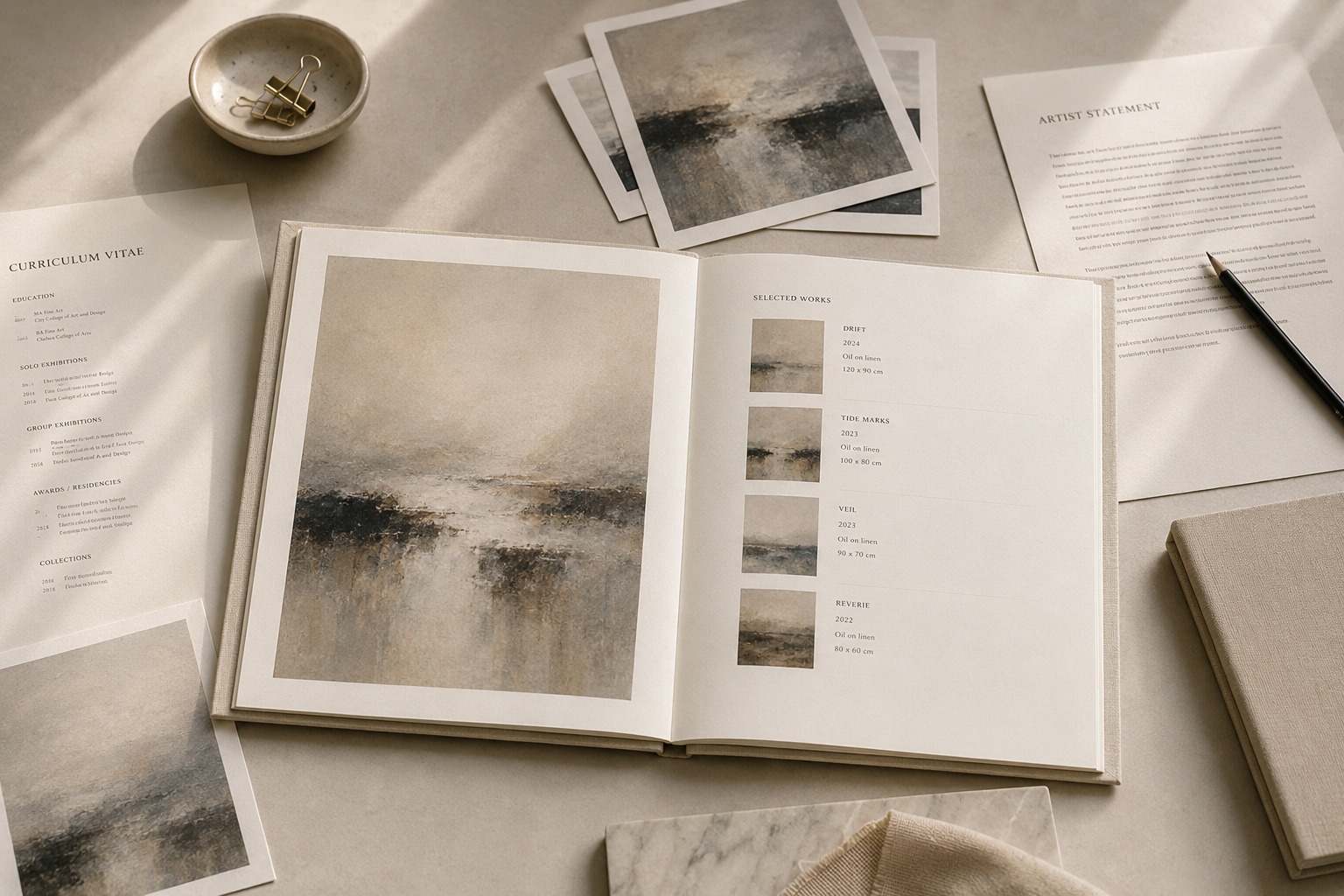
An artist portfolio is the document that decides whether a gallery opens a conversation, whether a collector follows up after a studio visit, and whether a selection panel shortlists you for an open call. It is not a scrapbook of everything you have ever made. It is a tightly edited, well-presented record of a serious practice — designed to be read in five to ten minutes by someone who is busy.
This guide explains how to build a professional artist portfolio that actually works in those rooms. It is written for practising artists at mid-career or beyond, not for students preparing a foundation or BA application. Where art school portfolios reward range and process, a professional art portfolio rewards focus, consistency and evidence of a coherent body of work.
What Is an Artist Portfolio?
A portfolio is a curated presentation of an artist's practice, usually combining images of recent work with a short written context — a biography, an artist statement, an exhibition history and contact details. It exists in two forms: a digital portfolio (a website or PDF) and, for some submissions, a physical folder or printed book.
The purpose of an artist portfolio is not to show everything you have done. It is to help a specific reader — a gallery director, a curator, a collector, an open-call jury — understand your work quickly and decide whether to take the next step. Every choice in the portfolio should be measured against that single test.
A portfolio is also different from a catalogue. A catalogue documents a particular exhibition or body of work in depth, often with essays and full-page plates. A portfolio is leaner, more recent, and more flexible: it is the working document an artist updates several times a year as new work is finished, shown or sold.
What is the difference between an artist portfolio and an artist catalogue?
A portfolio is a current, edited overview of your practice used to introduce yourself to galleries, collectors and selection panels. A catalogue is a fixed publication tied to a specific exhibition or series, usually with curatorial essays and reproductions. Most artists need a portfolio at all times; a catalogue is produced occasionally, for a specific show.
What Galleries Expect from a Portfolio
Galleries look at hundreds of portfolios a year. They are not reading every word. They are scanning for three things: a coherent body of work, evidence that the artist is professional to work with, and a fit with the gallery's programme. A portfolio that does not signal all three within the first two pages is unlikely to be read further.
Curatorial focus and cohesion
The strongest portfolios show a recognisable practice. That does not mean every painting must look identical — but a viewer should be able to see a consistent visual language, a clear set of concerns, and a sense that the work is developing rather than wandering. Mixing wildly different bodies of work in the same portfolio is the single most common reason serious galleries decline to engage. If your practice covers multiple distinct strands, build a separate portfolio for each, or lead with the strongest and place the others in a clearly labelled supporting section.
Presentation standards for physical portfolios
For galleries that still accept or request physical portfolios, presentation matters as much as content. Prints should be on a heavy, matte or lightly textured paper; binding should lie flat; the cover should be plain and durable. Loose prints in a folder are acceptable if they are uniform in size and well sleeved. Anything that feels improvised — inkjet prints on office paper, mismatched sizes, handwritten captions — undermines the work before the gallery has read a word.
What Collectors Expect from a Portfolio
Collectors read portfolios differently from galleries. They are usually looking at one or two artists at a time, often after a recommendation or a studio visit. They want enough information to feel confident about a possible purchase, and enough context to follow the artist's career over the years that come after it.
Provenance and documentation
Serious collectors expect to see that the artist runs a proper studio practice. That means clear documentation: each available work named, dated, sized and priced; a record of where works have been exhibited; and, where relevant, a note that a certificate of authenticity will be issued at sale. Strong documentation feeds into provenance, which is what protects the value of a work over decades.
Artist background and exhibition history
Collectors also want to understand the trajectory of the practice. A short artist biography and an honest exhibition history matter more than self-promotional language. Where you have shown, who has written about your work, and which collections hold it are all evidence of seriousness. Omit nothing significant, and inflate nothing minor.
Portfolio Websites vs. Physical Portfolios
Most professional artists now lead with a digital portfolio. An artist portfolio website is the single most-shared link in an artist's working life — sent in cold introductions, included in open-call applications, and forwarded between curators. A physical portfolio still has a place, but it is a supporting object rather than the primary one.
When a website is essential
A portfolio website is essential because it is searchable, updatable and shareable in a single click. The basic requirements are modest: a clean homepage, a clear navigation to current and past work, an about page with biography and statement, and a contact page. The site should load quickly on a phone, be free of pop-ups, autoplay sound and aggressive newsletter prompts, and let a viewer look at images at a reasonable size without friction. A custom domain, even a simple one, looks markedly more professional than a free subdomain.
When a physical portfolio still matters
A physical portfolio still matters in specific situations: in-person studio visits, gallery meetings where the work itself cannot travel, art-fair conversations, and some open calls that explicitly request printed material. A well-bound A4 or A3 portfolio with twelve to twenty plates, captioned and accompanied by a short statement and CV, is enough. Print on demand has made this easier than it used to be; a soft-cover photo book printed by a quality lab is acceptable and often preferred to a ring binder.
How to Choose Portfolio Images
Image selection is the most important editorial decision in any portfolio. A small number of strong, well-photographed works carries more weight than a long sequence of uneven ones.
Quality over quantity
Twelve to twenty images is the working range for a professional artist portfolio. Below twelve, the body of work looks thin. Above twenty, attention drops. Lead with your strongest work, not your most recent. Within the selection, sequence the images so that the viewer's first three and last three impressions are the strongest — these positions are remembered most clearly.
Image specifications and formatting
Each image should be a clean, square-on photograph of the work, with no perspective distortion, no frame glare, and accurate colour. Shoot in even daylight or with two soft, balanced lights; calibrate against a known reference if you can. For digital use, supply at least 2000 pixels on the long edge; for print, 300 dpi at the printed size. Caption every image with title, year, medium, dimensions and — where appropriate — price or status (available, sold, in a private collection).
How many images should be in an artist portfolio?
Twelve to twenty images for a general professional art portfolio. For a specific gallery submission or open call, follow the brief exactly — many will specify ten or twelve. Where the brief is silent, lean towards the lower end and curate harder. A tight selection of fifteen reads as confident; a sprawling selection of forty reads as undecided.
Writing the Artist Statement
An artist statement is a short piece of writing — usually 150 to 300 words — that explains what your practice is concerned with, in your own voice. It is not a manifesto, a theoretical essay or an autobiography. It is a clear, calm description of the work and the thinking behind it.
What to include
A good artist statement names the subject of the practice, the materials and methods used, and the broader concerns the work engages with. It is written in plain language, in the first person, and grounded in the actual work rather than abstract theory. It should make sense to an intelligent reader who knows nothing about contemporary art.
Common mistakes to avoid
Most weak statements share the same problems: art-school jargon, grand claims without evidence, vague references to "exploring" and "interrogating", and an over-reliance on philosophical name-dropping. Cut anything that could appear, unchanged, in another artist's statement. Keep what is specific to your work.
How long should an artist statement be?
Between 150 and 300 words for a general portfolio. A longer version — up to 600 words — is useful for grant applications and detailed open calls. Always have both ready, and never pad the short version to fill space.
Artist Biography and CV
A biography and a CV are different documents and should not be confused.
Biography vs. CV: what's the difference
A biography is a short prose paragraph — typically 80 to 150 words — written in the third person, summarising who you are and what you do. It belongs on your website, on press releases, and at the front of your portfolio. A CV is a structured list of credits: education, exhibitions, collections, residencies, awards, press and publications. It is read by people checking specifics, not browsing.
What to list (and what to leave out)
On a professional CV, list solo exhibitions, group exhibitions, public and notable private collections, residencies, awards, grants, published writing and press coverage. Use a clear, consistent format: year, title, venue, city. Group exhibitions older than ten years can be pruned if the list becomes too long; solo shows and significant credits stay. Leave out coursework, art-school year shows after the first few years of practice, and any "exhibition" that was effectively self-organised without curatorial selection — they weaken rather than strengthen the document.
Exhibition History and Press
Exhibition history is the spine of a professional CV and a key signal for galleries, collectors and selection panels. It shows where your work has been shown, by whom, and in what company.
How to present credits and reviews
List exhibitions in reverse chronological order, separated into Solo Exhibitions, Two-Person Exhibitions and Group Exhibitions. Each entry should give the year, the exhibition title in italics, the venue, the city and — for group shows — the curator where named. For press, list reviews and feature articles with author, publication, title and date; link to online pieces where possible. Quote sparingly from reviews on the website itself; a single well-chosen sentence carries more weight than a wall of extracts.
Artist Portfolio Example
The clearest way to understand a professional artist portfolio is to see one mapped out in full. The example below sets out the structure of a portfolio prepared for general use — gallery submissions, collector introductions and most open calls. The same skeleton, lightly adjusted, has been used by working artists across painting, sculpture, print and photography.
This structure works because it answers, in order, the three questions every serious reader asks: who are you, what is the work, and what is the evidence that this is a real practice. The cover and biography establish identity. The statement and twelve plates carry the work itself. The exhibition history, CV and contact block provide the supporting evidence and the route to a follow-up.
It works for galleries because the curatorial reading happens in the first half — they can decide whether the work fits the programme without scrolling through credits. It works for collectors because the documentation in the second half gives them everything they need to assess a possible purchase and check provenance later. And it works for open calls because the structure maps almost exactly onto the fields most application forms ask for: bio, statement, image list, CV, contact.
Artists looking for artist portfolio examples to model from will find that almost every strong professional portfolio — across very different practices — sits close to this shape. The variables are the work and the voice; the architecture is largely constant.
Common Portfolio Mistakes
Most portfolios that get declined share a small number of avoidable problems.
Image and formatting errors
Bad photography is the most common single failure: phone snaps on studio floors, raking light across canvases, visible frames and reflections, inconsistent colour between plates. Inconsistent image sizes within the same document read as careless. Missing captions force the reader to guess at scale and medium. Watermarks across images suggest distrust of the viewer and are universally disliked by galleries.
Content and tone errors
On the writing side, the most common errors are an over-long statement, a CV padded with weak credits, a biography written in marketing language, and a portfolio that mixes three unrelated bodies of work without explanation. Spelling errors and inconsistent date formatting do more damage than artists tend to expect: they suggest the studio is run loosely, and they undermine the certainty that buyers rely on.
Do I need a portfolio website if I already use Instagram?
Yes. Instagram is a discovery channel, not a portfolio. It compresses images, controls the order in which they appear, surrounds the work with advertising, and disappears entirely if the account is suspended or the platform changes. A portfolio website is a stable, controllable, professional document that you own. Use Instagram to drive traffic to it, not as a substitute.
Should I include sold work in my portfolio?
Yes — clearly marked as sold or as belonging to a named collection where the collector has agreed. Sold work shows that the practice has a market and that institutions or collectors of standing have committed to it. Remove sold work only when the portfolio becomes weighted too heavily towards unavailable pieces; in that case, build a separate Selected Past Work section.
Final Checklist
Before sending a portfolio to a gallery, a collector or an open call, run through the following:
- The cover names you, dates the work and shows a single image.
- The biography is current, third person and under 150 words.
- The artist statement is in the right length range and free of jargon.
- Twelve to twenty images, square-on, colour-accurate, consistently sized.
- Every image is captioned with title, year, medium, dimensions and status.
- The CV is on one page, in reverse-chronological order, with consistent formatting.
- Exhibition history is honest and trimmed to significant credits.
- Contact details are professional and current.
- The whole document is a single PDF or a clean website link — never a folder of separate files.
- A trusted reader (ideally another working artist) has read it through and flagged anything that does not land.
A portfolio that passes this checklist will be taken seriously. It will not guarantee acceptance into any specific gallery or open call — nothing does — but it will remove every avoidable reason for the reader to put it down.
Frequently Asked Questions
Continue Reading
Read How Certificates of Authenticity Work — the document that should accompany every original work sold from your portfolio. For the wider record that supports resale and long-term value, see What Is Artwork Provenance?. For the statement that sits at the centre of every portfolio, see How to Write an Artist Statement. Once the portfolio is working, see How to Sell Artwork Online for direct sales and Gallery Consignment for Artists for the commercial relationship most galleries actually offer. The systems behind a serious studio practice live in artwork documentation and artwork cataloguing.
For related reading in this Studio Journal, see Artist CV and Biography.