
Artwork Management for Artists: A Complete Guide
How artwork management helps artists organise inventory, documentation, provenance, certificates of authenticity and long-term records.
14 min read
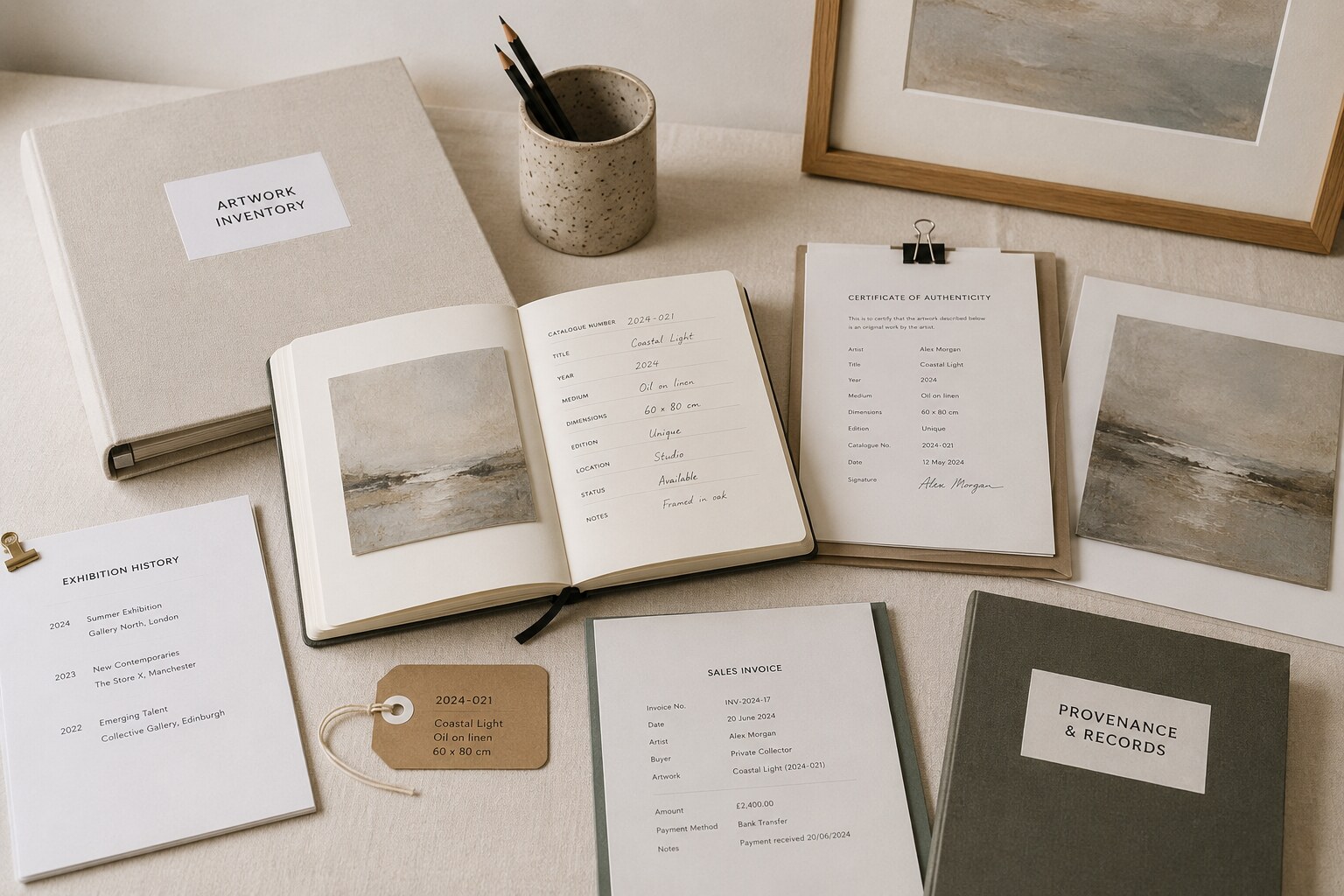
Artwork management is the practice of keeping organised, accurate and retrievable records of every artwork you make, own or care for. For artists it covers the studio side: what you have created, where it is, who has it, and what paperwork supports it. For collectors, galleries and institutions the same discipline is usually called collection management. The mechanics are largely shared.
This guide is written for artists who want a working system rather than a theoretical one. It explains what artwork management is, why it matters, how it relates to collection management, the components a complete system needs, and how a single artwork moves through that system from studio to sale.
What Is Artwork Management?
Artwork management is the ongoing activity of recording, tracking and preserving information about the artworks you have produced. It combines three disciplines: a structured artwork inventory that lists every work you have made, careful artwork documentation that captures the facts about each one, and an archive that keeps those records safe over time.
It is not the same as marketing or sales. Artwork management is the quiet underlying layer that makes marketing, sales, exhibitions, loans, insurance and resale possible. When a collector asks for a certificate, an editor asks for a high-resolution image, or a gallery asks for an exhibition history, the answer comes out of your management system — or it doesn't, and the opportunity slips.
At its simplest, artwork management answers four questions about any work in your catalogue:
- What is it? — title, year, medium, dimensions, edition, catalogue number.
- Where is it? — studio, in transit, on loan, in a private collection, with a gallery on consignment, sold.
- Who has owned it? — the chain of ownership from artist to current owner.
- What documents support it? — Certificate of Authenticity, sales invoice, condition report, photographs, exhibition records.
If you can answer those four questions for every work that has ever left your studio, you have an artwork management system. If you cannot, you have gaps — and gaps are where credibility, value and ownership disputes appear.
Why Artwork Management Matters
Artworks outlive the moment they are made. A painting sold this year may be resold in twenty years to someone who never met you, lent to an exhibition in forty, and reattributed by a researcher in eighty. The only thing that travels with the work through all of that is the record you kept.
Good artwork management protects several things at once:
- Authorship. A clear, consistent record links each work back to you. That matters for attribution, for resale and for any future catalogue raisonné.
- Value. Works with complete records sell more easily, insure more cleanly, and hold value better in the secondary market. A buyer is paying partly for the paperwork.
- Provenance. Provenance is built from documentation. Without an inventory, without invoices, without exhibition records, there is nothing to assemble into a credible history.
- Professional reputation. Galleries, curators and institutions notice which artists can produce records on request and which cannot. It shapes who they choose to work with.
- Your own time. A working system means you can answer a question in two minutes instead of two days. Over a career, that compounds.
The cost of poor artwork management is rarely visible day to day. It appears later, often at the worst moment: when a work resurfaces and cannot be authenticated, when an insurer asks for documentation that does not exist, when an estate has to be reconstructed from fragments.
Artwork Management vs Collection Management
The terms artwork management and collection management are often used as if they were interchangeable. They are closely related, but they describe the same discipline from different sides of the work.
Artists manage the artworks they create. Collectors manage the artworks they own. Galleries and museums manage collections of works by many artists. The records, fields and processes overlap heavily — title, medium, dimensions, condition, location, ownership history, supporting documents — because every party in the chain is recording the same underlying object.
| Party | Term commonly used |
|---|---|
| Artist | Artwork Management |
| Collector | Collection Management |
| Gallery | Collection Management |
| Museum | Collection Management |
In practice, what an artist builds in the studio becomes the seed of what a collector or institution later maintains. If your inventory is clean, your photographs are properly captioned, and your certificates are consistent, every party downstream inherits a working system. If your records are patchy, every later owner has to reconstruct what should have started with you.
The simplest way to think about it: artwork management is collection management from the source. The same foundations — inventory, documentation, provenance, records, archive — apply at every stage.
The Core Components of Artwork Management
A complete artwork management system has five components. They are not separate tools; they are layers of the same record.
- Inventory. The master list of every artwork you have made, with a unique identifier for each.
- Documentation. The detailed facts about each work — medium, dimensions, materials, photographs, condition.
- Records. The transactional history — sales invoices, consignment notes, loan agreements, certificates.
- Provenance. The continuous history of authorship, ownership, exhibition and condition.
- Archive. The long-term storage of all of the above, in a form that will still be readable in twenty years.
Each of the sections below covers one of these layers. They are written for an artist starting from scratch as much as for one tidying up an existing practice.
Building an Artwork Inventory
An artwork inventory is the spine of the whole system. It is a complete, ordered list of every artwork you have produced — finished and unfinished, sold and unsold, in your possession or elsewhere. Without it, none of the other layers have anything to attach to.
A useful inventory entry contains, at minimum:
- A unique catalogue number — short, consistent, and never reused.
- Title and year of completion.
- Medium and support (oil on linen, etching on Somerset paper, bronze, etc.).
- Dimensions (height × width × depth, in consistent units).
- Edition information for prints, photographs and sculpture (edition size and number).
- Current status — in studio, on loan, on consignment, sold, destroyed, lost.
- Current location.
- Owner, if not you.
- Date the entry was created and last updated.
The single most important rule is that every artwork gets a number, and that number never changes. Titles change, prices change, owners change. The catalogue number is the anchor that holds the rest of the record together. A simple, durable scheme — for example artist initials, year, and a running number such as EM-2024-018 — is easier to live with than anything clever.
Cataloguing is not a one-off project. Artwork cataloguing is the ongoing activity of adding new works as they are made, updating status when works move, and correcting errors as they surface. Set aside a small recurring slot — half an hour a week is more than most artists do — and the inventory stays current rather than collapsing into a backlog.
Artwork Documentation and Records
If inventory is the spine, artwork documentation is the body. It is the descriptive and visual record of each work in enough detail that someone who has never seen the piece in person can understand it.
A complete documentation set for a single artwork normally includes:
- High-resolution photographs — front, verso, signature detail, edge or frame detail, and a contextual shot at scale.
- Materials and process notes — paint brand, ground, varnish, paper type, firing temperature, any conservation-relevant detail.
- A baseline condition report — written at completion, describing the work as it left the studio.
- Signature and labelling — what is signed where, what label is attached to the verso, and whether a QR code or archive reference is included.
- Statements and texts — the artist's own short text on the work, if one exists.
These sit alongside the transactional artwork records — the paperwork generated when a work moves or changes hands. Records typically include sales invoices, consignment agreements, loan forms, shipping documents, insurance valuations and any correspondence that affects ownership or condition.
The discipline is to file the document at the moment it is created. A photograph taken on the day a work is finished, named with the catalogue number, and saved into the right folder takes thirty seconds. The same photograph reconstructed three years later, after the work has shipped to a buyer, may not be possible at all.
For a deeper view of the photographic, written and visual record that supports a working studio, see our guide on how to create a professional artist portfolio — many of the same assets feed both systems.
Provenance and Ownership History
Provenance is the documented history of an artwork: who made it, who has owned it, where it has been shown, and how it has been cared for. It is built from the inventory and documentation already described, plus the transactional record of each change of ownership.
The core of provenance is the chain of ownership — an unbroken sequence from the artist to the current owner. For most works the chain is short: artist to first collector. Over time it lengthens, and each link needs a document behind it. A sales invoice records the first transfer. A consignment note and resale invoice record the next. A bequest or gift needs its own paperwork.
For an artist, provenance is not a separate task. It is what good inventory and documentation produce as a by-product. If every work has a catalogue number, every sale has an invoice, every exhibition is logged and every condition report is filed, provenance assembles itself.
Why this matters in practice: provenance is what allows a future buyer, gallery or institution to verify a work without needing to contact you. For a fuller treatment of how provenance is structured, what a complete record contains, and how collectors verify it, see What Is Artwork Provenance?.
Certificates of Authenticity and Supporting Documents
A Certificate of Authenticity is the document by which the artist confirms a specific work is genuine. It is one of the most important pieces of paper attached to any artwork, and one of the most commonly mishandled.
A working certificate identifies the work unambiguously (title, year, medium, dimensions, edition, catalogue number), includes a thumbnail image, carries a unique certificate reference and is signed by the artist. It is issued once, kept on file by the artist, and transferred with the work to each new owner.
Supporting documents sit alongside the certificate and complete the package:
- Sales invoice — the legal record of first transfer.
- Condition report — the written assessment of the work's physical state at key moments.
- Loan and exhibition records — venues, dates, insurance values, transport notes.
- Photographs on file — the same images held by the artist as a reference for future verification.
Together, these documents are what a buyer, insurer or institution will eventually ask to see. They are also what allows a work that has been out of view for decades to be re-authenticated. For a full guide on how certificates are structured and used, see How Certificates of Authenticity Work for Original Artwork.
Digital Archives and Long-Term Preservation
The final layer is the digital archive. This is where all of the above — inventory, documentation, records, provenance, certificates — is stored over time in a form that will still be readable in twenty or thirty years.
A serviceable digital archive has four properties:
- Completeness. Every artwork has its own folder, named with the catalogue number, holding every relevant file.
- Redundancy. At least two copies in two different places — for example a working drive plus a cloud backup, ideally with a third offline copy held off-site.
- Stable file formats. Photographs as TIFF or high-quality JPEG, documents as PDF, master files preserved alongside any compressed versions used for the web.
- A readable index. A single document, spreadsheet or database that lets you find any artwork's folder from its catalogue number, title or year.
The point of an archive is not perfection on day one. It is that the system survives without you needing to remember it. The discipline is structural: name files consistently, save them in the right folder at the moment they are created, and back up on a schedule rather than when you remember to.
A Practical Artwork Management Workflow
The clearest way to see how these layers fit together is to follow a single artwork through its life. The example below is hypothetical but realistic.
1. Creation. Low Field, Late March (oil on linen, 90 × 70 cm) is finished in the studio. The artist photographs the work front, verso and signature detail. A label is fixed to the verso with title, year, medium, dimensions and a QR code. The work is assigned catalogue number AB-2025-014.
2. Inventory. A new row is added to the inventory: catalogue number, title, year, medium, dimensions, current status (in studio), current location (studio). The entry is created the same day the work is finished.
3. Documentation. A folder named AB-2025-014_Low-Field-Late-March is created in the digital archive. Into it go the photographs, a baseline condition report, materials notes (paint brand, ground, varnish) and a short artist statement on the work.
4. Certificate of Authenticity. A certificate is generated for the work — title, year, medium, dimensions, catalogue number, thumbnail image, unique CoA reference AB-COA-2025-014. It is signed, scanned, filed in the work's folder, and held ready for sale.
5. Exhibition. The work is selected for a group show. The artist logs the exhibition in the inventory (venue, dates, insurance value), produces a pre-loan condition report, updates the status to "on loan", and files the loan agreement in the work's folder. When the work returns, a post-loan condition report is added.
6. Sale. The work is sold through the artist's representing gallery. A sales invoice is issued from gallery to buyer. The artist updates the inventory: status changes to "sold", current owner is recorded, date of sale is logged. The certificate, a copy of the invoice and the documentation pack travel with the work to the new owner.
7. Provenance record. Behind the scenes, the provenance entry for AB-2025-014 now reads cleanly: created by the artist in 2025, exhibited at a named venue in 2025, sold to a named collector in 2025, with certificate, invoice, condition reports and photographs on file. Any future buyer, gallery or institution can verify the work without needing to contact the artist directly.
None of these steps is heavy on its own. The discipline is doing each one at the moment it happens rather than later. That is what separates a functioning artwork management system from a folder of good intentions.
Common Artwork Management Mistakes
A few patterns appear again and again in studios that have never put a system in place:
- No unique numbering. Works are referred to by title alone. Two paintings end up with similar names, and records cannot be matched to objects with certainty.
- Photographs taken too late. Works are photographed only when needed for a sale or submission. Baseline images of the work as it left the studio do not exist.
- Certificates issued inconsistently. Some works have certificates, some do not. Formats vary. References are reused or missing.
- Records spread across tools. Invoices in email, photographs on a phone, inventory in a notebook, condition notes nowhere. Nothing can be assembled in one place.
- No backup. Everything lives on one drive or one laptop. A single failure removes the entire archive.
- Updates delayed. Sales, loans and location changes are recorded weeks or months later. By the time the entry is updated, details have been forgotten.
Each of these is easy to avoid at the start of a practice and slow to repair later. The remedy in every case is the same: a consistent system, applied at the moment each event happens.
Frequently Asked Questions
Where to Begin
If you are starting from nothing, build the layers in order. Create the inventory first — even a simple spreadsheet, with one row per artwork and a consistent catalogue number, is enough to begin. Then attach documentation: photographs and basic facts for each work. Then formalise the records: certificates of authenticity, invoices, condition reports. Provenance and the digital archive will assemble themselves as long as each event is logged at the moment it happens.
Artwork management is not a project to finish. It is a quiet, ongoing discipline that pays back over decades. The artists whose work is easiest to trust in twenty or fifty years will not necessarily be the ones who made the most noise — they will be the ones who kept the cleanest records.
For related reading in this Studio Journal, see Artwork Valuation and Insurance and Copyright for Artists.
A useful artwork record should also contain a concise description of the work itself. The guide to artwork record descriptions explains how to write text that works for sales pages, certificates and long-term documentation.