
How to Write Artwork Descriptions
A practical guide to writing clear, specific artwork descriptions for websites, portfolios, online sales, open-call submissions, certificates and long-term artwork records.
16 min read
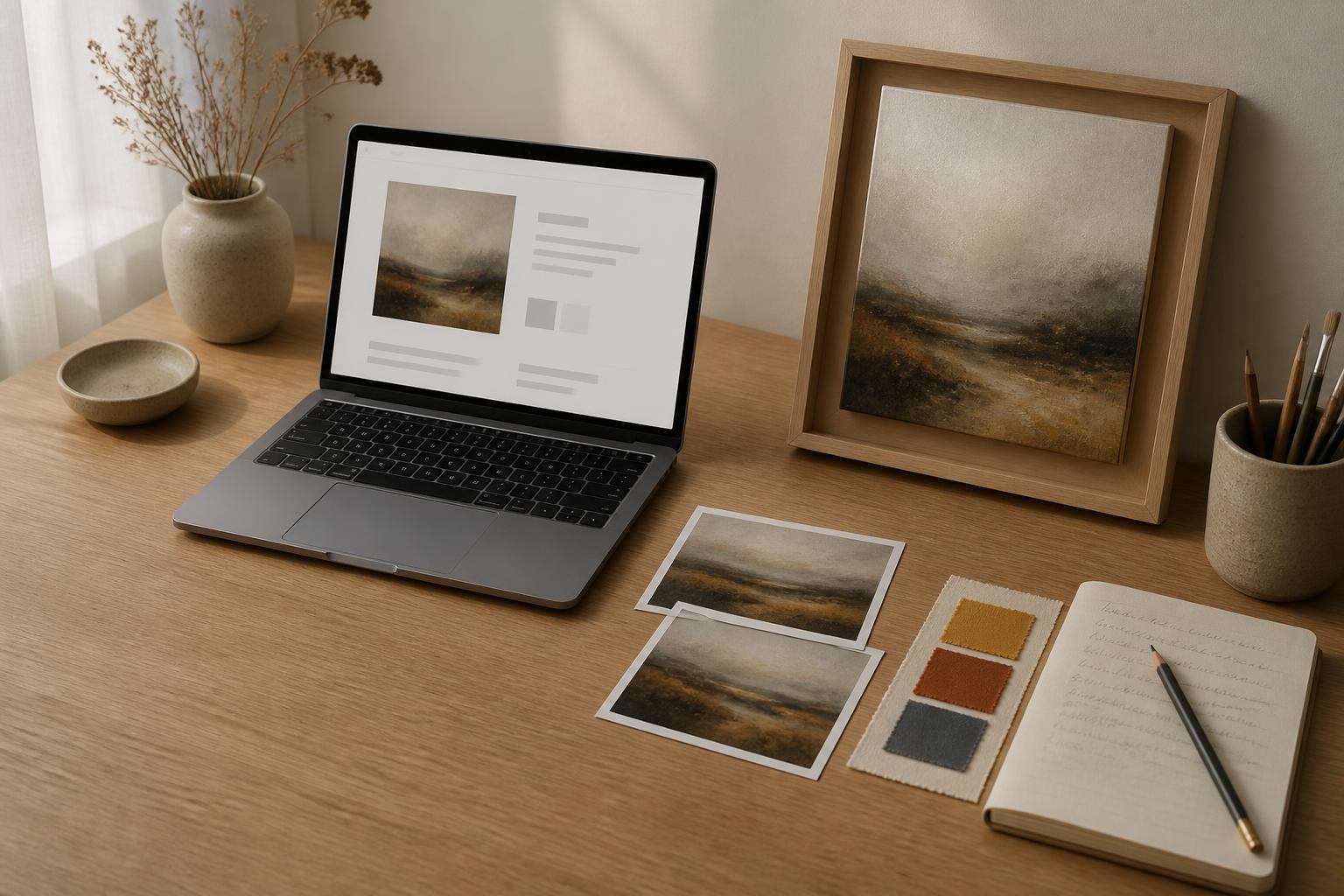
Many artists can make strong work and still struggle to write about it. A painting that took weeks in the studio gets a one-line caption online, a flat list of materials on a portfolio page or a generic paragraph copied across every listing. The work deserves better, and so does the artist. A clear artwork description is not decorative text — it is what stands in for the object when a buyer, curator or selector cannot see it in person, and it is a piece of information that lives in the artwork record for years.
This guide is a practical answer to how to write an artwork description, written for practising visual artists. It covers websites, portfolios, online sales, open-call submissions, certificates and archive records, with examples, templates, a useful word bank and a checklist you can reuse. It is not a school-style essay or a generic list of descriptive words for artwork. The aim is to help you write descriptions that are specific, honest and useful — for buyers, for curators, for selectors, and for the long-term record of your own work.
Why artwork descriptions matter
Most buyers see the work online before they see it in person. The photograph does the visual work, but it cannot answer everything: scale, surface, framing, materials and intention all sit in the words around the image.
Descriptions support trust. Alongside strong photography, a clear, specific description tells a collector that the artist takes the work seriously. Vague or inflated text has the opposite effect. If you have not yet sorted out reliable images of your work, the guide on how to photograph artwork sits naturally alongside this one.
Descriptions also support every place the work appears: website product pages, portfolio PDFs, online sales listings, open-call submissions and gallery materials. Search engines read them too, which is where the natural overlap with art listing descriptions and product descriptions for art comes in. And once a description is written well, it does not disappear when the work sells. It becomes part of the long-term artwork record, attached to the certificate of authenticity, the condition report, the inventory entry and the file the next owner or registrar will read.
Artwork description vs artist statement vs certificate text
These four pieces of writing are often confused, and the confusion shows up on the page.
- Artwork description — one specific work. What it is, what it looks like, what it is made from, what informs it.
- Artist statement — the wider practice. The themes, concerns and approach across a body of work, not a single piece. The supporting guide on how to write an artist statement covers this properly; descriptions and statements should not duplicate each other.
- Certificate text — factual authentication and record information. Title, artist, year, medium, dimensions, edition, signature, provenance reference. Written for the record, not for the buyer's emotions. See how certificates of authenticity work for original artwork for the wider context.
- Portfolio text — a concise professional presentation of a piece in the context of a body of work. Often shorter than a website description, more direct than a sales listing.
Mixing these up is one of the most common reasons artwork descriptions read badly. A description that sounds like a statement floats away from the work. One that reads like certificate text feels cold. One that imitates sales copy feels untrustworthy. The reader can tell.
What every artwork description should include
Not every description needs every element, but most strong ones draw from the same list:
- title
- artist name
- year
- medium
- dimensions
- surface or support (canvas, panel, paper, board)
- subject or visual content
- colour, tone and atmosphere
- texture, process or materials
- inspiration or context
- relationship to a series or body of work
- framing or presentation
- edition details if relevant
- availability or enquiry context if used on a sales page
Use this as a menu, not a checklist to complete in order. A short Instagram caption may only use four or five items; a full website page may use most of them; an open-call submission may focus on subject, medium, dimensions and a single sentence of context. The skill is choosing the right items for the place the description will appear.
Start with what the viewer can see
The most useful opening to almost any artwork description is the visible work itself. Begin with subject, composition, palette, surface, marks, space, scale or mood before moving to interpretation. This is the single most reliable fix for descriptions that feel vague.
Avoid openings that float above the work:
- "This piece explores emotion and identity."
- "An evocative journey through colour and form."
- "A meditation on the human condition."
These sentences could sit under almost any image.
Stronger openings tie the words to the work:
- "A narrow watercourse cuts diagonally through a muted, low-toned landscape."
- "Layered marks in oxide red and warm grey build across a deep-edge canvas."
- "Three small figures stand at the edge of a flooded field, painted thinly on board."
The reader can already see something. Meaning can follow once the visible work has been described.
How to describe subject, medium, scale and surface
Different kinds of work need slightly different language, but the underlying approach is the same: be specific.
- Landscape. Name what the work shows — woodland, moorland, coast, estuary, industrial edge — and the time of day or weather where it matters. Describe the structure of the image: foreground, distance, horizon, light.
- Abstract work. Describe the visible facts before any concept — shape, gesture, balance, palette, surface, scale. Then connect those choices to intention. The most common mistake with abstract work is skipping straight to meaning.
- Figurative work. Describe the figure, the setting, the gesture or pose, and how the work is painted or drawn. Avoid imagined narrative the painting does not show.
- Still life. Name the objects, describe the arrangement, and note the light and surface.
- Printmaking. Name the technique — etching, screen print, linocut, woodcut, lithograph, giclée print — the paper, the edition and the signature.
- Mixed media. Be specific about materials and how they are combined.
- Works on paper. Name the medium and the paper. If the work is in a mount or behind glass, mention it.
- Textured paintings. Describe the surface honestly — built up, scraped, layered, smooth — without inventing techniques that were not used.
Accurate medium descriptions matter beyond the buyer. Galleries, insurers, registrars and the artwork record all rely on consistent terms. "Acrylic and ink on linen-covered panel, 60 × 80 cm" is more useful in every direction than "mixed media on board, medium size".
A short reference for common surfaces and media:
- canvas, panel, paper, board, linen
- acrylic, oil, gouache, watercolour, ink, charcoal, graphite, pastel
- collage, monoprint, screen print, etching, giclée print
- unframed, float-mounted, tray-framed, gallery-framed
If the work is part of a limited edition, name the edition size and the artist's proof count where relevant.
How to write about meaning without overexplaining
Meaning should support the work, not smother it. The reader does not need a thesis; they need enough context to look at the work with a little more understanding. Connect visible choices to intention — say what the work does and then, briefly, why — and leave room for the viewer.
Weaker:
"This deeply emotive and powerful painting invites the viewer on a profound journey through the elemental forces of memory, identity and human experience, exploring themes of light and dark in a truly evocative way."
Better:
"Built in thin layers of oxide red and grey, the painting reflects on a particular stretch of moorland walked over many years. The structure is deliberately quiet — a single low horizon, a narrow path divides the foreground from the distance — so the surface and the slow tonal shift carry most of the work."
The second is shorter, more specific and says nothing the artist would not stand behind in person.
Descriptive words for artwork
Adjectives are not a substitute for description, but the right vocabulary helps. A short, useful word bank, organised by category, is more valuable than long lists of generic terms.
- Colour. muted, vivid, restrained, luminous, earthy, cool, warm, tonal, high-contrast, saturated, subdued, ochre, oxide, indigo, slate
- Surface. layered, textured, scraped, glazed, smooth, weathered, expressive, translucent, opaque, raked, sanded, varnished
- Composition. balanced, open, compressed, divided, centred, asymmetrical, spacious, geometric, fragmented, framed, anchored, rhythmic
- Mood. quiet, atmospheric, dramatic, contemplative, unsettled, calm, energetic, austere, intimate, expansive, restrained
- Process. built up, washed back, scored, collaged, sanded, overpainted, gestural, drawn, painted in stages, worked from photographs, painted from life
A warning: adjectives alone are not a description. "A vibrant, evocative, powerful, beautiful painting" tells the reader nothing. The same words used to describe specific choices — "vibrant ochre and slate" or "powerful diagonal across the composition" — do real work.
Artwork description examples
A few worked examples for different contexts. All are written about an imagined painting called "Held Light" by an artist called J. Bowers, oil on linen-covered panel, 60 × 80 cm, 2026, from a series called "Quiet Divides".
Short website description (60–90 words)
Held Light is an oil on linen-covered panel, 60 × 80 cm, painted in muted ochres and slate greys. A low horizon divides foreground moorland from a pale, lit sky, with a narrow path running diagonally across the lower third. Built up in thin layers and washed back in places, the surface carries the slow tonal shifts of a single piece of land observed over time. The work belongs to the Quiet Divides series, framed in a natural oak tray frame.
Full artwork page description (150–250 words)
Held Light, 2026, oil on linen-covered panel, 60 × 80 cm. The painting shows a stretch of open moorland under a pale, low-lit sky, painted in muted ochres, oxide reds and cool slate greys. A narrow path divides the foreground from the distance, anchoring the composition without dominating it. The surface has been built up in thin layers and washed back in places, so the underpainting reads through the upper marks; small areas of raised paint catch the light and give the otherwise quiet tonal shifts a physical surface to sit on.
The painting belongs to Quiet Divides, an ongoing series concerned with subtle structures in the landscape — paths, boundaries, watercourses and the marks of long use. The work reflects on a particular area of upland the artist has walked over several years rather than a single observed view. It is presented in a hand-finished natural oak tray frame, ready to hang.
Held Light is one of a small group of paintings produced for the 2026 studio release and is available as an original work; signed verso, accompanied by a certificate of authenticity and added to the artist's archive.
Open-call description
Held Light, 2026. Oil on linen-covered panel, 60 × 80 cm. Quiet Divides series. A low-toned moorland painting built in thin layers of ochre, oxide red and slate grey, divided by a narrow diagonal path. Unframed image supplied; presented framed in natural oak tray frame for exhibition. Signed verso.
This version is direct, factual and follows the kind of brief most open calls expect. The supporting guide on open calls for artists goes further on how to read the brief itself.
Artwork record description
Held Light. Artist: J. Bowers. Year: 2026. Medium: oil on linen-covered panel. Dimensions: 60 × 80 cm (unframed); 65 × 85 cm framed. Series: Quiet Divides. Signature: signed verso, lower right. Edition: original, unique work. Presentation: hand-finished natural oak tray frame. Notes: low-toned moorland subject, narrow diagonal path, layered surface in ochre, oxide red and slate grey. Condition at record: as new, studio. Linked documents: certificate of authenticity, condition report, provenance entry.
This version reads like a record, not a sales page. It belongs in the inventory entry and on the certificate of authenticity text.
Limited edition print description
Held Light (Edition), 2026. Archival giclée print on 310gsm cotton rag, image size 40 × 53 cm, paper size 48 × 61 cm. Edition of 25, plus 3 artist's proofs. Signed and numbered in pencil below the image. Printed under the artist's supervision from a high-resolution master file. Supplied unframed in a flat archival sleeve; suitable for tray, float or window-mounted framing. See limited edition prints for wider conventions on edition documentation.
Writing descriptions for websites and online sales
For websites and online sales, clarity matters more than pressure. A good description tells the buyer what the work looks like, what it is made from, how large it is, how it might feel in a room and whether it is framed. It says whether it belongs to a series, and it reads like the artist, not like a catalogue.
A useful structure for a website artwork page:
- one or two sentences naming the work, medium, size and the immediate visual impression
- one short paragraph on materials, surface and process
- one short paragraph on subject, series or context
- a final line on presentation, framing and availability
Natural search phrases — "artwork description", "art listing description", "product description for art", "artist website description" — appear in this kind of writing without forcing. The guides on how to sell artwork online, how to build an artist website and artist portfolio examples describe how those product pages fit into the wider online sales picture.
Writing descriptions for portfolios and open calls
Portfolio descriptions are concise and professional. They sit beside an image and one or two facts; their job is to support the work in the context of a body, not to sell on the page. Keep them tight: a sentence or two of context, the relevant materials and dimensions, the series or theme.
Open-call descriptions follow the brief. Read the call carefully and write to what is asked — title, year, medium, dimensions, a short statement of intent, sometimes a single line on context. Avoid unsupported claims and avoid making every work in your portfolio sound the same. Selectors read across many submissions in one sitting; the artist whose descriptions sound interchangeable is harder to remember than the artist whose descriptions describe distinct works. The supporting guides on open calls for artists and how to prepare artwork for an exhibition cover the wider submission and presentation work.
How artwork descriptions support records and provenance
Once a piece has been described well, that description becomes part of the documentation that follows the work for the rest of its life. A useful description supports:
- the artwork inventory entry, where the work is identified, photographed and tracked
- provenance entries, where each owner, exhibition and event is recorded against the piece
- the certificate of authenticity, which carries the factual description for the lifetime of the work
- the condition report, where the description provides the reference point against which condition is judged
- gallery submissions and consignment paperwork, where consistent terms reduce confusion
- insurance schedules, where vague descriptions create real problems at claim time
- future resale, where the original description supports identification years later
The supporting guides on artwork management for artists, artwork archive database and record systems, what is artwork provenance and certificates of authenticity for artwork describe how those records hang together.
Common mistakes when writing artwork descriptions
The same problems come up again and again:
- writing too vaguely, with nothing the reader can picture
- using too much jargon and academic art-speak
- describing the artist instead of the artwork
- forgetting medium, dimensions or surface
- overexplaining the meaning until the work has no air around it
- making every artwork sound the same
- leaning on clichés such as "unique", "stunning", "vibrant" or "evocative"
- writing only for search engines and not for people
- failing to update the description when the work is framed, exhibited or sold
- keeping no description at all in the artwork record
Reading a description aloud — and asking whether a stranger could picture the work from those words — is usually enough to find the worst offenders.
Simple artwork description template
A practical template you can fill in for any piece.
Short version
- title
- medium
- size
- subject
- mood
- one distinctive feature
Full version
- what the viewer sees
- how the work was made
- materials or surface
- inspiration or context
- series or body of work
- presentation details
A reusable sentence template:
"[Title] is a [medium] on [surface], measuring [dimensions]. The work shows/uses [subject, forms, colour or composition]. Built through [process/materials], it creates a sense of [mood/atmosphere]. The piece forms part of [series/body of work] and reflects [brief context]. It is presented [framed/unframed/on panel/etc.]."
Filled in:
"Held Light is an oil painting on linen-covered panel, measuring 60 × 80 cm. The work shows a low-toned stretch of moorland divided by a narrow diagonal path, in muted ochres and slate greys. Built through thin layers of paint, washed back and overpainted in places, it carries a quiet, observed atmosphere. The piece forms part of the Quiet Divides series and reflects on a particular area of upland walked over several years. It is presented in a natural oak tray frame, ready to hang."
Artwork description checklist {#artwork-description-checklist}
Run through this before publishing or filing any description:
- Does it identify the artwork clearly — title, artist, year?
- Does it describe what the viewer can see?
- Does it include medium and dimensions?
- Does it mention surface, support or presentation where relevant?
- Does it explain process without overcomplicating it?
- Does it give enough context without overexplaining?
- Does it sound like the artist, not a sales brochure?
- Does it use natural search phrases where they fit?
- Does it work alongside the artwork photograph?
- Is it stored in the artwork record alongside images, certificate and provenance?