
Artwork Valuation and Insurance
Learn how artwork valuation and insurance work, what records support value, and what artists should document before exhibitions, sales, shipping or claims.
15 min read
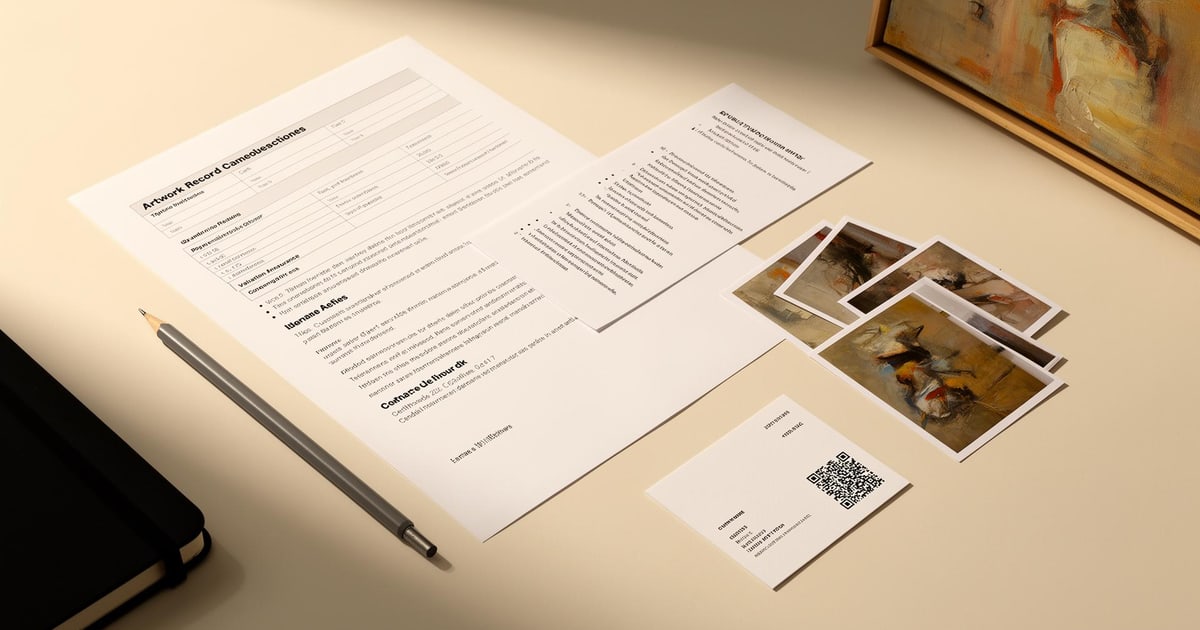
Most practising artists only think seriously about artwork valuation and insurance when something has already gone wrong. A painting comes back damaged from an exhibition, a courier loses a package, a collector asks for an insurance value years after purchase, or a gallery requests a declared value for an upcoming consignment. In each case the artist suddenly needs evidence — and the strength of that evidence depends entirely on what was recorded long before the incident.
Value matters in a wider set of situations than most artists expect: pricing, exhibitions, consignments, shipping, studio records, collector relationships, estate planning and claims. In all of these situations, the underlying question is the same: how much is this artwork worth, and what evidence supports that figure?
Insurance, in turn, depends on evidence rather than memory. An insurer assessing a claim is interested in what the artist can document — title, dimensions, medium, sale price, exhibition history, condition, certificates, provenance, photographs.
Valuation is also not the same as price. A price is what an artist asks, or what a buyer paid. A valuation is a considered assessment of value, often for a specific purpose: insurance, probate, sale, donation or dispute. The two are related, but they are not interchangeable. Treating them as the same is one of the most common causes of trouble at exactly the moment evidence is needed.
This article is a practical guide for practising visual artists on the basics of artwork valuation, the basics of art insurance, and what records to keep so that future valuation, insurance and claims are easier to support. It is general practical guidance, not financial, legal, tax or insurance advice. For formal situations, qualified valuers, insurers, solicitors and accountants are the right people to involve.
Why artwork valuation and insurance matter
Artists need values for everyday professional reasons. Exhibitions need declared values for transit and venue insurance. Consignments need an agreed value between artist and gallery. Shipping needs a declared value for the courier. Studio records need internal values for the artist's own management. Sales need clear pricing that holds together across website, invoice, certificate and archive. Estates eventually need values for inheritance and disposal.
Collectors need values too — for insurance schedules, collection management, resale decisions, gifting and estate planning. They rely on the artist's records, and on independent valuers where appropriate, to support those figures.
Galleries sit in the middle. They need declared values for consignment, exhibition and transit, and they need to know which party carries the risk at each stage.
Insurers may ask for evidence of value, ownership and condition at the point of a claim. Good records do not guarantee a claim will be paid, but they make the conversation realistic.
The artwork record becomes the evidence hub: images, descriptions, dimensions, medium, sale price, certificate, condition notes, provenance and exhibition history. Everything else — declared values, schedules, claim forms — draws from that single source.
Price, value and valuation: what is the difference?
These three words are often used interchangeably, and the confusion causes real problems.
| Term | Meaning | Example |
|---|---|---|
| Price | The amount asked or paid for a work | Listed for £1,200 |
| Sale price | The amount actually paid in a completed transaction | Sold for £950 |
| Market value | An estimate based on comparable works and market context | Comparable works sell around £900–£1,200 |
| Insurance value | The figure used to insure the work, often replacement-based | Insured for £1,200 or at an agreed valuation |
| Valuation | A written assessment of value for a specific purpose | Written valuation for insurance, probate or sale |
A few practical points sit behind that table.
An asking price is not the same as market value. A piece listed at £2,000 but never sold at that level is weaker evidence of value than a completed sale at or near that price.
An insurance value may differ from a resale value. Replacement cost — the cost of producing or sourcing an equivalent work — can be higher than what the same piece would fetch at resale, particularly for early-career artists. Some policies use agreed-value cover, others use replacement-cost cover, and the figures can look different.
Artists should avoid making unsupported valuation claims. Saying a work is "worth £5,000" with no sales history, no comparable evidence and no independent assessment is not a valuation. Insurers, valuers, courts and collectors recognise the difference.
How is artwork valued?
A valuation considers a range of factors and weighs them against each other. There is no single formula, but a reasonable assessment usually looks at:
- The artist's sales history at similar size, medium and period
- Exhibition history, particularly with recognised venues
- Gallery representation or consignment history
- Comparable works by the same or similar artists
- Size and medium
- Date and period of work within the artist's career
- Condition
- Provenance and ownership history
- Certificates and supporting documentation
- Scarcity, including edition size for prints
- Subject matter and how it sits within the artist's body of work
- Wider demand and market context
Valuation is evidence-based. Professional valuers typically rely on comparable sales, recent transactions and market data. They will look closely at condition, provenance and documentation, because all three affect what a sensible buyer would pay.
Artists can document the relevant evidence — sales records, exhibition history, certificates, provenance — but should not present their own estimate as a formal independent valuation where one is required. An artist's records support a valuation; they are not a substitute for one in formal situations.
Can artists value their own artwork?
Artists set prices. That is a normal and necessary part of professional practice. Setting a price is not the same as carrying out an independent valuation.
Artists can sensibly record:
- A current retail price
- The sale price of completed transactions
- An internal replacement value, useful for studio records and informal insurance discussions
- A consignment or trade price agreed with a gallery
- An exhibition declared value for transit and venue cover
Those internal figures are useful and should be kept consistent across the artwork record, the website, the certificate, the invoice and any gallery paperwork. Consistency itself is part of the evidence.
The same internal figures may not be sufficient for insurance schedules, probate, legal disputes or high-value claims. For those situations, qualified valuers, insurers, galleries, auction specialists or other advisers can provide the independent view that the situation requires. The artist's records make their job easier; they do not replace it.
An artist's price list is useful evidence, but it is not always the same as an independent valuation. Treating it as one — particularly with inflated figures and no sales behind them — tends to undermine credibility at the moment evidence is most needed.
When might you need a professional artwork valuation?
There are situations where an independent, written valuation is either expected or sensible. These include:
- Insurance schedules for higher-value works or collections
- Higher-value private or institutional collections more generally
- Inheritance and probate, where formal valuations may be required
- Divorce or other legal disputes involving artworks
- Donations to institutions or charitable bodies
- Estate planning, particularly where an artist estate is being structured
- Significant damage or loss claims
- Decisions about resale or auction consignment
- Lending work to public or institutional exhibitions
- Consignment disputes between artist and gallery
The exact rules vary by country and situation. In the UK in particular, probate, tax and donation contexts have their own conventions, and a written independent valuation is usually expected in formal situations rather than an artist's own estimate.
What records support an artwork's value?
This is the section that genuinely sits within the artist's control. Whatever else changes about valuation and insurance practice over time, the underlying requirement is the same: clear, consistent records attached to each piece.
For each artwork, the artist should aim to keep:
- Title
- Artist name
- Date or year
- Medium and materials
- Dimensions, framed and unframed
- High-quality photographs, including front, back and details
- Signature details
- Certificate of authenticity
- Edition number where relevant
- Sale price and buyer record
- Price history over time
- Exhibition history
- Gallery and consignment history
- Provenance
- Condition notes
- Framing details
- Invoices, receipts and correspondence
- Shipping records
- Any previous valuations
The principle is simple. Records should be kept before they are needed, not assembled in panic after a loss. Evidence is stronger when it is consistent across website, certificates, invoices and archive — and weaker when the website says one thing, the certificate another and the invoice a third.
For the underlying record-keeping side of this, Artwork Management for Artists and the Artwork Archive Database / Record System guide go into the full structure of an artwork record. Certificates of Authenticity for Artwork covers the certificate side specifically, and What Is Artwork Provenance? covers the ownership-history side. For collectors, Collection Management for Artists and Collectors extends the same thinking across a whole collection.
These records are the same evidence base that supports valuation, insurance, claims, sales and estate planning.
What is art insurance?
Art insurance is cover for loss, theft or damage to artwork, with the details depending on the specific policy. Ordinary home contents or general business insurance may not automatically cover higher-value art adequately. Single-item limits, exclusions and conditions can quietly leave significant gaps.
Specialist fine art insurance is designed for the specific risks that artworks face. Policies in this area may cover collections held at a private address, works in transit, works on exhibition, works in storage and works on consignment. The exact terms vary considerably between policies and insurers.
Artists may need different cover from collectors. An artist's studio holds finished works, works in progress, materials, equipment and sometimes consigned or borrowed pieces. A collector's home or storage facility holds completed works of varying ages and values, and policies tend to reflect that difference.
Galleries and exhibition venues often have their own insurance requirements, which may shape what artists need to provide before a piece can be hung, transported or sold.
Throughout all of this, the only safe assumption is that policy wording matters and that "is this covered?" is always a question for the actual policy, in writing, before the event. This article does not recommend any specific insurer, broker or product, and does not promise that any policy will cover a particular loss.
Is artwork covered by insurance?
Possibly — it depends on the policy.
Home contents insurance often has single-item limits, which can be lower than the value of individual artworks in a working artist's studio or a collector's home. Items above that limit usually need to be listed specifically on a schedule. Without that, an expensive piece may be treated as a contents item with a modest cap.
Business or studio insurance may treat artwork differently from household contents. Finished works may be classed as stock. Materials and equipment may be classed separately. Works on consignment with a gallery, on loan to an exhibition or in transit may not fall under the same policy at all. The picture changes again where commercial premises, public access or staff are involved.
Works in transit, on exhibition, in storage or on consignment may need specific cover. The location of a work, the reason it is there, the party in legal control of it and the value declared are all relevant. Collectors with significant collections may need works listed individually on a scheduled policy.
Artists should not assume cover exists. The question is not only "is it insured?" but "where, when, for how much, against what risks, and on what evidence?"
Insurance for artists: studio, exhibition, shipping and consignment
For practising artists, insurance tends to fall into several overlapping categories. Each has its own risks and its own evidence requirements.
Studio stock and finished works. The completed pieces sitting in the studio, racked, framed or stored, awaiting exhibition or sale — usually the highest-value items in the working space.
Materials and equipment. Paint, canvas, paper, easels, tools, presses, kilns and cameras can also be high value, particularly for printmakers, sculptors and photographers.
Works in progress. Pieces that are partially complete. Their value is often awkward to articulate, because the finished work may be worth significantly more than the materials invested so far.
Works on exhibition. Pieces hanging in a public or private venue. The venue may have cover in place, or may require the artist to carry it, depending on the agreement. Fine art exhibition insurance is the term often used for this kind of cover, and the responsible party should be clear in writing before the show opens.
Works in transit. Pieces moving between studio, gallery, venue, collector or storage. Fine art shipping insurance — sometimes built into specialist policies, sometimes purchased per shipment — typically requires specific declared values and condition notes before each movement.
Works on consignment with a gallery. The artist may still own the work while the gallery holds it; responsibility for insurance during that period needs to be agreed in the consignment agreement.
Works borrowed or loaned. Pieces lent to the artist for reference, study or exhibition. Insurance responsibility for borrowed work should be agreed in writing before the loan begins.
Public liability cover, which protects against third-party injury or property damage, is usually a separate matter from cover for the artworks themselves.
In all of these contexts, the same supporting evidence keeps reappearing: a clear declared value, current photographs, condition notes before the work leaves, and a clear written record of who is responsible at each stage. For exhibition and consignment workflows specifically, Gallery Consignment for Artists and Open Calls for Artists cover the wider agreements those values sit inside. For online sales, How to Sell Artwork Online covers the shipping and record side from a sales perspective.
Insurance for collectors and collections
Collectors face a related but not identical set of considerations. The artist's evidence still matters — provenance, certificates, condition at sale, photographs — but the collector also needs to build a record of their own ownership.
For a working collector, the practical elements usually include:
- Records of ownership for each work
- A collection schedule that lists works individually with their values
- Provenance and certificates received from the artist or previous owner
- Purchase receipts, invoices and correspondence
- Condition reports at the point of acquisition and after any movement
- Updated valuations over time, particularly for higher-value works
Documentation matters at the point of a claim and also at the point of estate planning. A collection that is well documented passes cleanly to heirs, executors, charities or new owners. A collection that is poorly documented can be slow, expensive and contested to deal with.
Collection Management for Artists and Collectors goes further into this side, and the underlying record-keeping principles overlap closely with the artist's own archive.
What to document before shipping, exhibiting or storing artwork
Most insurance disputes about artwork loss or damage come back to a simple question: what condition was the work in when it left? The artist who can answer that with photographs, notes and a declared value is in a much stronger position.
Before a work leaves the studio for exhibition, transport or storage, it is worth recording:
- Current photographs of the work: front, back and details
- Condition notes, including any pre-existing marks or repairs
- Frame condition where applicable
- Packaging notes and any specific handling instructions
- Declared value for transit and venue purposes
- Certificate or inventory number
- Dimensions and weight, packed and unpacked
- Destination or venue
- Courier or transport details
- A copy of the loan, consignment or exhibition agreement
- Insurance responsibility at each stage: artist, gallery, courier, venue or collector
- Dates the artwork leaves and is expected to return
This is essentially a condition report attached to the artwork record, refreshed before each significant movement. It does not need to be long. It needs to exist, and it needs to be dated.
Common mistakes with artwork valuation and insurance
A short list of patterns that come up repeatedly and are worth checking against.
- Assuming a website price proves value, without any sales behind it
- No sale records for completed transactions
- No condition photographs before the work left the studio
- No certificate of authenticity issued at the point of sale
- No provenance record showing chain of ownership
- No inventory or archive reference attached to the piece
- Out-of-date values, sometimes years behind current pricing
- Unclear ownership during consignment, loan or exhibition
- Assuming a courier's standard insurance covers fine art fully
- Assuming an exhibition venue automatically covers loaned work
- Not checking single-item limits or exclusions on existing policies
- Not recording the work's condition immediately before transit
- Overstating value without supporting evidence
- Mixing retail, replacement and resale value into a single confused figure
Most of these are evidence problems, not insurance problems.
Artwork valuation and insurance checklist
A practical checklist to work through, piece by piece and policy by policy.
- Is each artwork recorded with title, date, medium and dimensions?
- Are high-quality images stored for each piece?
- Is there a certificate of authenticity where appropriate?
- Is provenance recorded, including original sale and any subsequent transfers?
- Are sale prices and invoices saved against the artwork record?
- Is exhibition and consignment history recorded?
- Are condition notes up to date, and refreshed before significant movements?
- Are framed and unframed details recorded clearly?
- Are declared values consistent across website, certificates and invoices?
- Is insurance responsibility clear in writing before shipping or exhibition?
- Are policy limits, single-item caps and exclusions checked against actual values?
- Are valuations reviewed periodically, particularly as the artist's market changes?
- Are collector or buyer records securely stored where the artist holds them?
If all or nearly all of these are in place, both valuation conversations and insurance conversations become significantly easier when they matter.