
Limited Edition Prints
How limited edition prints work for artists: edition sizes, signing, numbering, certificates, records and selling prints professionally.
18 min read
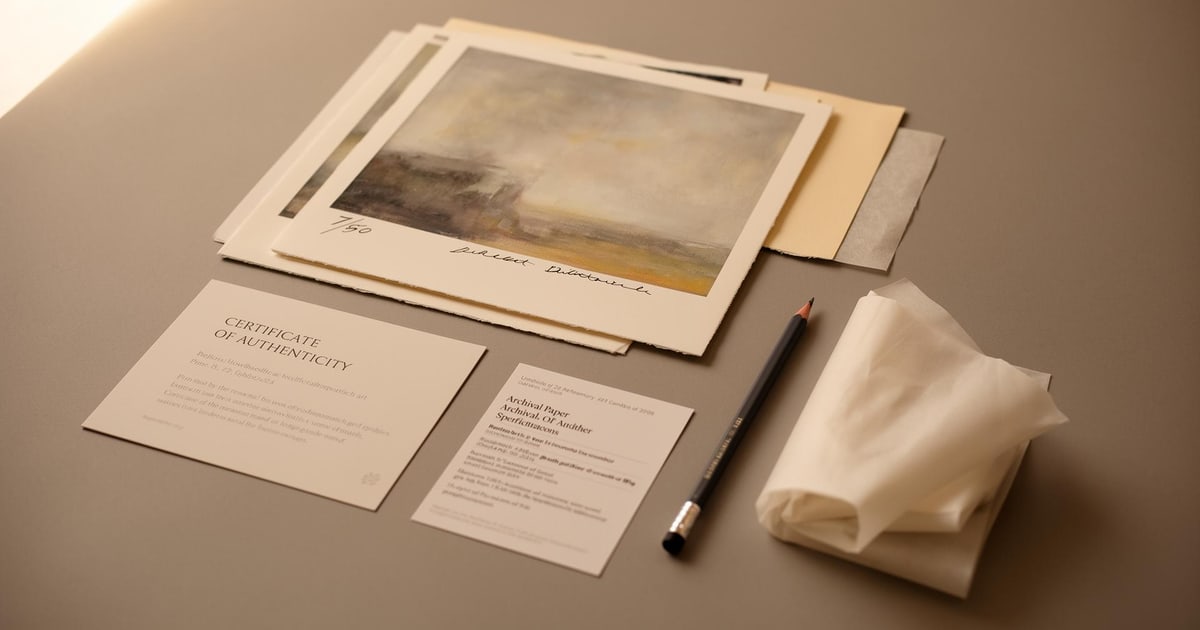
Limited edition prints make an artist's work more accessible without diluting what makes the original work matter. A well-run edition turns a single image into a structured group of objects — each one numbered, signed, documented and accounted for — and for many artists, signed limited edition prints sit alongside originals as a sensible part of a professional practice.
But "limited edition" is a commitment, not just a label. The edition size, the signing convention, the certificate, the records and the future availability of that image all need to be handled consistently, or buyer trust collapses quickly. This guide is written for practising artists who want to create and sell limited edition prints professionally, and for buyers who want to understand what they are paying for. It does not claim that limited edition prints automatically rise in value.
What Is a Limited Edition Print?
A limited edition print is produced in a fixed number of copies. Once the edition is complete, no further prints should be made as part of that same edition. Any later version in a different size, colour or process should be treated and described as a separate edition. The edition is closed. That is the whole point.
This is what separates a limited edition from an open edition, where the artist or publisher can keep printing more copies as long as there is demand. It also separates it from a one-off original, which exists in a single physical version. All three are valid ways to sell work; they are simply different products, with different expectations attached.
Collectors care about the edition size and about consistency. They want to know how many prints exist, that every one of them was made the same way, and that the artist will not quietly print more next year. A "limited edition print" that turns out not to be limited is, to a serious buyer, no longer a limited edition at all.
Editions are not restricted to a single medium. They can include screen-prints, etchings, lithographs and other traditional printmaking, as well as limited edition giclée prints, photographic prints and digital prints output to archival papers. What matters is not the process so much as the discipline around it: a fixed number, a clear method, and records that match what is being sold.
Limited Edition Prints vs Open Edition Prints
Both limited editions and open editions can be a legitimate part of an artist's offering — the open edition vs limited edition decision is about what you are promising the buyer, not about quality.
| Feature | Limited edition | Open edition |
|---|---|---|
| Number made | Fixed in advance | No fixed cap |
| Numbering | Every print numbered (e.g. 1/50) | Usually not numbered |
| Certificate | Certificate of authenticity expected | Often none, or simple receipt only |
| Scarcity | Defined and finite | Ongoing availability |
| Price | Generally higher per print | Generally lower per print |
| Record keeping | Per-print records required | Aggregate sales records may be enough |
Open editions are simpler and suit lower-priced, accessible prints where the artist wants to keep offering the image. There is nothing wrong with selling work this way, provided it is described as open and not dressed up as something it is not.
Limited editions require more discipline. Once a number is announced, the artist is bound by it. Reissuing the same image after the edition sells out, or raising the edition size mid-run, breaks the implicit promise to buyers. If you may want to keep printing an image indefinitely, call it an open edition from the start.
Limited Edition Prints vs Original Artwork
Limited edition prints and original artwork are different products. An original is a single, unique object: one painting, one drawing, one unique print. A limited edition print is one of a fixed group of physical copies sharing the same image, process and edition reference. Both can be signed and certificated, but expectations differ.
Originals command higher prices because they are unique. Limited edition artwork sits below originals in price but above open editions, and is often the most accessible way for new buyers to begin collecting an artist's work. Buyers expect originals to be clearly identified as unique and prints to be clearly identified as one of an edition — never blurred in a listing or price list.
Documentation differs too. An original has a single artwork record, certificate and buyer. A limited edition print has shared edition information (image, process, paper, edition size) plus per-print details (number, certificate, buyer, sale date and price). Treating an edition as a single artwork loses most of the information that makes it trustworthy later.
How Limited Edition Print Runs Work
A limited edition print run is the full set of prints produced under one edition reference. It is defined before any prints are sold, fixed in size, and closed once complete. Everything else — numbering, signing, certificates, records, pricing — depends on the run being defined at the start.
There is no single correct edition size. Common choices include 10, 25, 50, 100 and 250, but the right number depends on the work, the audience and the artist's wider plans. Smaller editions feel more scarce and justify a higher price per print but cap total revenue; larger editions reach more buyers but reduce scarcity and make consistent production harder. An edition that is large just to sound impressive means more work, more storage, more admin and slower sell-through.
When choosing, think about audience, realistic price point, cost of production per print, and likely demand in the first year or two. Decide in advance whether there will be APs, and how many. As a rough guide:
- Higher-value fine art editions: 10–25 prints, often with a small number of APs.
- Emerging artist paper prints: 25–50, balancing scarcity and volume.
- Lower-cost, accessible print runs: 100–250, where reach matters more than per-print value.
Whichever number is chosen, it must be set before the first print is signed and never changed once any print has been sold. Extending a sold-out edition — even quietly, even "just a few more" — converts a limited edition into something closer to open, and buyers who paid for scarcity are entitled to feel misled. The image, paper, print process, signature, certificate format and edition reference should match across every print in the run.
How to Number Limited Edition Prints
The conventional way to number a limited edition print is in the format 1/50, 2/50, 3/50 and so on. The first number identifies the individual print within the edition; the second number is the total edition size. So 7/50 means the seventh print in an edition of fifty. Limited edition print numbering is the simplest piece of documentation in the whole system, but it has to be right and it has to match the records.
Artist's proofs are usually marked AP, A/P or written out as Artist's Proof, and sit outside the main numbered edition (see the next section). Other variants — PP (printer's proof), TP (trial proof) and HC (hors commerce, "not for sale") — appear in more traditional printmaking workflows. Most contemporary artists working with digital or photographic editions will not need them. If they are used, they should be defined in the artist's notes and treated like any other numbered impression: counted, recorded and disclosed.
The important point is consistency. Every print should be numbered, in the same place, in the same way, and tied directly to the artist's records. A pencil number that does not appear in the edition log is no better than no number at all.
Signed Limited Edition Prints
Most artists sign limited edition prints below the image, in pencil, in the bottom margin. Pencil does not fade or bleed and is the traditional signing medium for fine art prints. Ink can suit some processes, but only when known to be archival and compatible with the paper.
A common convention for signing is:
- Left: edition number (for example,
12/50orAP 2/5) - Centre: title of the work
- Right: signature and, optionally, the year
Some processes make a full three-part inscription impractical. What matters most is that every print in the edition is signed the same way, in the same place, by the artist. Where the print itself cannot reasonably be signed — for example, face-mounted photographs or works behind permanent glazing — the signature can sit on the certificate, which then becomes the primary authenticating document. Never sign a print that has not also been logged in the edition record.
What Is an Artist Proof?
An artist proof print, usually marked AP or A/P, is a print from the edition that sits outside the main numbered run. The convention dates back to traditional printmaking, where APs were the artist's own working copies. In modern photographic and giclée editions, APs are usually identical in quality to the main edition rather than rough proofs.
APs are typically capped at around 10% of the edition size, though there is no universal rule. An edition of 50 might have 5 APs; an edition of 25 might have 2 or 3. Smaller is usually better. The count must be declared up front: 1/50 + 5 APs is clear and honest; an edition that quietly gains extra APs after the main run sells out is much harder to justify.
APs need the same records as numbered prints — their own reference (AP 1/5), their own certificate, and their own row in the edition log noting whether they are held, gifted, sold or loaned. Where APs are sold they sometimes carry a small premium, but no claim should be made that APs always appreciate. Above all, APs must never act as a back door to extend a sold-out edition.
Certificates of Authenticity for Limited Edition Prints
A certificate of authenticity matters more for editions than for one-off originals. With a unique work, the object carries most of the evidence. With a numbered print, the limited edition print certificate is what binds an individual physical copy to the artist's record of the edition.
A good certificate of authenticity for a limited edition print should include:
- Artist's full name
- Title of the work
- A clear image or thumbnail reference
- Edition number (for example,
12/50orAP 2/5) and total edition size, including any APs - Medium and print process (for example, archival pigment, screen print, c-type)
- Paper or substrate, image and sheet dimensions
- Date or year of the edition; printer or studio, where relevant
- A unique certificate ID or archive reference, and the artist's signature
- Buyer name and sale date, where issued to a specific buyer
The certificate must match the print and the artist's private edition record exactly. If the print is 12/50 on a 40 × 50 cm sheet on Hahnemühle Photo Rag, the certificate should say the same. Contradictions between print, certificate and records are the fastest way to undermine confidence.
For more, see Certificates of Authenticity for Artwork, the Certificate of Authenticity glossary entry, What Is Artwork Provenance? and Artwork Archive Database / Record System. Certificates only mean what the rest of the record says they mean.
How Artists Should Keep Limited Edition Print Records
A single artwork record is not always enough for an edition. The image, edition size, process and paper are shared across the run, but each numbered print has its own life — a specific buyer, sale date, price and certificate. Strong limited edition print records keep both layers connected: either one artwork record with structured sub-records for each numbered print, or one record per print referencing a parent edition record.
What needs to be tracked includes:
- Edition number (including APs)
- Buyer name and contact
- Sale date and price
- Certificate issued (with its ID)
- Delivery method and tracking
- Frame status, if relevant
- Replacement copies issued for damaged or lost prints
- Notes on artist's proofs (held, gifted, sold)
These records matter years after the sale, when a buyer asks about provenance, an insurer asks for proof of value, a gallery arranges a resale, or an estate sorts through a catalogue. The public listing, the certificate and the private record need to stay aligned across every change. For broader principles, see Artwork Management for Artists, Artwork Archive Database / Record System and What Is Artwork Provenance?.
Limited Edition Print Value and Buyer Trust
Limited edition print value is a question buyers ask all the time, and the honest answer is that limited edition prints do not automatically increase in value. Some appreciate, most hold steady, some fall. Treating an edition as an investment is the wrong frame for both artist and buyer, and any sales copy implying guaranteed returns should be removed.
What an edition can be is trustworthy. A trustworthy limited edition is one where:
- The edition size is stated clearly, including any APs, and never changed after sales begin.
- Every print is numbered, signed and produced to the same specification.
- Every print has a certificate of authenticity that matches the print and the records.
- Per-print records link edition number to buyer, sale date and the artist's own certificate reference from the edition log.
- Provenance is documented from the moment the print leaves the studio.
- The prints are stored, shipped and handled so they arrive — and stay — in good condition.
- Presentation is consistent across the artist's website, galleries and any third-party platforms.
Those small, deliberate behaviours support value over time far more than any claim about scarcity. Buyers who feel well-handled tell other buyers; galleries take on artists whose records they can verify; insurers and resale specialists work more readily with documented editions. None of this guarantees price growth, but it gives the work the best chance of holding its place in a collection. For wider context, see Artwork Valuation and Insurance.
Pricing Limited Edition Prints
Limited edition print pricing is a piece of professional judgement, not a formula. Prices should reflect print size, paper and process, production cost per print, edition size, the artist's current demand and exhibition history, whether framing is included, and the certificate and documentation supplied.
Smaller editions usually justify higher prices per print, because each one represents a larger share of the total available. Larger editions need to sit lower to reach the volume of buyers they require. Within an edition, some artists raise the price as numbers sell through — for example, after 10 of 50, or after 25 of 50. This can work, but only if the steps are planned in advance and applied consistently. Quiet, ad-hoc increases confuse early buyers and erode trust.
For UK artists, pricing also has to take in £ pricing decisions, the cost of UK shipping and packaging, and — at higher turnover — general awareness of the VAT registration threshold, without treating any of this as tax advice. Pricing for international buyers should be considered separately, with currency, delivery and any import duties shown clearly at checkout.
A few principles worth keeping in mind:
- Pricing should be consistent across the artist's website, any galleries and any third-party platforms. A buyer who finds the same print at three different prices online usually walks away from all three.
- Underpricing early numbers without a clear reason rarely pays off. It can stall later sales and devalue the edition in collectors' eyes.
- No promise of investment growth should ever be made. The value of a limited edition print is not guaranteed, and pretending otherwise is both inaccurate and reputationally risky.
For pricing across the whole catalogue, see How to Price Your Art; for the mechanics of selling, see How to Sell Artwork Online.
Common Limited Edition Print Mistakes
Most of the things that go wrong with limited editions are administrative rather than artistic, and they are avoidable. Watch for:
- Changing the edition size after sales have begun, or printing more after it has sold out
- Blurring different print types (limited, open, print-on-demand) without telling buyers which is which
- Selling without a certificate of authenticity, or keeping no per-print record
- Drifting on paper, size or process partway through the edition so prints are no longer consistent
- Selling the same image as "limited" in several formats without explaining how the formats relate
- Forgetting to count or document APs, or quietly issuing extra APs after the run sells out
- Losing the buyer record so the artist no longer knows who owns which number
- Calling print-on-demand products limited when fulfilment is handled by a third party with no real production control
- Letting prices drift across platforms so the same print sells at different prices in different places
None of these are dramatic failures on their own. They are small slips that compound, and cumulatively they turn a confident edition into something that looks improvised.
How Vault Canvas Helps Artists Manage Limited Edition Prints
Managing limited edition prints is easier when edition information, per-print details, certificates and buyer records live in one place rather than across spreadsheets, drafts and email threads. Vault Canvas treats each edition as a structured artwork record: shared edition information at the top — image, process, paper, edition size, declared APs — with per-print details (number, certificate reference, buyer, sale date, price, delivery, frame, condition) attached underneath.
Certificates are generated from the same record, so the artist's certificate reference, edition number, dimensions and process always match the print and the private log. Provenance, exhibition history and valuation notes sit alongside the artwork, which is what makes them useful years later when an insurer, gallery, collector or estate needs to verify what was sold. Public listings, prices and available numbers update from the same source of truth, so the website never disagrees with the studio. One place for the edition, the records and the certificates — without losing the per-print detail buyer trust depends on.
Limited Edition Print Checklist
Before a limited edition goes on sale, work through this checklist. Anything answered with "not yet" is a sign to pause before the first print leaves the studio.
- Have you chosen a fixed edition size, including any APs?
- Is the print process — printer, paper, ink, colour management — fully consistent, with paper, sheet size and image dimensions recorded?
- Is every print signed and numbered in the same way, in the same place?
- Is every sale logged against the specific edition number sold?
- Is there a certificate of authenticity, with a unique reference, for every print, matching your private record?
- Are available and sold numbers tracked accurately so listings stay correct?
- Is pricing consistent across your website, any galleries and any third-party platforms?
- Is delivery, packaging and framing information clear in every listing, including UK and international shipping where relevant?
- Is the edition formally closed once it sells out, with no further prints planned?
Treat this as a minimum standard. The strongest editions maintain it over years, not just at launch.