
Email Marketing for Artists: Build Your Collector List
A practical guide to email marketing for artists — how to build a mailing list, what to send, how often to email, and how email fits alongside social media, your website, exhibitions and online sales.
16 min read
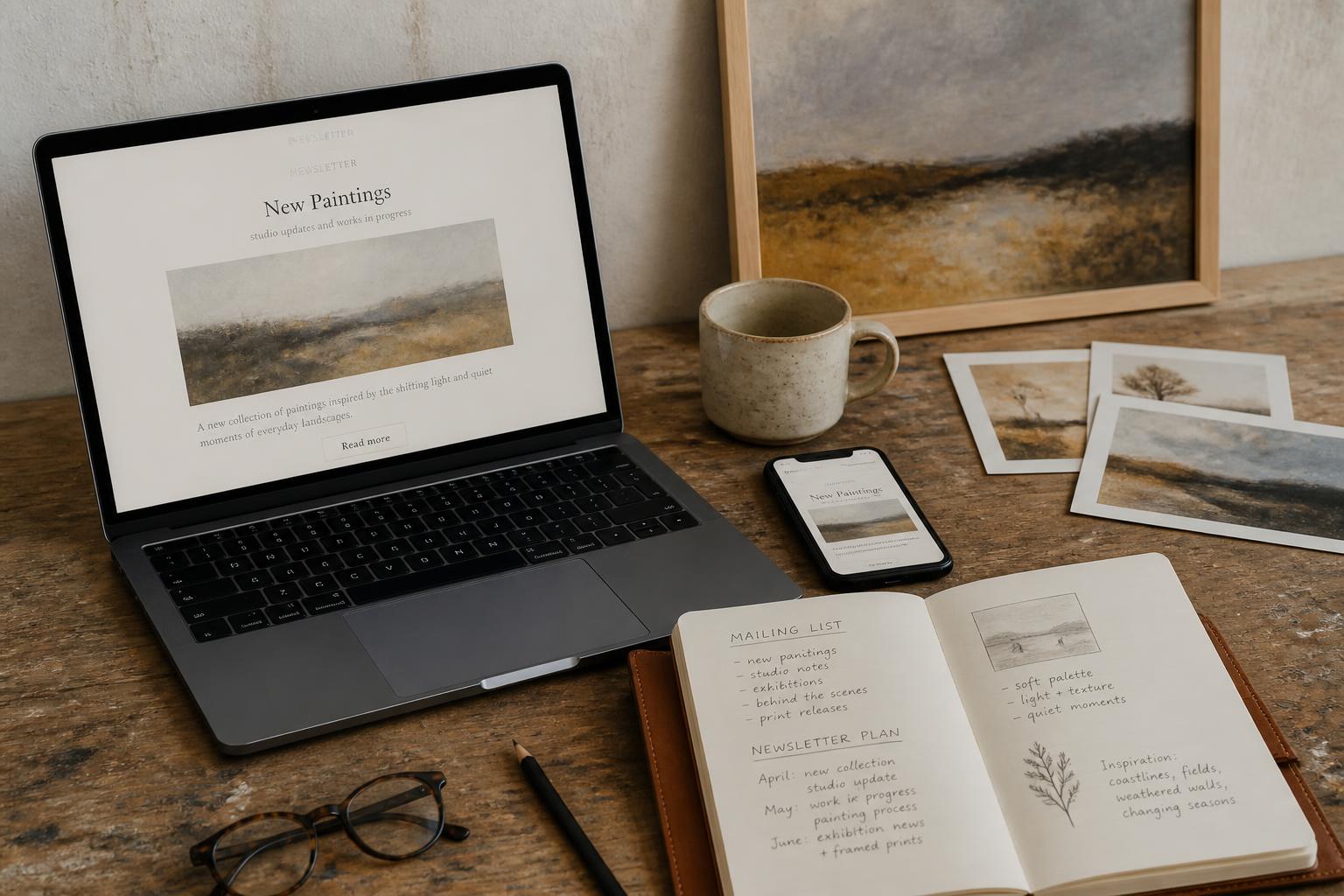
Most artists rely heavily on social media to share their work, but social media reach is unpredictable and followers are not the same as collectors. Email marketing gives artists something quieter and more dependable: a direct line to people who have actively asked to hear from them. It is not about spamming subscribers or sending constant sales messages; it is about building trust with interested people, slowly, over years.
This guide takes a calm, practical view of email marketing for artists. It sits alongside the wider artist marketing plan — the website, the artwork records, the exhibitions, the social presence — and shows how a small, well-tended mailing list can support all of them without becoming another thing to dread.
Why email marketing matters for artists
The case for email is unflashy but strong. Where social media generates encounters, email develops relationships.
- email is more direct than social media — it lands in a personal inbox rather than competing inside a feed
- everyone on a mailing list has actively opted in; they are, by definition, interested
- email supports exhibitions, new work launches, online sales, open studios and post-purchase follow-up
- a mailing list is portable in a way a social media following is not — it belongs to the artist, not to a platform
- email helps maintain relationships in the long gaps between shows, launches and online drops
- it gives artists a quieter route to communicate with serious supporters without performing for a public feed
For many artists, a well-kept mailing list can become one of the most reliable marketing assets they own. Platforms change, algorithms shift, accounts get suspended; an exported list of subscribers survives all of that.
What is an artist mailing list?
An artist mailing list is a list of people who have given permission to receive updates from the artist. That single phrase — given permission — is the whole definition.
A real artist mailing list might include:
- past collectors and buyers
- enquirers who never bought but stayed interested
- exhibition or open-studio visitors who left their details
- curators, art consultants and interior designers who follow the work professionally
- gallery contacts who have asked to be kept informed
- friends, family and long-term supporters who genuinely want updates
A mailing list is not any of these:
- a bought list of "art collector" emails
- a scraped list of gallery or museum addresses
- a random address book imported from a phone or email account
- a list of people quietly added without permission after meeting them once
An artist email list should be treated as a relationship asset, not just a sales tool. The list will almost always be smaller than the social media following — and almost always more valuable.
Use the same care with how the list is described. Calling it a collector mailing list sets one expectation; calling it a studio newsletter sets another. Both are fine, as long as what arrives matches what people signed up for.
How artists can build a mailing list properly
A mailing list for artists is built one person at a time, and almost always through clear, consent-led routes. The practical channels are not exotic:
- a sign-up form on the artist website — homepage, footer, dedicated newsletter page and individual artwork pages all work
- a sign-up link in the bio or pinned post on each social media profile
- a printed sign-up sheet or QR code at exhibitions and open studios
- an explicit invitation to join the list after a genuine enquiry, once a real conversation is already underway
- a tick-box opt-in at checkout or after purchase, where it makes sense
- studio events, talks, workshops or private views, where attendees can opt in alongside RSVPs
- blog or journal posts that offer a single, calm prompt to subscribe at the end
- post-show or post-sale follow-ups that include a clear, optional sign-up
A few simple rules underneath all of this:
- never add people to the list without permission, even close contacts
- keep the sign-up wording honest — say what subscribers will receive and roughly how often
- avoid dark patterns like pre-ticked boxes or hidden bundled consents
- record where each contact came from where possible; it makes later segmentation and trust much easier
How to make an artist mailing list, in practice, is mostly about removing friction from the sign-up routes you already have. A clear form in the website footer and on each artwork page will almost always outperform clever campaigns. The supporting guides on how to build an artist website and how to sell artwork online cover those sign-up surfaces in more detail.
What should artists send to their mailing list?
The most useful artist newsletters draw from real studio activity, not invented content. If there is nothing genuine to share, it is almost always better to wait.
Useful email content for artists includes:
- new artwork announcements
- a current available-works list
- exhibition invitations and previews
- open studio dates and reminders
- studio updates and short reflections on the current series
- work-in-progress notes
- behind-the-scenes images — framing, packing, installation
- collector previews of new work before it goes public
- framing or presentation updates
- limited edition print releases
- post-exhibition notes and remaining available works
- links to new journal or blog posts
- occasional practical updates such as Christmas delivery deadlines or commission windows
Two principles keep all of this grounded. Emails should feel useful and personal, not like generic marketing campaigns. And every email should ideally start from a real artwork or a real studio moment, not from a content calendar that needs feeding.
How often should artists email their list?
There is no single right cadence. Consistency matters far more than frequency.
- a monthly rhythm is a good starting point for most artists
- a quarterly rhythm can work well for artists with slower practices or fewer launches
- email around exhibitions, launches and open studios when there is a genuine reason
- avoid emailing only when there is something to sell — the audience can feel it
- equally avoid disappearing for a year and then sending a hard sales email
- do not send weak emails just to keep a schedule
A practical test is whether you would be happy to receive the email yourself. If the answer is "not really, but I need to send something this month", it is almost always better to wait a week and send a stronger one.
Match the email frequency to the artist's real studio and exhibition rhythm, not to a marketing calendar imported from a different kind of business.
How email supports exhibitions, open studios and launches
Email is at its most useful around real-world events. Exhibitions, open studios and launches are the moments where a small, well-tended list reliably produces visits, enquiries and sales.
A useful sequence around an exhibition or open studio:
- a pre-show invitation a few weeks ahead, with date, time, location and a small handful of preview images
- a private collector preview to the mailing list before any public announcement
- a reminder a day or two before opening, with practical details and an RSVP route
- a short note during the run with install shots and a selection of available works
- a post-show email thanking attendees, sharing install images and listing remaining available works
- a follow-up to specific enquirers, ideally one-to-one rather than as part of a campaign
A new work launch sequence can follow a similar shape: tease, preview, launch, available works, post-launch update. None of this needs to be elaborate; four short, well-judged emails will usually do more than a complex automated sequence.
The companion guides on open calls for artists and how to prepare artwork for an exhibition cover the exhibition side itself; email is what carries the audience through it.
How email connects to artwork records and collector trust
The quality of an email follow-up depends almost entirely on the quality of the records sitting behind it. When an enquiry arrives, the artist needs to be able to answer quickly and accurately.
For every available piece, that means having ready:
- title, medium, support, size and date
- price and current availability
- a strong image and any useful detail crops
- framing notes and delivery information
- provenance and any exhibition history
A complete artwork record — supported by a clear artwork inventory, accurate artwork metadata, up-to-date provenance entries and an issued certificate of authenticity once a piece sells — is what turns a polite email enquiry into a confident sale. The supporting guides on the artwork archive and record system, certificates of authenticity for artwork and what artwork provenance is cover those records in more detail. A documented condition report for older or framed works belongs in the same place.
Collector previews depend on the same records. A "first look" email is only as trustworthy as the information attached to each piece.
What email marketing platform do artists need?
Artists do not need an enterprise marketing system. The best email marketing platform for artists is almost always the simplest one that does the basics well.
The features that actually matter:
- a clean contact list with import and export
- a simple sign-up form that embeds on the website
- a working unsubscribe link in every email
- a straightforward editor that handles a single image and a few paragraphs well
- basic analytics — opens, clicks, unsubscribes
- optional light segmentation, such as separating collectors from general subscribers
- reliable deliverability rather than exotic features
The trap is choosing a tool so complicated that the newsletter never goes out. A simple email marketing platform that gets used every month will outperform a sophisticated one that sits unopened. Keep templates calm and image-led; resist the urge to design a magazine.
This guide deliberately does not name specific tools or turn into a platform comparison. The right answer depends on the artist's budget, existing tools and tolerance for software. The decision is far less important than the habit of actually sending the emails.
Privacy, consent and trust
A short, careful word on privacy. The detail of what is required varies by jurisdiction, and artists should check the rules that apply where they and their subscribers live, or take advice when in doubt. The principles below are common-sense practice rather than legal advice.
- use clear opt-in wording at every sign-up route
- do not buy lists, and do not scrape email addresses from gallery or institutional websites
- include a working unsubscribe link in every email
- send what people signed up for — a "studio newsletter" should not turn into a constant sales channel
- keep the tone respectful, including to people who unsubscribe
- avoid over-emailing
- keep records of where each contact came from, where possible, in case consent ever needs to be demonstrated
Treating the list with care is also the most effective long-term strategy. Subscribers who feel respected stay subscribed, open emails, recommend the artist to others and become collectors over time.
A simple email marketing plan for artists
A workable email marketing strategy for artists does not need to be complicated. A repeatable monthly and quarterly rhythm is usually enough.
A simple monthly rhythm:
- Week 1: decide the purpose of the email — new work, available pieces, exhibition, studio update
- Week 2: prepare images and gather the relevant artwork details
- Week 3: draft the email — short, specific, one clear next step
- Week 4: send the email and record any replies or enquiries
A simple quarterly layer on top:
- one studio update or "behind the series" email
- one available works or collector preview
- one exhibition or open studio email, where relevant
- one list and website check — sign-up forms working, unsubscribes processed, contacts tidy
A simple artist newsletter template that holds up across almost any of those purposes:
- a short personal greeting
- one main image — the strongest available
- a short paragraph about the work, the update or the news
- the practical details — title, medium, size, price, dates, location
- a single clear link or next step
- a calm sign-off, with name and studio
That is enough. Most strong art newsletter examples are built on a structure no more complex than this.
Common mistakes artists make with email marketing
Almost every problem in artist email marketing falls into one of these patterns:
- never starting because the list feels too small
- waiting until there is a large audience before sending the first email
- emailing only when trying to sell
- adding people without permission, often after a friendly first meeting
- writing too formally, or too vaguely, with no real content
- sending image-heavy emails with no context, captions or links
- linking nowhere, so interested readers have no obvious next step
- failing to include title, medium, size or availability when promoting work
- finishing an email with no clear call to action of any kind
- choosing overly complex software and then never sending anything
- neglecting the website sign-up form, so the list stops growing
- not following up after exhibitions or open studios while interest is still warm
- treating email as separate from the artwork archive, sales records and wider marketing plan
A small list, emailed well and consistently, is worth far more than a large list that hears from the artist twice a year.
Email marketing checklist for artists
A short checklist to run through before every send:
- Do I have permission to email every person on this send?
- Is the purpose of this email clear in one sentence?
- Is the subject line specific to what is inside, rather than vague or generic?
- Is the main image strong, well-lit and properly cropped?
- Have I included the relevant artwork details — title, medium, size, price, availability?
- Is there a single clear next step — a link, an enquiry route, an RSVP?
- Does each link go to the correct artwork, exhibition or website page?
- Is the tone personal but professional, in keeping with what subscribers expect?
- Is there a working unsubscribe route?
- Will I record any enquiries, replies or sign-outs after the send?
- Does this email support the wider artist marketing plan, or is it a one-off?
If most of these answers are clear, the email is almost certainly ready. If several are not, it is usually worth holding the send back a day or two.