
How to Price Your Art: A Practical Guide for Artists
A practical guide for artists on how to price paintings, original artwork and commissions — with a working formula, worked examples and UK gallery, VAT and Artist Resale Right considerations.
14 min read
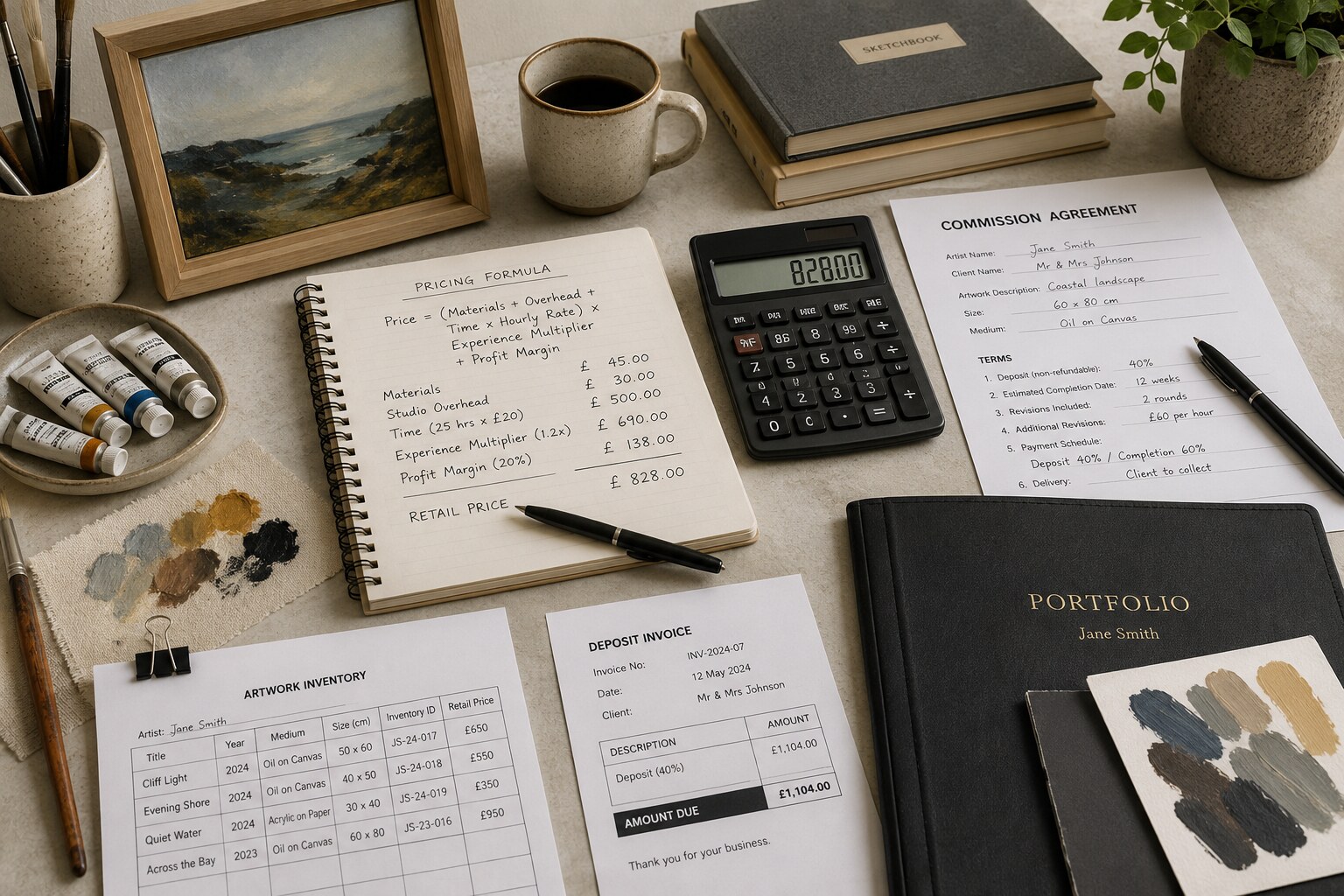
Pricing is the single business decision artists put off the longest. The work is finished, the studio is quiet, and a number has to appear next to it — a number that has to make sense in a studio sale, a gallery showroom, a commission contract and a collector's living room, sometimes all in the same month. This guide is written for artists who want a working method rather than a debate. It covers how to price your art using a clear formula, how to price your paintings consistently across sales channels, how to value artwork beyond cost, how to price art commissions, and how the UK realities of gallery commission, VAT and the Artist Resale Right shape the numbers you set.
Why Pricing Artwork Is Difficult
Pricing an original artwork is harder than pricing almost anything else an independent practitioner sells. Three pressures collide.
The first is that no artwork has a fixed market price per unit. Two paintings of the same size by the same artist can sell for different sums depending on subject, period, exhibition history and who is asking. There is no reference list to copy from.
The second is emotional proximity. Artists either undervalue work through habit ("it only took me a fortnight") or overvalue it through attachment. A method is what separates the price from the feeling.
The third is the channel-multiplier problem. The same painting may be sold direct from the studio, through a gallery taking 40–50% commission, on consignment, or as a private commission. Each route changes what the artist receives, but the price the buyer sees has to stay consistent across all of them.
How to Price Your Art Using a Simple Formula
The most useful starting point is a cost-based formula. It will not tell you what your work is ultimately worth on the secondary market, but it will tell you the minimum number below which selling the work costs you money. Everything else builds upward from that floor.
The formula in full:
Price = (Materials + Studio Overhead + Time × Hourly Rate) × Experience Multiplier + Profit Margin
The process is the same for every work. Calculate each input, multiply by where you are in your career, then add the margin the practice needs to sustain itself.
Materials
List every consumable: stretcher bars, canvas or panel, primer, paint, mediums, varnish, frame, hanging hardware, packaging, and any specialist materials. Itemise rather than estimate. Most artists underprice this line by 30–50% because they only count the obvious materials and forget studio supplies that are quietly absorbed.
Studio Overhead
The annual cost of keeping the practice running, allocated across the works you produce in a year: rent, utilities, insurance, software, equipment depreciation, memberships, photography and accounting. Divide by the realistic number of finished works per year. For most working artists this lands between £30 and £200 per work.
Time and Hourly Rate
Track hours honestly — preparatory drawing, surface preparation, considered drying days, final varnishing and framing. Set an hourly rate that reflects skilled creative labour. £20–£50 per hour is a reasonable UK range, scaled by experience. If you would not accept the rate from a client commissioning your time, do not accept it from yourself.
Experience Multiplier
The experience multiplier is how the formula scales with your career. As a guide:
- 1.0× — Emerging. No solo exhibitions, no gallery representation, small private sales record.
- 1.3–1.6× — Early-career. Group shows, occasional press, building a collector base.
- 1.8–2.2× — Mid-career. Solo exhibitions, gallery representation, consistent sales velocity, institutional or press attention.
- 2.5×+ — Established. Long exhibition history, secondary-market activity, museum or major private acquisitions.
The multiplier is not vanity. It reflects what the market has already shown it will pay for work at that stage, evidenced by a track record.
Profit Margin
A 10–30% margin sits on top of cost. It funds the next body of work, the unpaid weeks between sales, and the slow accumulation that lets an artist keep going. A practice that prices at cost is not a practice; it is a subsidy to the buyer.
Run this process once on a recent finished work before reading further. The number it produces is your floor.
How to Price Your Paintings
Applied to paintings specifically, the formula above is the right starting point — but most ranking guides on how to price paintings stop at the square-inch method, and that is a mistake. A price per square inch (or square centimetre) is useful as a consistency check, not a primary method.
The square-inch method works like this: total height in inches × total width in inches × a rate per square inch. The rate is calibrated by experience and medium. An emerging oil painter might use £2–£4 per square inch; a mid-career painter £6–£12; an established painter £15 and upward. A 40 × 50 cm painting is roughly 16 × 20 in = 320 sq in; at £3 per square inch that is £960.
Use this number to cross-check the formula result. If the formula gives £700 and the square-inch method gives £960, the gap tells you something. Perhaps the formula undercounts your time. Perhaps the square-inch rate is aspirational rather than supported by recent sales. The retail price you publish should reconcile both — not just whichever number is higher.
Two further rules apply. Small works should not collapse to a token price simply because the maths is small; a coherent minimum (often £250–£400 for emerging painters) protects the value of the larger work. Very large works should not scale linearly; the experience multiplier matters more at scale than the square-inch rate.
How to Value Artwork
Pricing and valuation are not the same thing. The formula tells you what the work must sell for to sustain your practice; valuation tells you what the work commands in the market. The two have to be reconciled. Five factors drive how to value artwork.
Exhibition history. Work that has been shown in selected, respected exhibitions carries demonstrable cultural endorsement. A line of solo and selected group shows in the catalogue raises value in a way no marketing can.
Collector demand and sales velocity. A waiting list, a sold-out edition, a series that sells within weeks of release — these are signals the market reads. Pricing should rise in measured steps when demand consistently outpaces supply.
Provenance. A clean, documented chain of ownership protects value over decades. Works without provenance are discounted heavily in resale. The presence of a clear record is itself part of what the buyer is paying for.
Representation and reputation. Gallery representation, press, awards and institutional acquisitions all compress into reputation, which the market converts into willingness to pay. None of this is invented; it is recorded, and it is read off the artist's CV before any price is discussed.
Documentation quality. A signed, numbered Certificate of Authenticity, professional photography, condition records and an organised archive raise the perceived seriousness of the practice — and reduce friction at the point of sale. Buyers pay more readily for work that arrives with paperwork that looks like the paperwork of a serious career. The supporting discipline is covered in our guide to artwork management for artists.
The work of building artwork provenance and issuing certificates of authenticity is part of pricing, not separate from it. Both defend the price after the sale.
How to Price Art Commissions
Commissions are not standard works sold at retail. They are bespoke, time-bound and contractual, and they should be priced higher than a comparable studio work — usually by 15–30%. The premium pays for the constraints: a specific brief, a specific deadline, a specific client, and the loss of the freedom to abandon or redirect the work mid-process.
The components of a commission price.
Base price. Apply the standard formula to the planned work as if it were a studio piece. This is the floor.
Commission premium. Add 15–30% on top of the base price. The lower end suits straightforward briefs from existing collectors; the upper end suits demanding briefs, tight deadlines, or first-time commissioners.
Deposit. A non-refundable deposit of 33–50% is standard practice and should be taken before any work begins. It commits the client and protects the artist's time. The remaining balance is paid on completion, before delivery.
Revisions. State the number of revision rounds included (typically two) and price additional rounds explicitly. Open-ended revisions are how commissions become unpaid labour.
Commercial use and licensing. Personal display rights are included in the sale. Any commercial use — reproduction, merchandise, advertising, digital distribution — is a separate licensing fee, contracted on its own terms. Never bundle licensing into the artwork price; it gives away rights the artist cannot easily recover.
Delivery, framing and installation. Treat as line items, not absorbed costs.
A short written agreement covering all of the above is non-negotiable. The commission price is what the client pays; the commission agreement is what makes the price stick.
Pricing Artwork for Galleries
Selling through a gallery does not change the retail price. It changes what the artist receives from the same retail price.
UK galleries typically take a gallery commission of 40–50% on works sold through their space. In exchange the gallery provides physical exhibition space, marketing, audience, sales handling, transactions and credibility. A £4,000 painting sold through a 50% gallery leaves the artist with £2,000 before VAT.
The non-negotiable rule is price consistency. The painting must carry the same retail price whether sold through the gallery, through the artist's website, or directly from the studio. Undercutting the gallery from the studio is short-term cash and long-term reputational damage; galleries stop working with artists who do it, and collectors stop trusting prices they see undercut elsewhere. For the practicalities of presenting and pricing work on your own website, see How to Sell Artwork Online.
VAT applies in the UK once turnover crosses the registration threshold (£90,000 from April 2024). Below the threshold, prices are quoted as a single number. Above it, the artist must add VAT (currently 20% standard rate, with the reduced 5% margin scheme available for some second-hand and art transactions through eligible dealers). VAT-registered galleries may quote prices VAT-inclusive to the public while accounting for VAT separately with the artist; the underlying retail price the artist sets needs to anticipate this. Take advice from an accountant familiar with the art trade before the threshold approaches.
Pricing Artwork for Consignment Sales
Consignment is a different model from gallery representation, though the terms are often confused. The work is placed with a dealer, gallery or third party who agrees to attempt to sell it within a defined period. Ownership remains with the artist (or the previous owner, in secondary-market consignment) until sale.
Consignment splits are usually more favourable than gallery commission splits — typically 60/40 or 70/30 in favour of the consignor — because the consignee carries less risk and offers fewer of the services a representing gallery provides. A written consignment agreement should cover: the works listed, the agreed retail price (which the consignee cannot vary without permission), the split, the consignment term, insurance responsibility while the work is held, return shipping terms, and the documentation that travels with the work.
That documentation is what protects the artist over a resale chain that may extend for decades. Each consigned work should leave the studio with current photography, a condition report, a Certificate of Authenticity and a clear inventory entry. For a full treatment of what every consignment agreement should contain, see Gallery Consignment for Artists.
The Artist Resale Right (ARR) applies in the UK to qualifying resales of original works through an art-market professional at €1,000 or more. The royalty runs on a sliding scale starting at 4%, capped at €12,500 per resale, and applies for the artist's lifetime plus 70 years. It does not apply to first sales by the artist, only to subsequent resales. Collecting societies such as DACS administer the right; registration is straightforward and the royalty arrives without the artist tracking resales personally.
How Much Should I Charge for My Art?
A useful question with an uncomfortable answer: the right amount is whatever the formula produces, calibrated honestly to your career stage and supported by the evidence of recent sales. Most artists at every stage are underpricing rather than overpricing, because they price against fear of rejection rather than against the cost of producing the work.
A working sanity check. If you sold every available work at your current price this year, would the income sustain your practice — the materials, the studio, the time, the months between sales? If the answer is no, the price is too low regardless of what the market is "willing to pay", because the current price is already a subsidy. Raise prices in measured steps (10–20% annually is sustainable when supported by exhibitions and sales) rather than waiting for a single breakthrough to justify a jump. The artists who price coherently across a decade end up with stronger secondary markets than the ones who price reactively.
Worked Pricing Examples
Three examples, with the formula visible.
Example 1 — Emerging artist, 40 × 50 cm oil on linen
- Materials: stretched linen £35, paint and mediums £20, varnish and packaging £10 → £65
- Studio overhead allocation: £40
- Time: 28 hours × £22 → £616
- Subtotal cost: £721
- Experience multiplier (emerging, 1.0×): £721
- Profit margin 20%: £144
- Retail price: ~£865
Square-inch cross-check: 16 × 20 in = 320 sq in × £3 = £960. The two methods bracket each other. A defensible studio retail of £900 rounds cleanly and sits between both.
Example 2 — Mid-career artist, 100 × 120 cm mixed media on panel
- Materials: panel £140, paint and mediums £85, varnish and float frame £180 → £405
- Studio overhead allocation: £140
- Time: 65 hours × £38 → £2,470
- Subtotal cost: £3,015
- Experience multiplier (mid-career, 1.9×): £5,729
- Profit margin 25%: £1,432
- Retail price: ~£7,160 → published at £7,200
Through a gallery on a 50% commission, the artist receives £3,600 before VAT. The retail price is identical from the studio, the website and the gallery.
Example 3 — Commissioned portrait, 60 × 80 cm oil
- Base price using the formula as a comparable studio work: £2,600
- Commission premium 25%: £3,250
- Deposit (50% non-refundable, taken at contract signing): £1,625
- Revisions: two rounds included; further rounds £180 each
- Licensing: personal display only; commercial use requires a separate licence
- Delivery and framing: itemised separately on the invoice
Final commission price: £3,250 plus delivery, with the balance of £1,625 due on completion before the work leaves the studio.
Common Artwork Pricing Mistakes
The recurring errors are predictable and worth naming.
- Pricing below materials cost. Selling a work for less than the receipts attached to it is a loss disguised as a sale.
- Inconsistent prices across channels. The same work appearing at three different prices online destroys trust faster than any single high price.
- Raising prices on a single sale. One generous collector does not establish a market. Raise prices on the evidence of consistent demand, not a single transaction.
- Bundling licensing into the artwork price. Once given away, commercial rights are difficult to reclaim. Price them separately.
- Forgetting VAT, packaging and shipping. All three eat into margin invisibly. Build them in before quoting.
- Discounting the studio price to undercut the gallery. Short-term cash, long-term loss of representation.
- Never raising prices at all. A static price list across five years signals a static practice. Annual review is standard professional discipline.
A solid pricing practice depends on a solid record of what you have made, where it has been shown and who has owned it. The supporting work belongs in the artwork management system and the professional artist portfolio that surfaces it to galleries, collectors and curators.
Frequently Asked Questions
A Sustainable Pricing Practice
Pricing is a system, not a single decision. The formula gives a floor; the experience multiplier scales it; the channel rules keep it consistent; the documentation defends it after the sale. Reviewed annually and applied consistently, the result is a coherent price history the market can read — and that supports the long career the work was made for.
For related reading in this Studio Journal, see Limited Edition Prints and Artwork Valuation and Insurance.