
What Makes a Good Artist Website?
A good artist website makes the work easy to see, understand and enquire about. Learn the essential pages, structure and practical details that help a portfolio feel professional.
14 min read
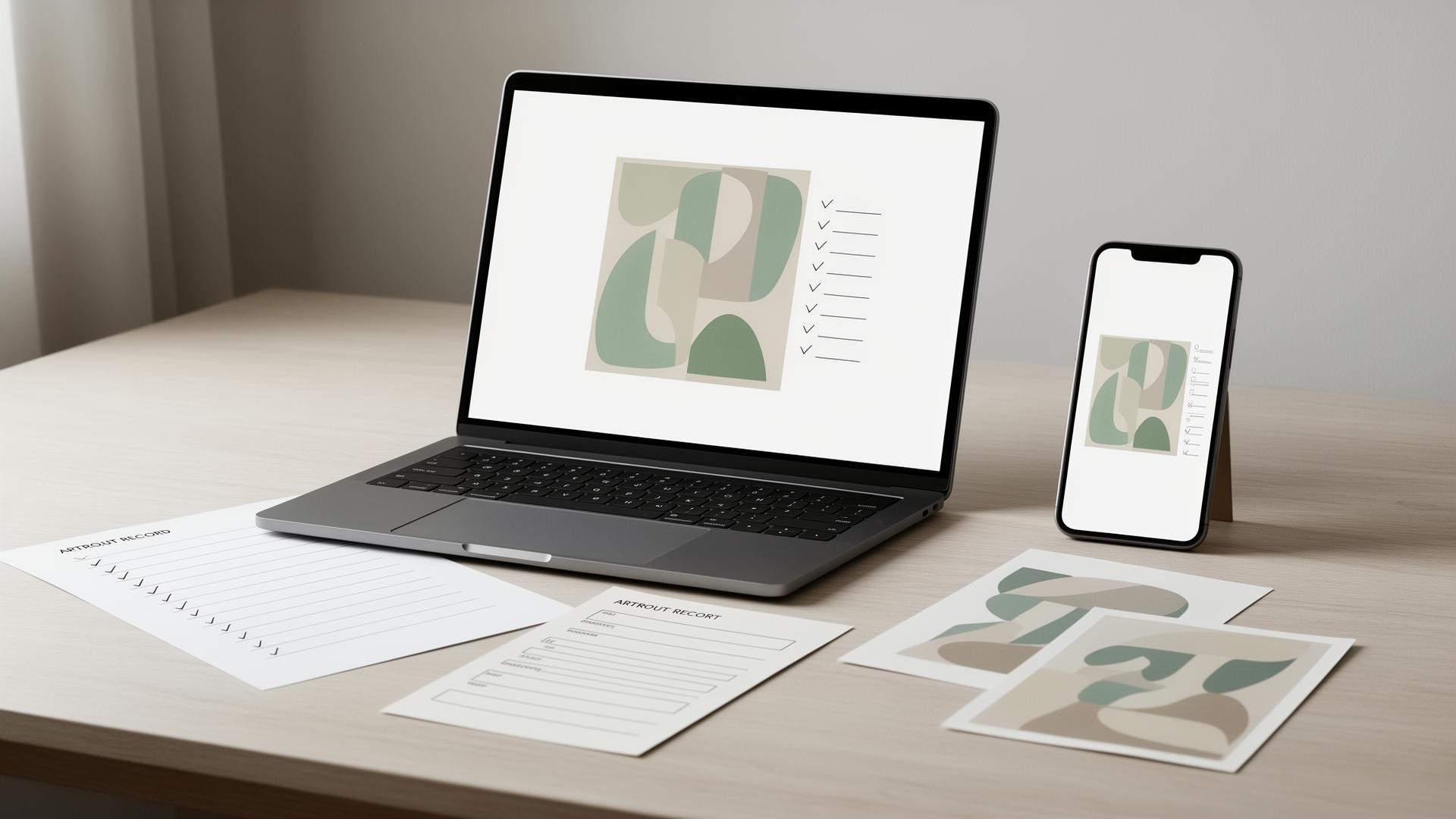
A good artist website is not the same as a beautiful one. Many practising artists judge their site by how it looks on a desktop preview, but visitors arrive with specific questions: who is the artist, what is the current work, is anything available, and how do they get in touch. If a website cannot answer those questions quickly, design alone will not rescue it.
This guide is written for practising visual artists — painters, sculptors, printmakers, photographers and mixed-media artists — who want to assess whether their existing website is good enough, and to understand what makes a good artist website. It is not aimed at music artists, student portfolios, makeup or tattoo artists, GCSE or AP coursework, or graphic-design job portfolios. The reference point throughout is the working artist website, the kind that has to function for collectors, galleries, curators and press as well as for friendly visitors.
The question "what should an artist website include" has a fairly settled answer. The harder question is how those elements work together. A good site shows the work clearly, explains the practice, makes enquiries easy, builds trust, performs on mobile, has basic SEO in place, and — crucially — stays connected to reliable private artwork records behind the scenes. Many artist websites, whether UK-based or international, fall short in two or three of those areas at once. How to make a good artist website, in practical terms, is mostly about closing those gaps.
Why "good" means more than attractive design
Visual design matters. A website that looks dated or inconsistent can quietly undermine years of serious practice. But attractive design is a baseline, not the finished job. A beautiful website can still fail badly if visitors cannot find what they need, if the available work is buried, or if the contact route is unclear.
Different visitors arrive with different priorities. A collector wants to see current work and know what is available. A gallery or curator wants to understand the practice, see exhibition history, and gauge whether the work fits a programme. A press contact wants quick access to a biography, statement and high-quality images. A returning buyer wants to check provenance or follow up on a previous purchase. A good artist website acknowledges those differences and makes each path short.
Good design supports the artwork rather than competing with it. Heavy typography, aggressive colour, busy backgrounds and constant animation pull attention away from the work. The professionalism of a site comes less from its visual fashion and more from clarity, completeness and trust. Visitors should feel that someone is looking after the site, that information is current, and that the artist behind it takes the practice seriously.
A good artist website shows the work clearly
The artwork is the reason the site exists. Images need to be large, accurate and consistent. Photographs taken in different lighting conditions, at different angles, or against different backgrounds make a portfolio look uneven even when the work itself is strong. Where possible, document new work in the same way each time: square-on, even lighting, a neutral background, and a known colour profile.
Avoid over-cropping. A square thumbnail might look tidy on a grid, but if the click-through still hides part of the painting, visitors will not trust what they are seeing. Show the full image first, then offer detail shots, framed views or in-situ photographs as supporting material. Detail shots are particularly useful for textured surfaces, printmaking and mixed media, where the small-scale decisions matter.
Keep the interface and background calm. Pale grey, off-white or a restrained dark tone tends to serve painting and photography better than strong colour. Avoid distracting sliders, automatic carousels, pop-ups and constant animation. Each of those elements asks for attention that should be going to the artwork. The artwork should feel like the main event, not decoration inside a template.
A good artist website explains the artist and the practice
Visitors want to understand who made the work and why. A short biography, written in plain language, is more useful than a long one written in art-school prose. Cover where the artist is based, the main medium, the recurring themes, and the broad shape of the professional history so far.
An artist statement sits alongside the biography and goes a step further. It explains what the work is concerned with — the questions, materials, processes and references that shape current practice. Keep it grounded. Visitors do not need a manifesto; they need enough context to look at the work with more attention. For a fuller treatment, see How to Write an Artist Statement.
For how the biography and statement sit alongside current work, recognition and contact, see how to write an artist About page.
Avoid overlong, vague or over-theoretical writing. Statements that could apply to almost any artist tell a visitor very little. Specific references — to a place, a material, a process, a set of ideas — give the work somewhere to stand. A separate Artist CV & Biography Guide will cover the CV side of this in more depth in a later article.
A good artist website gives important artworks their own pages
A simple grid of thumbnails is fine as an overview, but it cannot do the work of individual artwork pages. Galleries, curators and serious buyers expect to be able to click into a piece and find proper details.
Each individual artwork page should include, at a minimum:
- Title
- Artist name
- Medium
- Dimensions
- Year
- Price or status (available, on hold, sold, NFS)
- Availability and any edition information
- Short description or context
- Framed or unframed status
- Exhibition history where relevant
- Certificate or provenance notes where relevant
This is also where a public site begins to depend on a private artwork record. The page on the website is only as accurate as the underlying record. If the studio inventory says one thing and the website says another, the discrepancy will eventually be noticed — usually at the worst moment. For more on the record side, see Artwork Archive Database & Record System, What Is Artwork Provenance? and Certificates of Authenticity for Artwork.
A good artist website makes enquiries easy
Enquiries are the point at which a website stops being a brochure and starts being useful. Every artwork page should have a clear contact route — a button, a short form, or a visible email address — without forcing the visitor to hunt for it. A single Contact page tucked away in the menu is not enough.
The form itself should be reliable. Test it from a phone, from a different network, and from a different email address every few months. Make sure responses arrive in an inbox that is actually monitored. Tell the visitor what happens next: who will reply, in what kind of timeframe, and what information they should include if they are enquiring about a specific piece.
Avoid making people message only through Instagram or another social platform. Many serious buyers, galleries and press contacts will not start a conversation in a direct message. If general enquiries (press, exhibitions, commissions) need to go somewhere different from artwork enquiries, say so plainly.
A short mini-checklist for the enquiry layer:
- Is there a contact route on every artwork page?
- Does the buyer know what happens next?
- Is the artist reachable without creating an account or using social media?
A good artist website builds buyer and gallery trust
Trust is the quiet quality that makes the difference between a visitor browsing and a visitor enquiring. It is built from many small signals: a clear artist identity, accurate artwork details, consistent availability and pricing, professional photography, a coherent exhibition history, and visible attention to documentation.
Where work is sold, basic terms matter. Delivery information, returns or cancellation rights, payment methods and the broad shape of the sales process should be findable. Where a certificate of authenticity is issued with a sale, or where provenance is part of the work's history, mentioning this on the relevant pages reinforces that the artist treats records seriously.
Broken links, unfinished pages, missing images and out-of-date news erode trust quickly. A site that has not been touched in two years suggests a practice that may have moved on without updating its public face. For more on the wider sales and gallery context, see How to Sell Artwork Online, How to Get Your Art Into a Gallery and Open Calls for Artists.
A good artist website works properly on mobile
Most visitors arrive on a phone. They may tap a link in an Instagram bio, follow a newsletter, click through from a search result or open a gallery's email on the move. If the mobile experience is poor, the desktop experience does not get a chance.
Images should load quickly. Very large files that were perfect for desktop can stall on a phone, especially on slower connections. Text should be readable without zooming. Menus should be simple enough to use with a thumb. Enquiry forms should work on small screens and submit without forcing the visitor to scroll through unlabelled fields.
Test on real devices, not only on a desktop browser's mobile preview. Different phones, different operating systems and different browsers will surface issues that a preview window hides. A small amount of regular testing prevents the kind of silent failures — a contact form that does not send, a slider that traps a finger — that lose enquiries without ever being noticed.
A good artist website has basic SEO in place
Search is not a trick. Treat it as a long-term visibility system that helps the right people find the work. The basics are not difficult: each page should have a clear page title, a meta description that summarises what the page actually contains, and a single H1 that reflects the page's purpose. Artwork URLs should be descriptive rather than full of numbers and codes.
Alt text on images matters for accessibility and for search. Describe what is shown and who made it, rather than repeating the same keyword.
A few quick comparisons:
- Bad page title: "Untitled page"
- Better page title: "Available Abstract Landscape Paintings | Artist Name"
- Bad alt text: "painting"
- Better alt text: "Abstract landscape painting in acrylic on paper by Artist Name"
Beyond the basics, internal links between related pages — series to individual works, statement to biography, artwork pages to enquiry — help both visitors and search engines understand how the site fits together. Artist name searches, location, medium and style searches are the realistic targets for most practising artists. Avoid keyword stuffing; it reads badly to visitors and provides no lasting advantage.
A good artist website connects public pages to artwork records
The public website is the visible layer. Behind it should be a set of accurate records that the public pages draw from, directly or indirectly. The website is then a presentation of the archive, not a separate, parallel system that has to be kept in sync by hand.
The records behind a serious artist website usually include:
- An inventory number for each work
- Consistent dimensions and medium fields
- Current availability and sale history
- Exhibition history per work
- certificate of authenticity records
- provenance and ownership history
- Location tracking, including loans and storage
- Supporting artwork documentation — installation shots, condition notes, related correspondence
- A clear artwork cataloguing convention so nothing slips between systems
When the practice is small, all of this can be held together in spreadsheets and folders. As the body of work grows, as more pieces leave the studio, and as galleries and collectors begin to ask questions years after a sale, ad-hoc systems start to leak. Vault Canvas helps artists keep the public presentation of their work connected to the private records behind it — artwork details, documentation, certificates, provenance and portfolio information — without turning the website into a separate, disconnected task. For more on the record layer, see Artwork Management for Artists and Artwork Archive Database & Record System.
Signs your artist website needs improving
A few patterns tend to show up again and again when reviewing artist websites. Any one of them is a prompt to look more carefully:
- The work shown is several years out of date, or the current direction is not represented
- It is not clear which series or body of work is the current focus
- Artworks have no individual pages, only thumbnails
- There is no obvious contact route, or contact relies entirely on social media
- Availability is unclear, with sold work mixed in beside available work without any indication
- The mobile layout breaks, overlaps or hides important elements
- Images are slow to load, especially on phones
- There is no statement, or the statement reads as filler
- The CV or exhibitions list is months or years out of date
- Internal links are broken, or pages return errors
- Artwork details — title, dimensions, year, medium — differ between the website, invoices and certificates
These are the issues that quietly cost enquiries. None of them require a redesign. Many can be addressed through a focused review and a series of practical updates, especially once a proper artwork record system is in place behind the scenes.
Artist website checklist
A practical audit checklist for a working artist website. Used honestly, it is a more useful tool than a redesign brief.
- Does the first screen show strong, current work?
- Can visitors find available work within one or two clicks?
- Is the navigation clear, with no more than six or seven top-level items?
- Does every important artwork have title, medium, dimensions and year?
- Is availability clearly marked on each piece?
- Is there an obvious enquiry route on every artwork page?
- Is the artist statement easy to find from the main menu?
- Is the biography current, including location and main medium?
- Is the CV or exhibitions page up to date for the current year?
- Are images consistent in lighting, colour and framing?
- Does the site work on mobile, including menus and forms?
- Are page titles and meta descriptions filled in for every page?
- Is alt text present on every artwork image?
- Are internal and external links all working?
- Are public artwork details backed by private artwork records?
- Are certificates and provenance handled, where relevant, and reflected on the site?
If most of these are in place, the website is doing its job. Where several are missing, those are the places to start.
For background reading in this pillar, How to Build an Artist Website covers the broader structure, Best Artist Portfolio Websites compares platform options, and Artist Portfolio Examples shows portfolio structures suited to different practices.