
How to Create an Artist Marketing Plan
A practical, calm guide for visual artists who want a manageable marketing plan that connects their artwork, website, portfolio, exhibitions, sales channels and follow-up into a repeatable routine.
16 min read
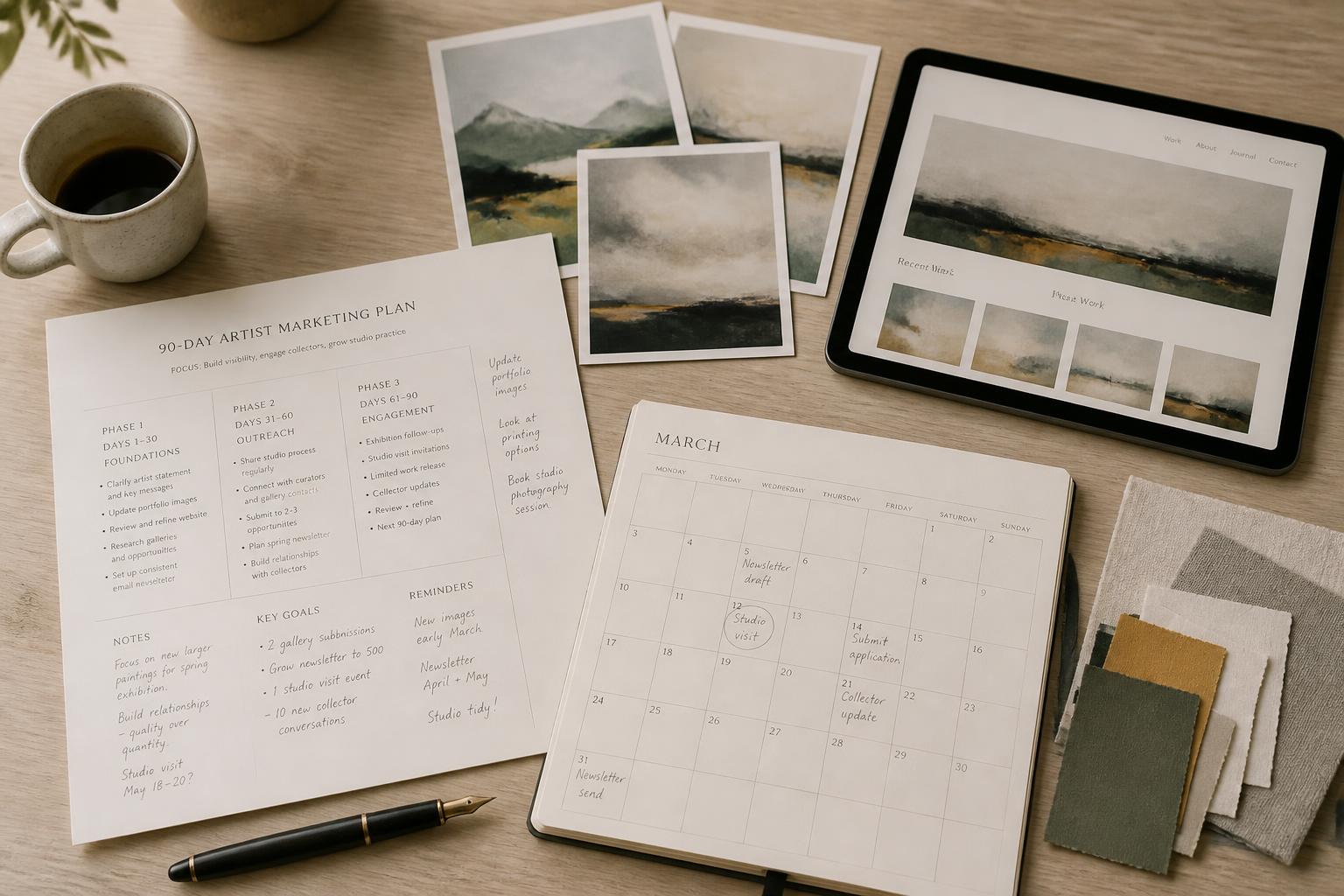
Most artists know they should be marketing their work, and most end up doing it reactively. A post goes up when there is a free afternoon. An open call gets a rushed application the night before deadline. The website is updated only when a piece sells or a gallery asks for a link. A sales push happens when the studio rent is due. The work is good; the marketing is patchy and anxious.
An artist marketing plan is the calm alternative. It is not a corporate document, a content calendar from a brand agency, or a list of growth hacks. It is a simple working system for helping the right people see, understand and remember the work. This guide sets out a practical marketing plan for an artist — built around real studio practice, designed for visual artists rather than marketers, and small enough to actually use. It connects website, portfolio, photographs, descriptions, social media, email, exhibitions, open calls and collector follow-up into a single routine you can repeat every quarter.
Why artists need a marketing plan
Visibility rarely happens by accident. A handful of artists build audiences through one viral moment; almost everyone else builds it slowly, through repeated, useful exposure — a website that ranks for the right phrases, a portfolio that gets passed around, a steady email list, a few exhibitions a year, a recognisable body of work shown well.
Collectors, curators and galleries usually need several encounters with an artist before they act. They see a piece on Instagram, then again in a newsletter, then on the website, then at an exhibition. The decision to enquire or buy lands somewhere in that sequence. A marketing plan is what makes those encounters likely instead of accidental.
A plan also reduces the last-minute panic that surrounds most launches, exhibitions and open-call deadlines. When images, descriptions, CV, statement and price list already exist in usable form, an opportunity becomes a single afternoon of preparation rather than a lost week.
Marketing should support the studio practice, never overwhelm it. If marketing eats the time you need to make the work, the plan is wrong.
What an artist marketing plan should include
A useful artist marketing plan covers a small number of core elements and connects them. You do not need to do everything at once; you need each part to exist at a basic level and to point at the others.
The core elements are:
- clear goals
- a defined audience
- positioning — what the work is and who it is for
- artwork assets — images, descriptions, prices, availability
- a website and portfolio that act as a stable home for the work
- a clear online sales or enquiry route
- a small number of consistent social media channels
- an email or contact list
- exhibitions and open calls
- a content plan you can actually sustain
- a follow-up routine for enquiries and collectors
- record keeping — inventory, certificates, provenance
- a simple review schedule
A marketing plan for an art business does not need to be longer than a single page. The depth is in the routine, not the document.
Define your audience and positioning
"Everyone who likes art" is not an audience; it is a hope. A useful audience is specific enough that you can imagine the kind of person you are writing for and the channels they actually use.
For most visual artists, the realistic audience is some mixture of:
- collectors who already buy work in your medium and price range
- curators and selectors who programme exhibitions and open calls
- galleries who might represent or consign work
- interior designers and art consultants placing work into projects
- open-call selectors who read submissions in bulk
- local buyers who discover work through events, studios or word of mouth
- online buyers who find work through search, social media or referrals
Positioning sits next to audience. It is the short, honest answer to "what is this work and who is it for?" — a sentence or two you can use across your website, portfolio, statement, applications and bio. Strong positioning makes every other piece of marketing easier.
Positioning is closely tied to your artist statement, your artwork descriptions and the writing on your portfolio pages. Those pieces of writing should agree with each other. If your statement says one thing, your portfolio says another, and your artwork descriptions sound like a third artist, the work is harder to place.
Set realistic marketing goals
Goals should be practical, measurable and short enough to act on. "Get more exposure" cannot be planned for and cannot be reviewed. Useful goals are concrete and time-boxed.
Examples of realistic goals for a visual artist:
- increase enquiries through the website by a defined amount over 90 days
- build a mailing list from zero to a first 100 contacts
- prepare a small series for an exhibition or studio open day
- sell a small group of works in a defined window
- improve open-call success by submitting to a small, well-chosen list
- bring the portfolio up to a standard you would send to a gallery without editing
- build repeat visibility with a defined group of existing collectors
Use 90-day goals rather than huge annual plans. A quarterly horizon is short enough to stay honest, long enough to do real work, and matches the rhythm of exhibitions, applications and studio cycles. Set two or three goals per quarter, not ten — marketing plans fail more often from overreach than from underambition.
Prepare your artwork assets
Marketing becomes dramatically easier when every artwork carries a complete asset set. Without that set, every opportunity becomes another scramble through camera rolls, half-finished spreadsheets and outdated descriptions.
A complete artwork asset set includes:
- strong photographs — full image, detail crops, framed or scale image
- a clear artwork description that can be reused across website, portfolio and listings
- title, medium, dimensions and year
- price or enquiry status
- availability — available, sold, reserved, on consignment, in exhibition
- certificate and provenance information where relevant
- social crops — square and vertical versions of the main image
- web-ready image files at consistent sizes
When this set exists for every piece, a launch becomes simple. A website page, a newsletter, a small group of social posts, an open-call submission and a price-list entry are all assembled from the same building blocks.
The supporting guides on how to photograph artwork and how to write artwork descriptions cover the two assets most artists underinvest in. The guides on artwork management for artists and the artwork archive database and record system describe how those assets stay organised over time.
Choose your marketing channels
Channels should match the artist's work, time and audience. A few consistent channels are always stronger than many neglected ones; one well-run newsletter beats three abandoned social accounts and an unused YouTube channel.
The realistic channel list for most visual artists:
- the artist website — stable, owned, searchable
- an email or mailing list
- one or two social media channels, usually Instagram
- Pinterest, when the work suits visual search
- short video or YouTube, when the process or studio reads on camera
- open calls and exhibitions
- gallery relationships and consignment
- local events, studios and open days
- online selling platforms or marketplaces, where they match the work
- art fairs and studio events
- direct follow-up with existing collectors and enquirers
Choose two or three primary channels and treat them seriously. Treat the rest as occasional.
Artist website and portfolio
The website is the stable home for the work. Social posts disappear within days and platforms come and go; an artwork page on your own domain remains searchable, linkable and yours.
Every artwork on the site should have strong images, a clear description, accurate metadata and a visible enquiry or purchase route. Portfolio pages should support credibility — series, exhibitions, press, CV — without overwhelming a first-time visitor. The website is the place that all other marketing activity should eventually point at, because it is the only place where people can act.
The supporting guides on how to build an artist website, the best artist portfolio websites and artist portfolio examples cover the structural side in more depth, and how to sell artwork online covers the enquiry and sales route.
Email marketing and collector follow-up
An email or contact list is one of the most stable assets an artist can build. It is not subject to algorithms, it does not disappear when a platform changes, and it tends to convert into actual enquiries and sales at far higher rates than social posts.
Useful artist newsletters are simple. New work, studio notes, exhibitions, available pieces and the occasional invitation are enough. Most artists overestimate how often they need to send and underestimate how willing their list is to hear from them — once a month, or even once a quarter, is plenty if the email is interesting.
Collector follow-up sits alongside this. Collectors often need time before buying. A respectful, well-timed update — a new piece in a series they have bought from, an exhibition opening near them, a quiet note when something becomes available — is more effective than any promotional push. Keep clear notes on enquiries, conversations, interests and previous purchases so follow-up is informed rather than generic.
Open calls, exhibitions and offline visibility
Marketing is not only digital. Open calls, exhibitions, studio events, local partnerships and gallery relationships build credibility in ways that no number of posts can match. They also produce the press, CV entries, install shots and quotes that strengthen the rest of the plan.
Planning ahead is what makes this work. Submissions and exhibitions reward artists who already have images, statements, CV, descriptions and labels prepared. Exhibition marketing should begin before the opening and continue afterwards — a pre-opening newsletter, a short run of posts in the week before, an opening-night recap, a post-show available-works update and a thank-you to anyone who came are all part of the same arc.
The supporting guides on open calls for artists, how to prepare artwork for an exhibition, how to get your art into a gallery and gallery consignment for artists cover the wider exhibition and gallery side.
Content planning without burnout
The marketing plan has to be sustainable. Artists do not need to post every day; daily posting at the cost of studio time is a bad trade.
Useful content categories repeat. Once you have five or six that fit the work, you can rotate through them without inventing fresh ideas every week:
- finished artwork
- detail or process
- studio notes
- exhibition or open-call news
- artwork stories and context
- archive, provenance or documentation behind a piece
- collector questions and responses
- a small available-works update
Turn one artwork into multiple pieces of content rather than treating each post as a separate creative project. Batch where possible: a single studio session can produce a month of material if photography and writing are done together. Review what actually leads to enquiries, visits and sign-ups — two or three formats will usually be doing almost all the work.
Records and follow-up
Marketing activity is wasted if the records behind it are weak. An enquiry that arrives through the website, a collector who asks about an upcoming piece, an exhibition that sold a work — all of these need somewhere to live so a future you can pick up the conversation.
The artwork record sits at the centre of this. Each piece has its images, description, dimensions, price, availability, exhibition history, certificate and provenance attached. Collector and enquiry notes sit alongside. A few minutes of admin after each enquiry saves hours of reconstruction later.
Strong records also protect the work. Up-to-date artwork inventory, accurate certificate of authenticity information, current provenance entries and consistent artwork metadata mean that any opportunity — an unexpected sale, a gallery enquiry, an insurance claim, a future resale — can be handled professionally rather than reactively.
Simple artist marketing plan template
A practical artist marketing plan template you can reuse every 90 days. Keep it to one page; the value is in completing it, not in the document.
Goal for the next 90 days. One or two specific outcomes — for example, prepare a small series for a December studio event and add 50 contacts to the mailing list.
Audience. Who you are trying to reach this quarter — local collectors, online buyers, a specific curator, a small gallery you would like to work with.
Key works or collection to promote. The pieces or series at the centre of the plan.
Website and portfolio tasks. What needs updating — new artwork pages, series page, portfolio refresh, About page rewrite, fixing broken images.
Artwork assets needed. Photographs, descriptions, social crops, certificates, prices and any missing record entries.
Main channels. Two or three — for example, website, Instagram, mailing list.
Content themes. Four or five repeatable categories you will rotate through.
Email and contact plan. Frequency, what each email will cover, what counts as a successful follow-up.
Exhibition and open-call dates. Deadlines and openings within the quarter, with the preparation work each one needs.
Follow-up actions. Enquiries to chase, collectors to update, post-show notes to send.
Record-keeping actions. Inventory updates, certificate issue, provenance entries, anything that has slipped.
Review date. A fixed date to look at what worked, what did not and what changes for the next 90 days.
A filled-in example, for an artist preparing to launch a small group of works:
Goal (Q1). Launch the "Quiet Divides" group of six works; convert at least three enquiries into sales; add 75 contacts to the mailing list. Audience. Existing collectors, local buyers within a two-hour radius, one regional gallery I have shown with before. Key works. Six paintings, 60 × 80 cm, oil on linen-covered panel. Website tasks. New series page; six artwork pages with images, descriptions and prices; updated About page. Assets needed. Full images, two detail crops each, one framed shot each, square social crops, written descriptions, certificates issued. Channels. Website, Instagram, mailing list. Content themes. Finished work, detail, process, series context, studio notes. Email plan. One pre-launch note, one launch email, one available-works update three weeks later. Exhibitions. Local group show in February; submission to one regional open call by 15 March. Follow-up. Update three existing collectors directly; thank-you note to everyone who attends the launch. Records. Inventory entries for all six works; certificates and provenance updated as sales close. Review date. End of March.
Artist marketing checklist
A practical checklist to run through before launching the next round of activity:
- Is the goal clear and time-boxed?
- Is the audience specific?
- Are the artwork images ready and consistent?
- Are the artwork descriptions written and stored?
- Are the website and portfolio pages up to date?
- Is there a clear enquiry or purchase route on every artwork page?
- Are social posts planned from real artwork assets, not invented on the day?
- Is there an email or contact follow-up route?
- Are open-call and exhibition deadlines recorded and prepared for?
- Are certificates, provenance and artwork records current?
- Is the plan realistic for the time you actually have between studio days?
- Is there a fixed review date in the diary?
Common mistakes in artist marketing plans
The same problems come up across hundreds of artist marketing plans:
- trying to market to everyone, and so reaching no one in particular
- relying only on Instagram and treating it as the whole strategy
- posting without ever linking back to a website or enquiry route
- launching new work before images and descriptions are ready
- having no mailing list or follow-up system, so every sales push starts cold
- treating every platform as equally important and stretching too thin
- setting vague goals such as "grow my audience"
- overplanning the document and never doing the work
- underplanning and reacting to every deadline at the last minute
- neglecting records, certificates and artwork details
- judging success only by likes rather than by enquiries, relationships and sales
The goal of a marketing plan for an artist is not perfection; it is to make the next 90 days less reactive than the last.
Social media for artists
Social media is useful and limited. It is a place to show finished work, process, studio context, exhibitions, launches and the stories behind pieces — but it is not the whole marketing plan, and it should not be treated as one. The algorithm decides reach, the platform owns the audience, and a single account change can erase years of work.
A few practical principles keep social media in proportion:
Pick the one or two platforms that match your work and audience, post consistently, and stop treating reach as the measure that matters.