
Artwork Documentation Checklist: What Artists Should Record for Every Artwork
17 min read
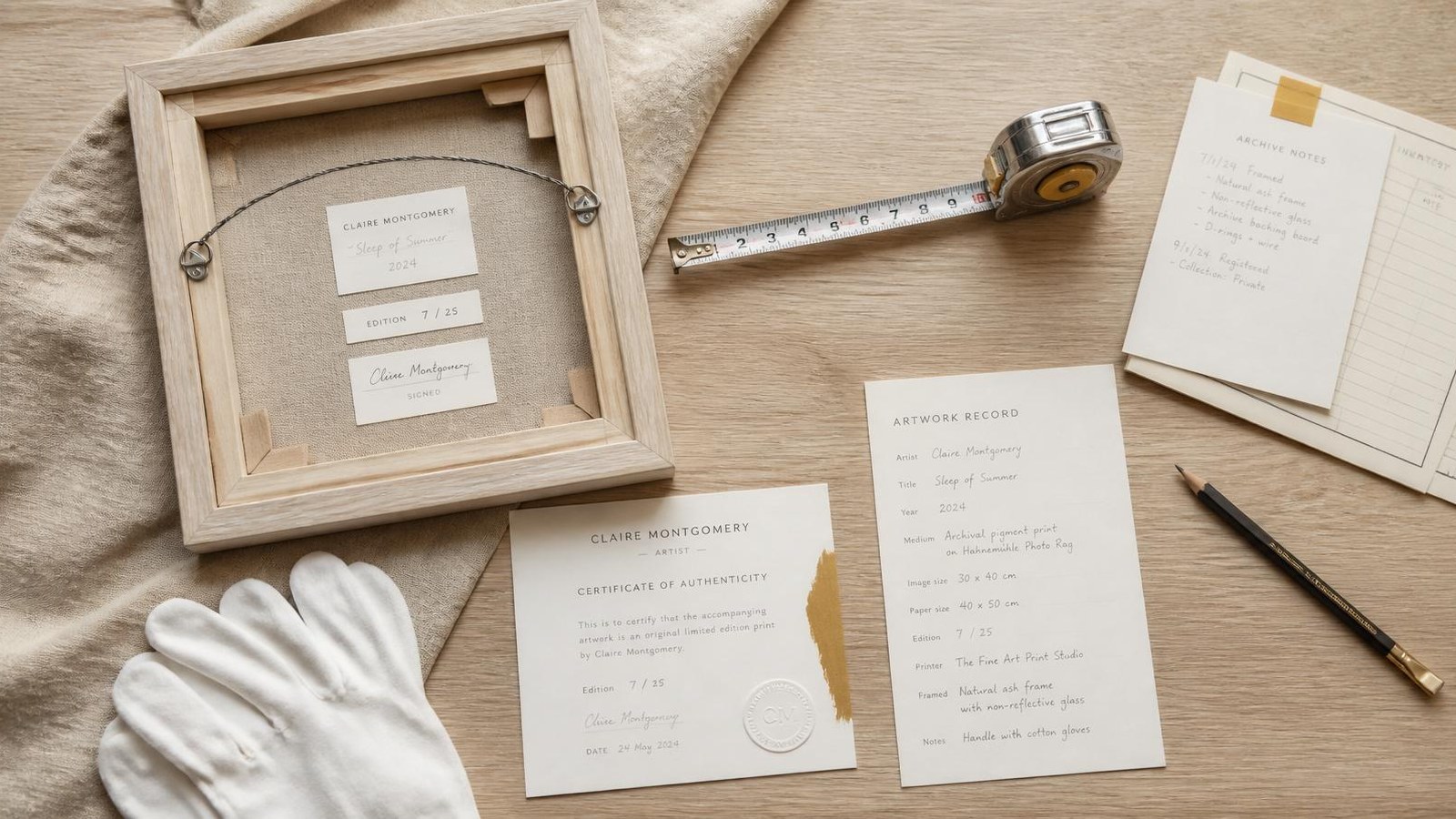
Artwork documentation is the quiet infrastructure behind a serious practice. It is what allows an artwork made today to be identified, verified, exhibited, sold, insured and resold years later — by the artist, an estate, a collector or a gallery — without guesswork. This guide sets out a practical artwork documentation checklist for artists, covering what to record when an artwork is made, what to capture before listing or selling, and what to update after a sale. It is written for artists who want their records to hold up to the standards collectors, galleries, open calls and insurers expect.
Why Artwork Documentation Matters
A painting, sculpture or print is a physical object, but its long-term value depends on information that lives outside the work itself. Collectors want to know who made it, when, from what, in what edition, in what condition, and where it has been. Galleries and open calls need accurate dimensions, medium, year and images. Insurers need clear identification and replacement value. A future buyer, decades from now, needs evidence that the work is what it claims to be.
When documentation is missing or inconsistent, the work loses context. Provenance gaps weaken resale value. Mismatched dimensions between a website, an invoice and a certificate raise doubts. A high-resolution image that no longer exists makes catalogue inclusion impossible. Good documentation protects the artwork, the artist's reputation and the buyer's confidence. It is also how a body of work becomes an archive rather than a collection of loose files.
Documentation is not bureaucracy. It is the difference between an artwork that travels through the world with a clear identity and one that gradually becomes anonymous.
What Is Artwork Documentation?
Artwork documentation is the complete written, visual and administrative record of an individual artwork. It includes the artwork's core identity (title, year, medium, dimensions, inventory number), its visual record (high-resolution images, detail shots, signature shots), its physical and material details, its provenance and ownership history, supporting documents such as a certificate of authenticity, its exhibition and publication history, its pricing and availability status, and any condition or conservation notes.
For an artist running a professional practice, this is best held as a structured record per artwork, not as scattered notes across email, phone photos, spreadsheets and notebooks. An artwork archive or database record system brings these elements into one place and connects them to the wider body of work.
Documentation differs from marketing copy. Marketing describes how an artwork feels; documentation describes what it is, factually and verifiably. Both matter, but they serve different audiences and should not be confused.
The Essential Artwork Details to Record
Every artwork should have a core identity record that does not change once the work leaves the studio. These are the details that appear on certificates, invoices, exhibition labels, insurance schedules and resale documents, and they must match across all of them.
The essentials are: artist name (as it should appear officially), title of work, year completed, medium, dimensions (height × width × depth, with units), unique inventory number, edition information if applicable, and signature location. Add the date the work was completed and signed, the studio or location where it was made, and a brief factual description.
The inventory number is the spine of the record. A consistent system — for example artist initials, year, sequential number (AJB-2026-0001) — makes it possible to reference the work across systems without ambiguity. Once assigned, an inventory number should never change, even if the title or pricing changes later. This is covered in more depth in the guide to artwork management for artists.
Artwork Images and File Records
Images are the most-used part of any artwork record. Most people who ever encounter the work will see it as an image first. Build the image record with the assumption that it will be reused for years: website, social posts, print catalogues, press features, gallery submissions, insurance claims and estate records.
For each artwork, capture: a flat front-on master image at the highest practical resolution, detail shots showing surface and texture, a signature shot, a verso (back) shot, an in-situ or scale shot, and a packaged or framed shot if relevant. Keep the original uncropped files. Save in a lossless or high-quality format, and keep a smaller web-ready version alongside them. Practical photography technique is covered in how to photograph artwork.
Name files consistently — typically inventory number plus a suffix (AJB-2026-0001-front, -detail-1, -signature, -verso). Avoid spaces and personal phone-generated filenames. Keep a record of who took the photographs, when, and any colour reference used. If the work is later reframed, repaired or restored, photograph that state too and label it clearly.
Medium, Materials and Process Notes
Medium and materials matter for valuation, conservation and authenticity. "Oil on linen" is not the same as "oil on cotton canvas", and "mixed media" without specification is not enough for a serious record. Be precise: pigments, binders, supports, primers, varnishes, mounts, papers, inks and any non-standard materials.
For each artwork, record the support (linen, cotton, panel, paper type and weight, board), the primary medium (oil, acrylic, watercolour, ink, pastel, pigment, etc.), any specific paint brands or pigments where relevant, the ground or priming, surface treatments and varnishes, and the substrate's manufacturer where known. For sculpture, record materials, internal armatures, fixings, finishes and any cast or fabrication details.
Process notes do not need to be exhaustive, but a short factual paragraph helps future conservators and serious collectors. Record any unusual techniques, drying times, layering, or materials likely to age in a particular way. These notes also strengthen the work's standing in submissions and curatorial conversations.
Dimensions, Framing and Physical Details
Dimensions are one of the most-cited and most-mistaken pieces of information in artwork records. Always record height × width × depth in that order, with a consistent unit (centimetres or inches — pick one and apply it throughout). For works on paper, record both image size and sheet size. For framed works, record framed and unframed dimensions separately. For sculpture and three-dimensional work, include weight where relevant.
Note the orientation, any rotation options for abstract works, and the intended hanging direction. For framed works, record frame material, finish, glazing type (museum glass, acrylic, none), mount, and whether the frame is original or replaceable. For unstretched canvases or rolled works, note the rolled diameter and shipping considerations.
These details feed into shipping quotes, gallery submissions, insurance valuations and condition reports. Discrepancies between recorded dimensions and physical reality cause real problems at gallery delivery, customs, and resale.
Measure each work twice and at the same point in the framing or stretching process. If a work is later restretched or reframed, update the record and keep the prior dimensions in a brief history note rather than overwriting them. For shipped or freighted work, the recorded shipping dimensions (with packaging) and weight should sit alongside the artwork's own dimensions, not replace them.
Pricing, Availability and Sales Information
Pricing is part of the documentation, not separate from it. For each artwork, record the current asking price (including currency), the price history if it has changed, any production cost or material cost recorded for reference, and the current availability status (available, reserved, on hold, sold, not for sale, in private collection, gifted, donated).
If the work is consigned to a gallery, record the gallery name, consignment date, agreed split, and any minimum price. If the work is offered through an exhibition or open call, record that channel and any associated commission. If the artwork is sold, record the sale price, sale date, buyer details, invoice number, payment status and any applicable rights (such as ARR / Artist's Resale Right in the UK and EU).
Pricing should be consistent across the website, gallery, certificate of authenticity and invoice. Inconsistent pricing across channels undermines collector trust. Wider guidance on selling and pricing channels is covered in how to sell artwork online.
Provenance and Ownership History
Provenance is the documented chain of ownership and custody of an artwork from creation to the present. It is one of the most important parts of any serious artwork record and a central pillar of long-term value. For new work, provenance starts simple: created by the artist in a stated year. Every subsequent move adds a line.
Record: original creation by the artist, date and place; any periods of consignment (gallery, agent, exhibition); first sale (date, buyer, channel, invoice number); any subsequent ownership transfers you are made aware of; loans for exhibition or publication; any periods in storage, restoration or conservation. Where possible, keep supporting evidence — invoices, consignment agreements, exhibition contracts, shipping documents.
The principles, terminology and importance of provenance are explored in detail in what is artwork provenance. Build the habit early: a clean provenance record is far easier to maintain from year one than to reconstruct twenty years later.
Provenance entries should be brief, dated and factual. Avoid speculation, and avoid removing earlier lines even when they describe a return, a withdrawn consignment or an unsold exhibition — these are part of the artwork's documented history. Where ownership has transferred privately and the new owner prefers anonymity, record "Private collection, [country], [year]" rather than personal details, and keep the underlying documentation in a private record.
Certificates of Authenticity and Supporting Documents
A certificate of authenticity (COA) is the artist's formal statement that an artwork is genuine and as described. It travels with the artwork through every future sale and is one of the documents collectors, galleries and auction houses look for first. A weak or missing COA materially weakens an artwork's standing.
A strong COA includes: artist name, title, year, medium, dimensions, inventory number, edition information if applicable, a clear front image, signature of the artist, date of issue, and a unique certificate reference. For editions, the certificate must state the edition size and the specific number of that copy. For commissioned or bespoke work, the certificate should reflect the commission terms.
Supporting documents to keep alongside the COA include: original invoice, condition report at point of sale, exhibition labels, shipping records, framing receipts, conservation reports, signed consignment agreements, and any signed statements about materials or process. Detailed guidance on certificates is covered in certificates of authenticity for artwork.
Exhibition, Submission and Publication History
An artwork's exhibition and publication history adds context, credibility and long-term value. For each artwork, record every exhibition it has appeared in (venue, city, exhibition title, dates, curator if known, group or solo), every open call or prize it has been selected for or shortlisted in, every publication it has appeared in (magazine, catalogue, book, press feature, online article — with citation details), and every submission it has been part of, including outcomes.
This record is what allows you to write a credible exhibition history on a CV, populate a portfolio entry, fill in open call application fields accurately, and answer collector questions confidently. It is also what allows future curators to trace the work. Practical workflow around submissions is covered in open calls for artists.
Treat this section as cumulative. Add to it as soon as something happens, not months later from memory.
Condition, Conservation and Handling Notes
Condition is rarely glamorous, but it protects everyone involved with the work. For each artwork, record its condition at completion (signed, dated, photographed in good light), any travel or handling events (shipped to exhibition, returned, loaned out, photographed), any incidents (drops, environmental exposure, surface marks, minor damage), and any conservation or restoration work undertaken (date, conservator, treatment, before/after images).
Note any specific handling requirements: avoid direct sunlight, requires climate stability, ships flat, do not glaze, requires specialist hanging. For sculpture, record installation requirements and any fixings supplied. For framed works, note glazing and frame fragility.
Insurers, shippers, galleries and serious buyers all rely on condition records. They are also essential for valuation. The relationship between documentation, condition and value is explored in artwork valuation and insurance.
Limited Editions, Prints and Edition Records
Limited editions need additional documentation beyond the unique-artwork checklist. For each edition, record the total edition size, the numbering format (e.g. 1/25), the number of artist proofs (APs), printer proofs (PPs) and any hors commerce (HC) prints, the printing method (giclée, screenprint, etching, lithograph, photographic print, etc.), the paper or substrate, the inks and any colour profile used, the printer or studio, the year of the edition, and the signing and numbering convention.
For each individual print in the edition, record where that specific number is — sold, available, gifted, in studio, lost or destroyed. Keep an edition register that tracks every copy across its lifetime. If the edition is closed or sold out, record the date. If the plate, screen, file or matrix is destroyed, record the destruction date and method.
The full workflow for editions, including signing conventions and certificates, is covered in limited edition prints. Robust edition records are central to buyer trust and to the long-term reputation of any print series.
For artists releasing prints over several years, the edition register also acts as a forward-looking sales tool: at any moment, the artist can say exactly how many copies of a given edition remain available, where signed copies are, and whether any APs have been released to galleries. Buyers and galleries increasingly expect this level of clarity before committing to a purchase, and it is much harder to provide retrospectively than to maintain from the first print run.
Artwork Documentation Checklist
Use this grouped checklist as a working template. For each artwork, work through these groups and tick off what is recorded. Anything missing should be added before the artwork is exhibited, listed, sold or shipped.
Core identity
- Artist name as officially used
- Title of work
- Year completed
- Medium (precise)
- Dimensions (H × W × D, unit specified)
- Unique inventory number
- Edition number and size (if applicable)
- Signature location
Images and files
- High-resolution front image
- Detail shots (surface, texture)
- Signature shot
- Verso (back) shot
- In-situ or scale shot
- Framed and packaged shots if relevant
- Consistent file naming using inventory number
- Photographer credit and date
Materials and process
- Support (canvas, panel, paper, etc.)
- Primary medium and brands where relevant
- Ground / priming / surface treatments
- Varnish, finish or coating
- Process notes for unusual techniques
- Sculpture: armature, fixings, finishes
Physical and framing
- Unframed dimensions
- Framed dimensions
- Frame material, finish, glazing
- Mount and backing
- Weight if relevant
- Hanging or installation instructions
Pricing and availability
- Current price and currency
- Price history
- Availability status
- Consignment details (gallery, dates, split)
- Sale price, date, buyer, invoice number (if sold)
- ARR / resale rights applicable (UK/EU)
Provenance and ownership
- Created by artist (date, place)
- Consignments and exhibitions
- First sale details
- Subsequent ownership transfers
- Loans, storage, restoration periods
- Supporting documents on file
Certificates and supporting documents
- Certificate of authenticity issued
- Unique certificate reference
- Signed and dated by artist
- Edition info on certificate (if applicable)
- Original invoice on file
- Consignment, shipping, framing records
Exhibition and publication history
- Every exhibition (venue, dates, curator)
- Open calls, prizes and outcomes
- Press features and publications
- Online features and catalogue entries
Condition and handling
- Condition at completion
- Travel and handling events
- Incidents or damage
- Conservation or restoration history
- Handling, climate and installation requirements
Editions and prints (where applicable)
- Edition size and numbering format
- APs, PPs and HCs declared
- Printing method, paper, inks, printer
- Per-print register of location and status
- Closure date and matrix destruction (if applicable)
This checklist works as a one-page reference. Print it, pin it in the studio, or use it as a template inside an artwork archive.
Common Artwork Documentation Mistakes
Several patterns weaken artwork records, often without the artist realising. Inconsistent inventory numbers — changing format halfway through a year or reusing numbers — make the archive unreliable. Mismatched dimensions between the website, certificate and invoice undermine buyer confidence and cause real problems at delivery. Vague medium descriptions like "mixed media on paper" leave conservators guessing.
Other common mistakes: relying only on phone photos with no high-resolution master file; deleting or overwriting images when reorganising folders; failing to update availability when a work sells, leaving it visible for sale on a website; missing or unsigned certificates of authenticity; no record of which gallery currently holds the work; no provenance line for consignments; no edition register for prints, so the artist cannot say which numbers have sold; recording exhibitions only on a CV but not against the individual artworks; and writing condition notes only after damage occurs rather than at completion.
Most of these are not failures of effort. They are failures of system. A consistent record per artwork, updated at the moment something happens, prevents almost all of them.
It also helps to separate the record from the marketing. Website copy, social posts and exhibition statements change over time and should sit alongside — not replace — the artwork's factual record. If a price is updated, an exhibition is added or a work is sold, the underlying record should be the single source of truth that everything else reads from. Artists who rebuild their website or move platforms without that source of truth often lose years of documentation in the process.
How Vault Canvas Helps Artists Keep Better Artwork Records
Vault Canvas is built around the idea that every artwork deserves a single, structured record that holds its full identity, history and supporting documents in one place. Rather than scattering details across spreadsheets, folders, email threads and phone galleries, the artwork itself becomes the record.
For each artwork, artists can hold the core identity (title, year, medium, dimensions, inventory number, edition details), the full image set (master image, details, signature, verso, in-situ), materials and process notes, framing and physical details, pricing and availability, provenance and ownership, certificates of authenticity, exhibition and publication history, condition notes, and edition registers for prints. Updates to one record stay consistent across the website, certificate, invoice and exhibition label — so a price change, a sale, a new exhibition or a restoration entry only needs to be recorded once.
The workflow follows the life of the artwork. When a piece is finished, the artist creates its record, uploads images, sets medium and dimensions, assigns an inventory number and issues a certificate. When it is consigned or exhibited, that history is added to the same record. When it sells, availability, sale details and provenance update together. When a buyer or curator asks for information years later, the answer is one record away. Used alongside a clean artist website, this turns documentation from an admin burden into a long-term asset.
Over time, the same record becomes the source for valuations, insurance schedules, exhibition labels, gallery submissions and estate planning. A short studio habit — recording an exhibition the day it opens, updating availability the day a work sells, adding a condition note after a return shipment — compounds into a complete archive across years and bodies of work.
The aim is not to add work — it is to make the records artists already need easier to keep consistent, complete and ready to use.