
Artwork Inventory System: How Artists Can Organise, Track and Manage Their Work
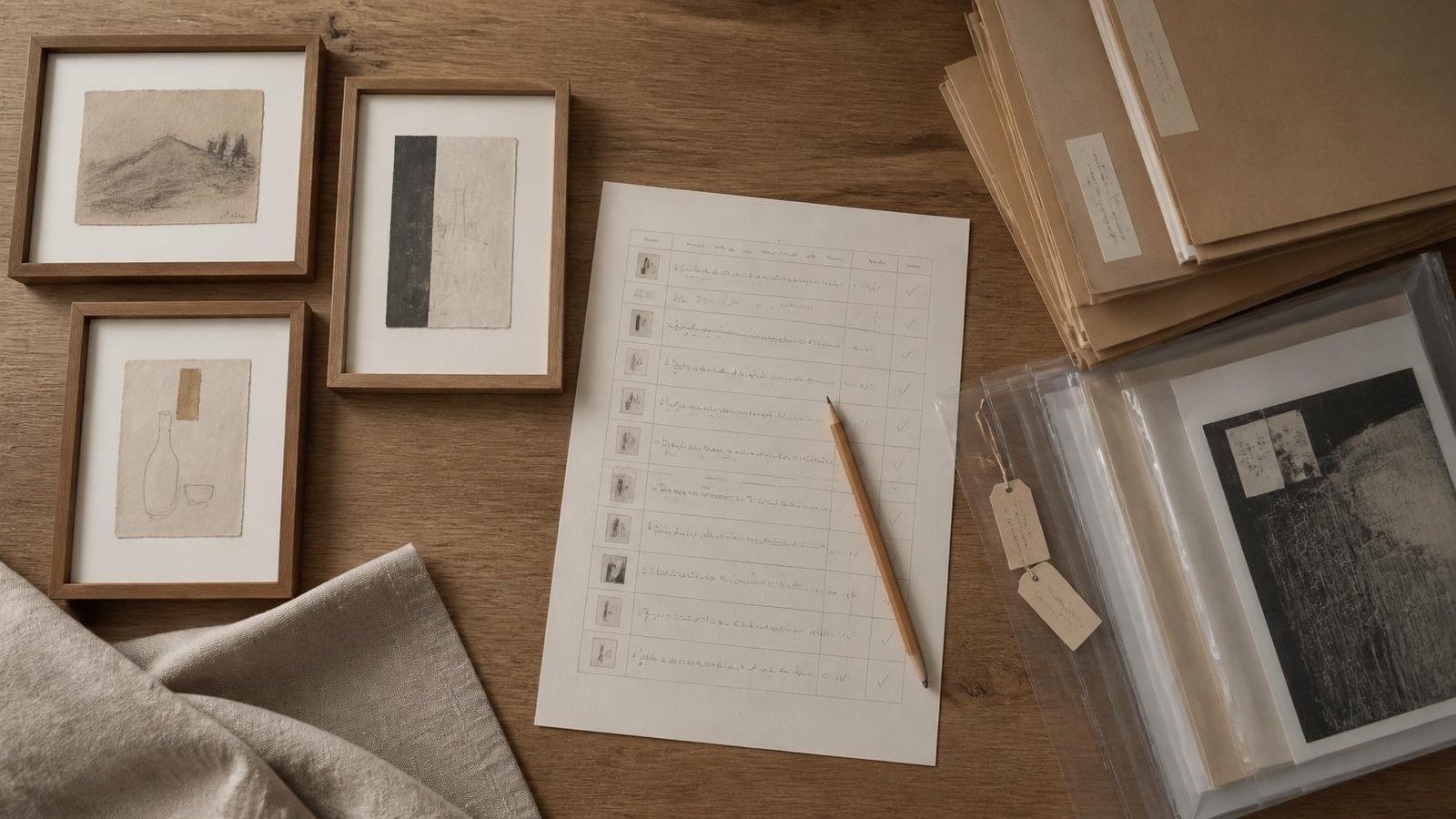
An artwork inventory system is how an artist knows what they have made, where each piece is, what it costs, whether it is available, who owns it, and which image and description appear on the website. It is the quiet backbone behind sales, exhibitions, insurance and provenance. When it fails, it shows up as duplicate listings, missing certificates, lost edition numbers, inconsistent prices, and works that cannot be sold because nobody can prove what they are.
This guide is for artists who have outgrown ad hoc folders and spreadsheets and need a reliable way to organise, track and manage their work. It is the practical companion to our artwork documentation checklist and our wider piece on artist record keeping: the checklist tells you what to record per artwork, record keeping describes the broader archive, and an inventory system is the working tool that holds it together day to day.
What Is an Artwork Inventory System?
An artwork inventory system is a structured way to record every artwork an artist has made, alongside the information needed to identify, value, locate, sell and exhibit it. At minimum it captures identity (title, year, medium, dimensions), images, an inventory number, pricing, availability, location and sales history. A mature system also tracks provenance, certificates of authenticity, exhibitions, edition records, condition notes and website visibility.
The phrase covers everything from a single well-disciplined spreadsheet to dedicated artwork inventory software. What distinguishes a real system from a pile of files is consistency. Each artwork has one record. Each record has the same fields. Each field uses the same conventions across the whole archive. One event — a sale, a loan, a price change — updates every relevant field in one place rather than scattering contradictions across notes, emails and Instagram captions.
A working inventory is not a museum-grade database. It is the operational ledger of an artist practice. It answers practical questions quickly: how many available paintings under £2,000 are in the studio, how many editions remain of a particular print, which works are currently on loan and when they return, which collectors have bought more than once, and which website pages need updating after the latest sale.
Why Artists Need an Artwork Inventory System
Most artists begin without a system. The first few sales are easy to remember. The trouble starts later. Bodies of work accumulate. Some sell, some travel to exhibitions, some are loaned, some sit in storage. Editions get printed in batches. Galleries take consignments. Collectors ask about works from years ago. Insurers ask for valuations. Buyers ask for provenance. Tax returns need totals. Suddenly the answer to "what do you have, where is it, and what is it worth" depends on whichever folder or inbox happens to be reachable.
An inventory system fixes the underlying problem: there is no single source of truth. Once each artwork has one canonical record, every downstream task pulls from the same place. The artist stops reconstructing answers from memory and starts looking them up.
There are commercial reasons too. Galleries and serious collectors expect organised records. A studio that can produce a clean inventory looks professional; one that cannot looks risky. Inventory hygiene quietly affects who wants to work with an artist. It also supports better pricing decisions, because the artist can finally see which series sold, at what price point, to whom, and when.
There is a quieter benefit. Artists with proper inventory systems make sharper decisions about their own practice. Patterns become visible. The studio stops feeling like a backlog and starts feeling like a body of work with measurable shape.
Artwork Inventory System vs Spreadsheet
A spreadsheet is the default starting point and there is nothing wrong with that. A disciplined spreadsheet — one row per artwork, consistent columns, a stable inventory number, linked image folder — can carry an early practice a long way. Many established artists still use one.
A spreadsheet starts to creak when several things happen at once. Images drift away from their records. Edition records, sales and exhibitions each need a separate sheet, and the relationships between them have to be maintained by hand. The website and spreadsheet drift apart. Certificates are generated outside the spreadsheet and saved with inconsistent file names. A collector asks for provenance and the answer takes an afternoon to assemble from four locations.
The fundamental limit of a spreadsheet is that it stores flat rows. Artwork life is relational. One artwork has many images, many exhibitions, possibly many editions, possibly many owners over time, and one public-facing website listing that needs to stay in sync. A dedicated artwork inventory system — whether self-built or off-the-shelf software — models those relationships natively. It also pushes consistency: required fields, controlled vocabularies for medium and status, one place for prices, one place for availability, and structured fields for certificates and provenance.
The right answer for most artists is a hybrid: a spreadsheet while the archive is small, then a transition to dedicated software once the cost of maintaining the spreadsheet exceeds the cost of moving. The signs the moment has come are usually obvious in retrospect: duplicate edition numbers, a sale that nobody removed from the website, a certificate the artist cannot find, or a collector who needs proof of authenticity for a resale and the trail goes cold.
What Should an Artwork Inventory System Track?
A useful inventory system tracks far more than a list of titles. The categories below describe the data an artist genuinely needs, regardless of which tool holds it. The next several sections walk through each in turn.
At a high level, an inventory should hold: identifying details for each artwork, high-quality images and visual records, pricing and availability status, sales information, current and historic locations, exhibition history, provenance and ownership records, certificates and supporting documents, edition records for prints and multiples, condition notes, and the public-facing details that should appear on the artist's website. Each of these is one face of the same artwork. The point of the system is that they stay aligned.
Artwork Details and Inventory Numbers
The core of every record is identity: title, year of completion, medium, support (canvas, panel, paper, etc.), unframed dimensions, framed dimensions where relevant, weight where relevant, signature and inscription notes, series or body of work, and a short catalogue-quality description. These are the fields a collector, insurer or registrar will quote in any future paperwork.
Each artwork must have a unique inventory number, set once and never reused. The number is the spine of the entire system. It links the artwork to its images, certificate, invoice, shipping documents, exhibition records, condition reports and website page. A simple convention is enough: artist initials, year, sequence (for example AB-2025-0142). Edition pieces add an edition reference (AB-2025-0142-E03/25). What matters is that the convention is consistent across decades and applied everywhere. For a deeper look at numbering conventions, our companion piece on artwork management for artists covers the trade-offs in detail.
Avoid putting commercial information into the inventory number. Numbers should be neutral identifiers, not encoded prices or status flags. Status and price live in their own fields so they can change without rewriting the spine of the archive.
Images, File Records and Visual Assets
Every artwork should have a defined set of images: a flat reproduction-quality master, a detail or two, a context shot showing scale, and where relevant a framed view. File names should embed the inventory number so the link to the record is never ambiguous. A practical convention is AB-2025-0142_master.jpg, AB-2025-0142_detail-1.jpg, AB-2025-0142_in-situ.jpg.
Master images should be stored at archival resolution and backed up in at least two places. Working derivatives — website-sized, social-sized, print-ready — should be generated from the masters rather than recreated by hand each time. A real inventory system keeps the link between record and image alive: open the artwork record, see the images. Close the record, the images remain in the same canonical location. The full discipline around capture and file structure is set out in the artwork documentation checklist.
It is also worth keeping a small set of process images per work — early stages, studio shots, drawings — separate from the master reproductions. These rarely belong in commercial listings, but they support catalogues, journal pieces and the kind of context that collectors and curators value years later.
Pricing, Availability and Sales Status
Pricing lives in the inventory, not in scattered emails. Each artwork should carry a current retail price, a record of any prior prices with dates, a currency, and a clear availability status: available, reserved, sold, on loan, not for sale, in storage, with gallery. Reserved and on-loan statuses should include who is holding the work and until when.
When a sale completes, several fields move together: availability flips to sold, sale price and date are recorded, buyer is linked, invoice and certificate are attached, location updates to the new owner, and the website listing is removed or marked sold. A good inventory system makes this a single workflow rather than five separate edits. For wider context on listing, pricing and selling online, see our guide to how to sell artwork online.
Historical pricing matters. A clean record of when prices moved, and why, supports honest conversations with galleries, sensible insurance valuations, and the kind of evidence that underpins serious artwork valuation and insurance decisions later in a career.
Locations, Exhibitions and Movement History
Every artwork has a location, and that location changes. An inventory system should record the current physical location of each work — studio, storage, framer, gallery, on loan, in transit, with collector — and a history of where it has been. The history is provenance in the making. Insurers care about it. Collectors care about it. Future cataloguers care about it.
Exhibition history is part of the same picture. Each time a work is shown, the inventory should log venue, exhibition title, dates, curator if relevant, and any catalogue reference. When the work returns, location updates back to studio or storage and condition is reviewed. Works that travel without being logged tend to acquire small damage that no one can date, which becomes a problem at the next valuation.
A simple discipline solves most of this: nothing leaves the studio without a logged movement, and nothing returns without a logged condition check. Over years, this builds an unbroken movement record per artwork — the kind of evidence that quietly increases the credibility of the whole practice.
Provenance, Collectors and Ownership Records
Provenance is the ownership history of an artwork from creation onwards. A proper inventory system records the first owner at the point of sale, any subsequent owners the artist becomes aware of, and the supporting documents at each transfer. For most living artists, provenance starts simply: studio to first collector, with the invoice and certificate as evidence. Over decades, those simple records become the backbone of resale value and authentication.
Collector records sit alongside provenance. Each collector should have a record with contact details, works owned, dates of purchase, prices, and any agreed conditions (no public resale, loan willingness, image permissions). Repeat collectors are one of the most valuable assets in any artist practice; a system that surfaces them is doing real commercial work. The wider principles are covered in what is artwork provenance.
Privacy matters here. Collector data is personal data. It belongs in the artist's private records, not in any public listing or shared spreadsheet. A good inventory system separates what is internal from what is public-facing and keeps the two cleanly apart.
Certificates of Authenticity and Supporting Documents
Certificates of authenticity, invoices, condition reports, shipping documents and consignment notes are part of the inventory, not an afterthought. Each should be linked to the artwork record using the inventory number so retrieval is instant. A buyer requesting proof years later should be a one-minute lookup, not a search through old folders.
A working system stores certificates as PDFs named from the artist's own artwork reference (AB-2025-0142-COA.pdf), generated to a consistent template, signed and dated, with a copy retained by the artist. For multi-edition works, each edition has its own certificate. For what a certificate should contain and how to produce one, see certificates of authenticity for artwork.
Supporting documents also include written permissions: image licences, exhibition loan agreements, gallery consignment terms. These rarely matter until they suddenly do. Keeping them attached to the artwork record means they are findable in the only place anyone will think to look.
Limited Editions and Print Inventory
Limited editions need more inventory discipline than unique works, not less. Each edition piece is a separate record (or sub-record) with its own number within the edition (3/25), its own certificate, its own price, its own buyer and its own location. The edition as a whole also needs a record: edition size, printer, paper, ink, date printed, artist proofs, whether the edition is open or closed, and the running tally of pieces sold.
The single most common edition mistake is losing count. An inventory system should make miscounts mechanically impossible by tracking each piece individually rather than asking the artist to remember which numbers are out and which remain. Anything else risks the integrity of the edition. The full discipline is covered in our guide to limited edition prints.
Print inventory also covers physical stock. If a print edition is held in flat files, the inventory should record location, condition and remaining count, and update each time a piece ships or is signed. Editions that exist on paper but cannot be physically located are a slow-burning problem; the inventory is what stops that from happening.
Website and Portfolio Consistency
The artist's website is the most public face of the inventory. Every published listing should correspond to a real, available artwork in the archive, with consistent title, year, medium, dimensions, image, price and availability. A common failure mode is the inventory and the website drifting apart: the studio shows a work as sold, the website still offers it for sale; the studio reframes a piece, the website still shows the old dimensions.
The fix is to treat the website as a view onto the inventory, not a separate source of truth. Either the website pulls from the inventory directly, or there is a defined routine that updates the website whenever an inventory field changes. The same discipline applies to portfolio platforms, gallery microsites and press images: one canonical version per artwork lives in the inventory; everything public is derived from it. Practical advice on building this layer is in our guides to how to build an artist website and artist portfolio examples.
Image rights belong here too. If a publication or gallery is granted use of an image, the grant is part of the artwork record. Years later, the inventory remembers what the artist's memory will not.
How to Choose an Artwork Inventory System
The right system depends on the size of the archive, the way the practice sells, and how much of the work is editioned. A handful of works a year and direct sales can be managed in a spreadsheet plus a disciplined image folder. A larger practice with prints, galleries, exhibitions and an active website outgrows that quickly.
When evaluating dedicated artwork inventory software, the questions that matter are practical. Does it model artworks, editions, exhibitions, sales, collectors and certificates as connected records, or as flat lists? Can it export everything in open formats without lock-in? Does it store images at archival resolution? Does it support the artist's actual currencies, units and date formats? Can it produce clean availability and sold reports in seconds? Is it backed up? And, crucially, does it fit the workflow the artist already has?
Cost matters, but the more expensive question is migration. The right system to choose is the one the artist will actually maintain. A modest tool used consistently is worth more than a powerful tool used patchily. For ongoing archive maintenance, our guide to artwork archive database and record system goes deeper into the structural choices.
Artwork Inventory System Checklist
Use this checklist to compare systems — your current spreadsheet, dedicated artwork inventory software, or a hybrid. For each item, ask whether the system handles it cleanly, partially, or not at all.
- Artwork records: one canonical record per artwork, with required fields and no duplicates.
- Images: master files at archival resolution, linked to the record, with consistent naming.
- Dimensions: unframed and framed, in both cm and inches, with weight where relevant.
- Medium and materials: structured fields, controlled vocabulary, suitable for catalogues.
- Inventory numbers: unique, stable, never reused, embedded in file names and documents.
- Prices: current price, historical prices with dates, currency, support for price changes.
- Availability: clear statuses (available, reserved, sold, on loan, not for sale, in storage).
- Locations: current location plus full movement history.
- Sales: sale date, sale price, buyer, invoice, certificate, linked to the artwork record.
- Collectors: structured records, repeat-buyer visibility, privacy-respecting storage.
- Provenance: unbroken ownership chain from studio to current owner.
- Certificates of authenticity: generated, numbered, signed, stored and linked.
- Exhibitions: venue, dates, curator, catalogue reference, condition before and after.
- Editions: per-piece records, edition size, artist proofs, running tally of sales.
- Website visibility: each public listing matches the inventory; sold works are removed or marked.
- Export and import: open formats, no lock-in, full data portability.
- Ease of use: routines the artist will actually maintain on a normal week.
- Long-term archive value: the records will still be readable, complete and useful in twenty years.
A system that scores well on most of these items is one the artist can build a serious practice on. A system that fails several of them will eventually leak important information, no matter how disciplined the artist tries to be.
Common Artwork Inventory Mistakes
A handful of mistakes account for most inventory failures. Reused inventory numbers, where two different works end up with the same reference because a row was deleted or a sequence restarted, corrupts the entire archive. Inconsistent file naming, where images for the same work live under three different conventions, breaks the link between record and image. Status fields that are not actually maintained — works marked available that were sold years ago, or vice versa — destroy trust in the whole system.
Storing certificates outside the inventory is another common failure. So is using the website as the source of truth for price or availability, with the inventory updated later (or never). Edition counts maintained from memory rather than per-piece records eventually drift. Collector data scattered across email and messaging apps eventually becomes impossible to assemble for VAT, insurance or a serious resale conversation.
The deeper mistake is treating the inventory as separate from the practice. Inventories maintained alongside sales, exhibitions and certificates stay accurate; those updated only when there is time become fiction within a year. The fix is procedural: every event that involves an artwork updates the inventory, and nothing is considered done until the inventory reflects it.
How Vault Canvas Works as an Artwork Inventory System
Vault Canvas is built around the daily work of running an artist practice. Each artwork has one record that holds its identity, images, dimensions, medium, inventory number, pricing, availability and status. Sales, certificates of authenticity, provenance entries, exhibitions and edition records attach to that record, so the answer to any future question about a work — what it is, where it has been, who owns it, what it sold for — sits in one place rather than spread across spreadsheets, folders and email threads.
The same record drives what visitors see. When availability or price changes inside the inventory, the public artwork page reflects it; when a work sells, the listing updates without a parallel website edit. Buyer details, invoices and private notes stay strictly inside the admin area and never appear on public pages. Edition pieces are tracked individually, so a limited edition cannot quietly drift out of count, and each edition piece can carry its own certificate, buyer and history.
The aim is to keep artwork records, images, prices, availability, certificates, provenance, exhibitions, edition records and website-facing information in one place. The inventory is the practice; everything else is a view onto it.