
Artist Record Keeping: A Practical Guide to Managing Your Artwork Archive
18 min read
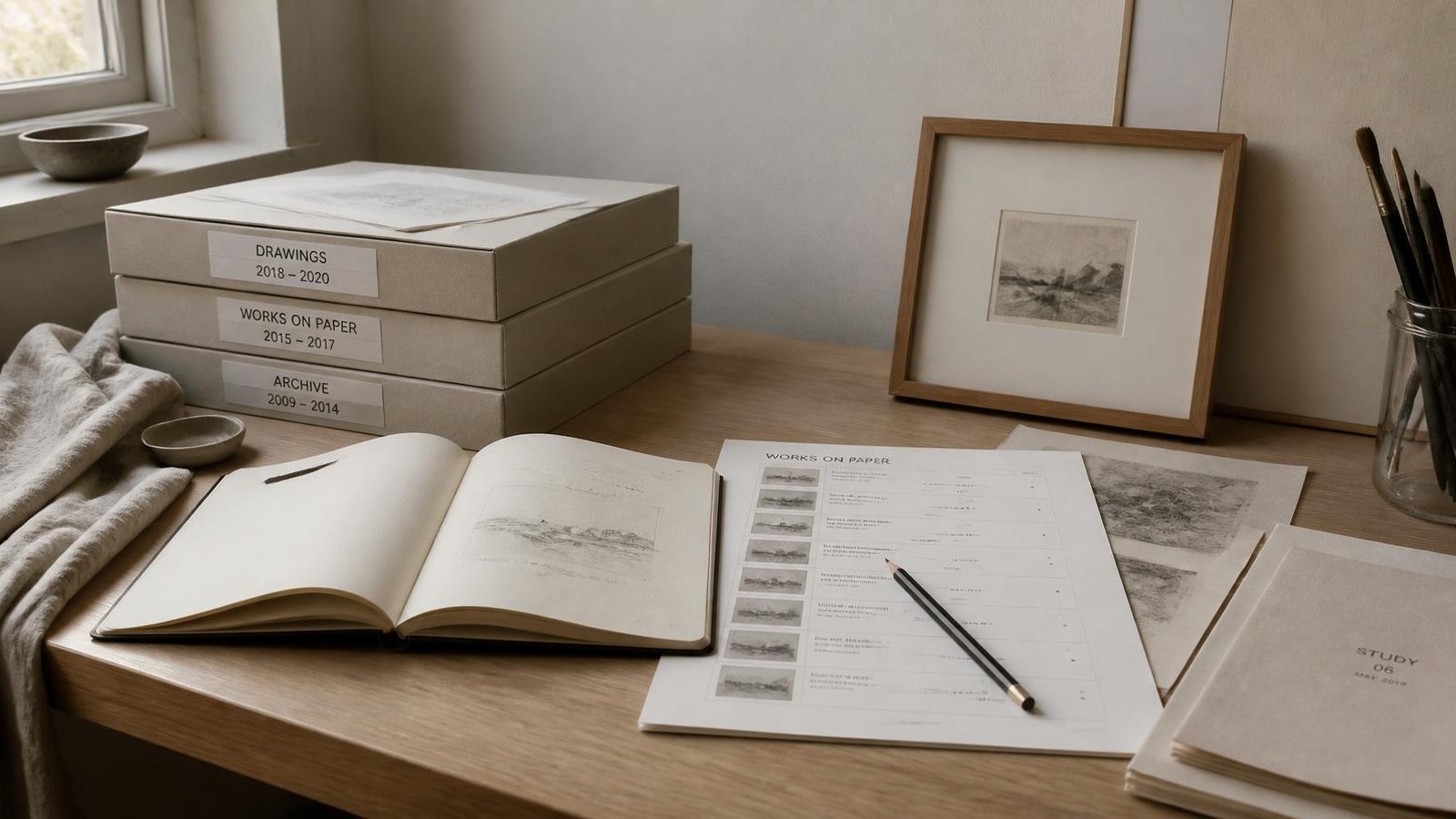
Artist record keeping is the steady, low-drama work that turns a collection of paintings, prints and studio notes into a coherent practice. It is the layer of professional admin that sits behind the artwork itself: what you made, when you made it, where it has been, who owns it now, what it sold for, what condition it is in, and which certificate, exhibition or publication is connected to it. Done well, record keeping rarely feels visible. Done badly, it shows up later as missing provenance, inconsistent prices across websites, lost certificates, forgotten edition numbers and works that cannot be sold or insured because no one can prove what they are.
This guide is the companion to our artwork documentation checklist, which covers what to record for each individual artwork. Here we step back and look at the wider system: the records, files and routines that keep an entire artist practice organised over years and decades, not just one work at a time.
Why Artist Record Keeping Matters
Galleries, collectors, insurers, valuers, framers and tax authorities all rely on records the artist created. A buyer needs to see when a work was made and that it is authentic. A collector reselling years later needs provenance back to the studio. An insurer needs a valuation, an image and a description. A framer needs measurements. A registrar planning an exhibition needs availability and condition notes. None of these conversations work well if the artist has to reconstruct the answer from memory.
Good records also protect the artist's own livelihood. They support honest pricing, defensible editions, accurate VAT and self-assessment, and the kind of long-term artwork valuation and insurance decisions that only make sense when there is a paper trail. Without records, an artist's earlier work effectively becomes invisible — uninsurable, unprovable and harder to place in serious collections.
There is also a quieter reason. Artists who keep good records make better decisions. Patterns become visible: which series sold, which open calls were worth entering, which collectors returned, which price points held, which framers handled work safely. Records turn a career into evidence you can learn from.
The same records support sensible long-term planning. Bodies of work that quietly accumulate without proper documentation often become invisible to the artist themselves — hard to count, hard to value, hard to revisit. A practice that records each work as it is made and updates the record as the work moves through the world ends up with something rare: a clear, accurate picture of its own scale, history and direction.
What Records Should Artists Keep?
At minimum, an artist's records should cover the artwork itself, the images of it, its price and availability, its provenance and ownership history, supporting documents such as certificates and invoices, exhibition and publication history, studio and process notes, edition information for prints and multiples, condition and location, and the public-facing details that appear on the artist's website and portfolio.
These are not separate worlds. A single sale touches almost all of them: the work changes owner (provenance), gets marked sold (availability), generates an invoice and certificate (supporting documents), ships to a new address (location), and needs to be removed or updated on the website (portfolio consistency). A record-keeping system is really a way of making sure one event updates every relevant record at once, without anything being missed.
It also helps to separate records by the role they play. Identity records say what a work is. Commercial records say what it costs, where it is offered and what happened when it sold. Custody records say where it is, who has it and what condition it is in. Story records say what it is part of — which series, exhibition, publication or collection. Most archive failures happen when one of these roles is well kept and the others are improvised. A practice that prices carefully but loses track of condition, or photographs beautifully but never logs certificates, is only half organised.
Artwork Records and Inventory Details
The core of any artist archive is the inventory: one record per artwork, each with a stable internal reference. Typical fields include title, year, medium, support, dimensions (unframed and framed), weight where relevant, signature and inscription details, an internal inventory or accession number, series or body of work, and a short description suitable for catalogues and listings.
The internal reference matters more than people expect. It should be unique, never reused, and applied consistently across the artist's spreadsheet or artwork archive database, file names, certificates, invoices and shipping labels. If a collector emails years later asking about "the smaller blue one from 2019", a clean reference number turns that into a one-second lookup. For deeper guidance on inventory structure and field design, see our broader piece on artwork management for artists.
Image Files and Digital Asset Records
Images are records. Treat them that way. Each artwork should have a master high-resolution photograph of the front, plus a photograph of the verso showing the signature, inscription and any labels. Detail shots of texture, edges and signature help with authentication and condition reporting later. Installation or in-room shots help with website and portfolio use.
Store master files at full resolution in a stable folder structure, ideally named with the artwork's inventory number. Keep clearly separated versions: master archive, web-optimised, social, print-ready. Note the photographer or capture date if relevant, and back the whole archive up to a second location. Image files that only exist on a phone or a single laptop are not records — they are a single point of failure.
It also helps to capture context once and use it many times. The alt text written for the artwork's main listing can travel with the image into open call submissions, press requests and accessibility-friendly portfolio pages. The verso photograph that documents a signature can support an authentication query a decade later. Detail shots taken at completion are the cleanest reference point for any future condition comparison. Time spent on images at the moment of finishing a work usually saves hours of re-shoots and email back-and-forth across the work's lifetime.
Pricing, Availability and Sales Records
Pricing records should cover the original list price, any subsequent revisions, the currency, whether the price includes framing or shipping, and what the work eventually sold for. Availability should be tracked with a clear status: available, reserved, on loan, in exhibition, sold, withdrawn, archive only.
Sales records should capture the buyer (subject to privacy), the date, the price paid, the channel (direct, gallery, open call, online), any commission, the invoice number, and how the work was delivered. Pricing across channels needs to stay consistent — the same work showing a different price on Instagram, a portfolio site and a gallery listing damages buyer trust quickly. Our guide on how to sell artwork online goes into channel-by-channel pricing and listing detail.
Treat repricing as an event, not a quiet edit. Note the date, the old price, the new price and the reason. Years later, this trail is what supports honest valuation conversations.
Provenance, Collectors and Ownership History
Provenance is the documented chain of ownership from the artist's studio to the current owner. For living artists, that chain starts with you, and you are the only person who can establish it cleanly. Each transfer of ownership should be recorded with date, parties involved, sale price where appropriate, and supporting documents — invoice, certificate, shipping confirmation.
Keep a simple collector record alongside the artwork record: name, contact details, which works they own, when they acquired them, and any relevant notes (gift, commission, exhibition loan). When a work resells through a secondary market years later, the artist's original record is often the single most valuable provenance document. For a fuller treatment of why this matters and how to structure it, see what is artwork provenance.
Privacy matters here. Collector records should be held with the same care as any personal data: kept securely, shared only where there is a legitimate reason, and respected when a collector asks to remain anonymous in public materials. The point is not to publish a list; it is to be able to answer, when asked by a valuer, insurer or executor, where a work has lived since it left the studio.
Certificates, Documents and Supporting Evidence
Every sold work should have a certificate of authenticity, and every certificate should be logged: certificate number, issue date, artwork reference, recipient, and ideally a PDF copy stored against the artwork record. Invoices, shipping documents, condition reports, framing receipts, restoration notes and consignment agreements all belong in the same supporting-document layer.
The principle is simple: if a document supports the artwork's identity, value, condition or ownership, it belongs in the archive, linked to the artwork it concerns. Loose PDFs in an email account are not records. For the practical mechanics of issuing and tracking certificates, see certificates of authenticity for artwork.
Exhibition, Open Call and Publication Records
Exhibition history is part of an artwork's value and an artist's CV. For each exhibition, record the venue, dates, exhibition title, curator or organiser, which works were shown, whether the works sold, and any catalogue or press coverage. Keep digital copies of catalogues, install shots and press clippings.
Open call records are equally useful: which calls you entered, when, with which works, the fee, the result, and any feedback. Over a few years this becomes a serious decision-making tool — most artists discover a small number of calls actually deliver value. Our guide to open calls for artists explains how to triage and track them. Publications — magazine features, online reviews, podcasts, interviews — belong in the same record, with the artwork references if specific works were discussed.
Studio, Materials and Process Notes
Materials and process records protect future conservation and authentication. For each work or series, note the substrate, ground, paints or inks, mediums and varnishes, any unusual techniques, and the framing or mounting specification. If a particular pigment, paper or ink was used, name it.
Twenty years on, a conservator working on a damaged piece will need to know what they are touching. The artist is the only person who can record that with certainty at the time of making. These notes do not need to be elaborate; a few honest lines per work, kept consistently, is enough.
Series-level notes save time. If a body of work shares a substrate, a ground recipe, a particular ink set or a framing specification, record it once at the series level and reference it from each work, then note only the differences per piece. The same applies to studio process notes that recur — drying times, varnish layers, mounting methods — that conservators or future collaborators may need to understand.
Edition Records for Prints and Multiples
Editions are where weak record keeping causes the most damage. For every edition, record the edition size, number of artist proofs, printer or studio, paper and ink specification, date of printing, and the location and status of each numbered impression. When an edition piece sells, record which number went to which collector.
Never reprint or extend a closed edition. Never lose track of artist proofs. Buyers of limited edition prints are buying scarcity backed by records — if the records are vague, the value is too. A simple edition log per print, updated as impressions are released or sold, is the minimum.
It also helps to treat the edition itself as a record with its own lifecycle: declared (size and proofs agreed), printed (date, printer, materials confirmed), released (impressions becoming available), partially sold (which numbers have gone where), and closed (no further impressions possible). Each impression carries its own status inside that parent. Galleries and serious collectors increasingly expect this level of clarity before committing to a print purchase.
Condition, Framing and Location Records
Condition records start at the moment a work leaves the studio and continue for its lifetime. Note condition at completion, at framing, at each shipment, at each exhibition return, and after any damage or restoration. Photographs help — a clean front-and-verso image at each major movement is worth pages of description.
Location matters because works move. At any moment, the archive should be able to answer: where is this work right now? In studio, with the framer, on loan to which collector, in which exhibition, in storage at which facility. Framing records (framer, materials, glazing, date, cost) sit alongside, because framing decisions affect both presentation and condition.
Website, Portfolio and Listing Consistency
The public face of the artist's records is the website, portfolio and any third-party listings. Every public listing should match the underlying record: same title, same year, same medium, same dimensions, same price, same availability status. Inconsistency between a portfolio, an Instagram post, a gallery page and a sales platform is one of the most common, and most damaging, record-keeping failures.
A useful discipline is to treat the artwork archive as the single source of truth and the website as a downstream view of it. When the archive changes — work sold, price updated, new exhibition added — the website should reflect that quickly. Our guides on how to build an artist website and artist portfolio examples both come back to this principle.
The same logic applies to third-party listings: open call submissions, gallery microsites, online marketplaces, museum loan forms. Each is another downstream view. If they all draw their facts from the same archive record — even if entered manually — the artist's public footprint stays coherent. If each is filled in from memory or last week's email, small drifts accumulate until two listings disagree about the medium, the year or the price of the same work. Collectors and curators notice.
Spreadsheet vs Artwork Archive System
Most artists start with a spreadsheet. That is fine, and for a small body of work it can be enough. A well-designed sheet with one row per artwork, stable column headings, and clear inventory numbers will outperform a badly used database every time.
Spreadsheets start to break when records depend on each other: when one work has multiple images, multiple owners over time, multiple exhibitions, multiple condition events and a related edition. Linking those across rows in a spreadsheet becomes fragile. Versions diverge. Backups get out of sync. Images live somewhere else entirely. Certificates are in another folder.
A dedicated artwork archive system holds the artwork, its images, prices, availability, provenance, certificates, exhibitions, sales, condition and location as connected records rather than parallel files. The decision point is usually somewhere between 50 and 200 works, depending on edition complexity, sales volume and how much the artist exhibits.
The transition does not have to be dramatic. Most artists migrate one body of work at a time, starting with whatever is currently being sold or exhibited, and bring older works in as time allows. The point of the move is not to make the records more elaborate but to remove the silent failure modes — the disconnected folder, the cell that was never updated, the certificate that lives only in a sent-mail folder.
Artist Record Keeping Workflow
Records work best when they update at known moments rather than in occasional catch-up sessions. A simple workflow:
When a work is started. Create the artwork record. Assign the inventory number. Note the substrate, intended medium, planned dimensions and the series or body of work.
When a work is finished. Photograph front and verso at full resolution. Update final dimensions, materials, completion date and signature. Decide list price, currency and availability. Write the short description that will travel with the work.
Before listing online. Confirm the public details match the archive: title, year, medium, dimensions, price, availability. Confirm web images are derived from the archive masters. Confirm the listing carries the inventory reference internally.
Before submitting to open calls. Confirm availability, dimensions and price match the entry form. Log the call: name, deadline, fee, works submitted, result expected by.
When a work is sold. Mark sold with date, channel and price. Issue and log the certificate. Issue and log the invoice. Record the collector and shipping address. Update website and any third-party listings. Move the work's status and location.
When a certificate is issued. Record certificate number, date, recipient and artwork. Store a PDF copy against the artwork record.
When a work is exhibited. Log venue, dates, title, curator, works shown. Update each work's location for the run. On return, update condition.
When a work is framed, moved, damaged, restored or repriced. Each is an event. Record date, what happened, who did it, cost where relevant, and any new condition photographs.
The pattern is the same across every event: one moment, one update, every relevant record.
Common Artist Record Keeping Mistakes
The most common mistakes are familiar. Reusing inventory numbers, or never assigning them at all. Letting image files drift across phones, laptops and email attachments with no master archive. Editing prices silently with no trail. Losing track of artist proofs. Issuing certificates without logging them. Keeping collector details in a head, an inbox or a notebook rather than against the artwork. Letting the website fall out of sync with the archive. Treating sales as one-off paperwork rather than archive events. Backing up nothing.
None of these are dramatic on the day they happen. They become dramatic later — at valuation, at resale, at insurance, at a serious gallery conversation, at probate. The fix is rarely heroic effort; it is a small, consistent routine applied at the right moments.
A useful test is to ask, for any work in the studio or out in the world, four questions: what is it, where is it, who owns it, and what supporting documents prove that. If any of those answers requires more than a quick lookup, the record is incomplete. Most artist record-keeping problems are not failures of effort; they are the absence of a routine that makes those four answers easy to maintain.
How Vault Canvas Helps Artists Keep Better Records
Vault Canvas is built around the idea that the artwork record should be the single source of truth for an artist's practice. The same record holds the artwork's details, its master images, its price and availability, its provenance and collectors, its certificate, its exhibition and sales history, its edition information, and the public-facing information that appears on the artist's website.
That structure changes the workflow. When a work is finished, its photographs and details enter one record. When it is listed online, the public page is a view of that record, so titles, dimensions, prices and availability stay consistent automatically. When a certificate is issued, it is generated and logged against the work. When the work sells, marking it sold updates availability, records the collector, links the invoice and certificate, and updates the public listing in the same step. When the work is later exhibited, loaned, reframed or revalued, those events attach to the same record rather than scattering into unrelated files.
For artists with editions, each numbered impression sits inside the parent edition record, with its own status, owner and certificate. For artists with longer histories, exhibition, publication and provenance history accumulate against each work over time rather than living in a separate CV document that has to be rewritten every year.
The practical result is fewer parallel systems. No separate spreadsheet for sales, folder for images, document for certificates, CV file for exhibitions and website CMS for listings. One archive, with everything connected to the artwork it concerns, and a public view of it that stays in step.
This matters most in the moments that usually go wrong. The sale that happens in a week when the studio is busy and the certificate gets forgotten. The exhibition return when condition is noted on paper and never typed up. The price change agreed by email that never reaches the website. When the same record handles the artwork, the certificate, the listing and the public page, those moments stop being separate tasks that can be dropped — they become single actions inside one system, which is how professional record keeping survives a working studio rather than only a quiet weekend.